
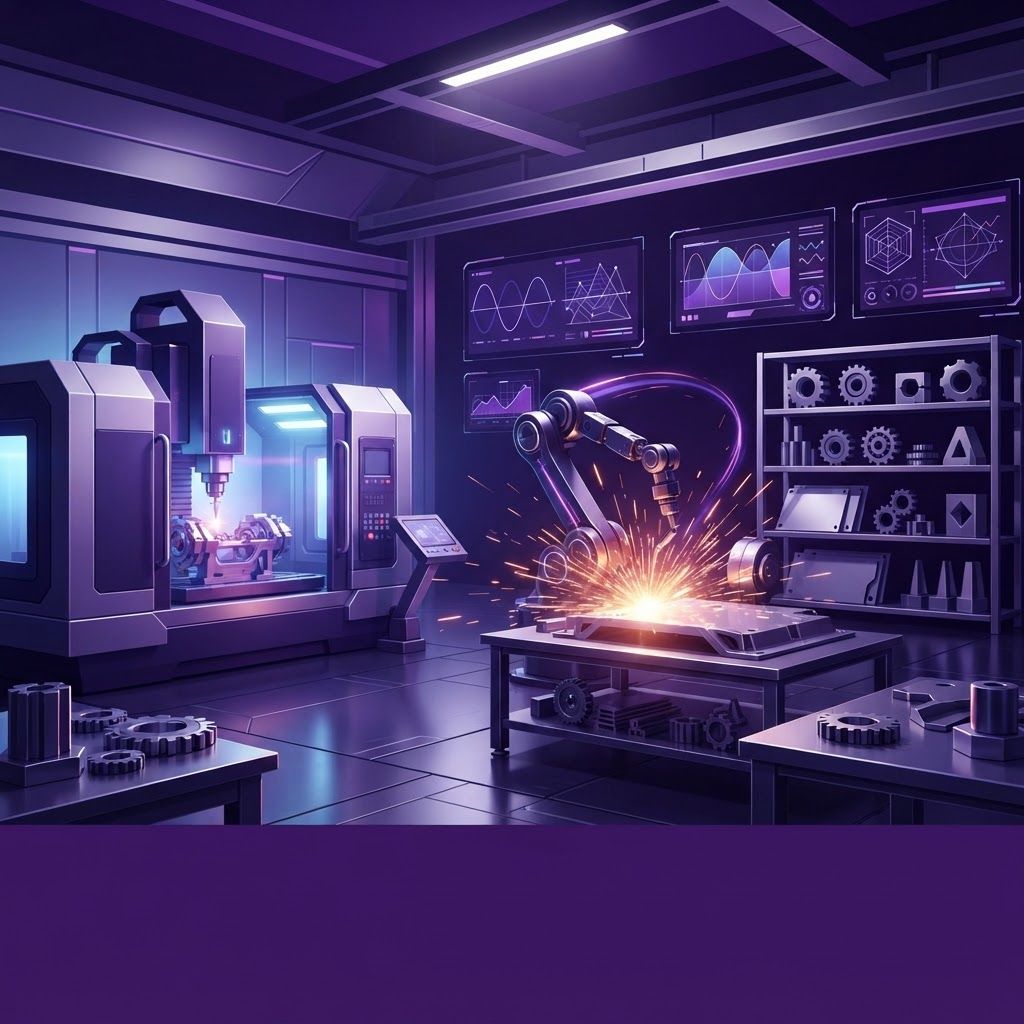
A City Built on Precision
Rochester's industrial identity was forged around optics, imaging and instrumentation, and those industries demanded tolerances measured in thousandths of an inch. That legacy produced a workforce and a supplier base fluent in precision, and when the region's largest employers restructured, much of that talent dispersed into independent machine shops, fabricators and finishing houses. The result is a metalworking cluster with unusual technical range for a city of Rochester's size.
Buyers feel this immediately. It is possible to source a single prototype fixture, a family of aerospace-grade turned components and a large weldment for a food processing line without leaving Monroe County. What varies is not whether a capability exists, but which shop is genuinely built for your part.
Where the Industry Is Heading
Automation is the headline trend. Robotic welding cells, bar feeders, pallet-changing machining centres and lights-out overnight running have all become common, driven less by cost cutting than by the difficulty of hiring experienced machinists and welders. For customers, automation shows up as tighter repeatability and better on-time delivery on repeat work.
Additive manufacturing has settled into a supporting role rather than replacing subtractive work. Shops use it for tooling, fixtures, jigs and conformal-cooling inserts, and occasionally for low-volume production in metals where geometry justifies it. The most capable Rochester shops treat additive as one more process in a hybrid workflow.
Quality documentation has become a differentiator in its own right. Aerospace, medical device and defence customers expect first-article inspection reports, full material traceability, calibrated in-process measurement and recognised quality system certification. Shops that invested in coordinate measuring machines and disciplined document control now win work that lower-cost competitors cannot bid.
Finally, reshoring has meaningfully increased quoting activity. Companies that spent years sourcing offshore have rediscovered the value of a supplier they can visit, and regional fabricators have absorbed a share of that returning volume.
The Top 10 Metalworks Companies in Rochester
1. Genesee Precision Machining — A CNC machining house serving optics, medical device and instrumentation customers. Genesee Precision Machining is known for holding tight tolerances on complex multi-axis parts and for a metrology department that makes its inspection data genuinely trustworthy.
2. Flour City Fabrication — Sheet metal and structural fabrication at scale. Flour City Fabrication runs laser cutting, press braking, robotic welding and finishing under one roof, which lets it deliver complete enclosures and frames rather than loose components.
3. Lake Ontario Steel Works — Heavy plate and structural work for industrial and infrastructure projects. Lake Ontario Steel Works handles large weldments, platforms and equipment frames, and its certified welding procedures matter for load-bearing and pressure-adjacent applications.
4. Monroe Tool & Die — Tooling specialists producing stamping dies, progressive tooling, moulds and production fixtures. Monroe Tool & Die is the shop other manufacturers call when a die needs rebuilding fast, because unplanned tooling downtime is expensive in a way few other failures are.
5. Irondequoit Metal Finishing — Anodising, powder coating, passivation, plating and industrial cleaning. Irondequoit Metal Finishing plays a quiet but essential role in the regional supply chain, since a finishing bottleneck can hold up an otherwise complete assembly.
6. Highland Sheet Metal Systems — Architectural and mechanical sheet metal, including ductwork, custom flashing, roofing metal and interior panels. Highland Sheet Metal Systems bridges construction and manufacturing, serving mechanical contractors and architects alike.
7. Erie Canal Machine & Repair — Industrial maintenance and repair machining. Erie Canal Machine & Repair reverse-engineers obsolete parts, rebuilds shafts and gearboxes and turns emergency replacements around quickly, which keeps older plants in the region running.
8. Upstate Laser & Waterjet — A cutting specialist offering fibre laser, waterjet and plasma processing. Upstate Laser & Waterjet is a common first stop for designers who need accurate blanks in exotic alloys, composites or thick plate before secondary operations.
9. Ridgeway Aerospace Components — Close-tolerance turned and milled components for aerospace and defence programmes. Ridgeway Aerospace Components competes on documentation discipline as much as on machining, with full traceability from raw material certification through final inspection.
10. Rochester Ornamental Ironworks — Architectural metalwork including railings, gates, staircases and decorative fabrication. Rochester Ornamental Ironworks serves designers, restoration projects and homeowners, combining traditional craft with modern fabrication equipment.
How to Select the Right Metalworking Partner
Match process to part. A precision turning shop and a heavy plate fabricator are not interchangeable, and asking either to do the other's work produces disappointing quotes. Be explicit about material, tolerance, finish and quantity when you send a request, because those four variables determine which shops should even see the drawing.
Ask about quality systems early. Request a sample inspection report, ask which measurement equipment is calibrated and how often, and confirm whether the shop can provide material certifications. If your industry requires specific certification, verify it directly rather than assuming.
Discuss capacity honestly. Ask what the shop's current backlog looks like, whether your job would run on a dedicated machine, and how it handles a schedule change. A shop that tells you it is busy is usually more reliable than one that promises everything immediately.
Value engineering support is the final differentiator. The best shops will suggest a different alloy, a simpler radius or a revised tolerance that cuts cost without affecting function. That conversation is only possible with a supplier who reads drawings critically rather than simply quoting them.
The Outlook for Rochester Metalworking
Rochester's metalworking sector is stable and, in several niches, expanding. Continued reshoring, sustained demand from medical device and aerospace customers, and infrastructure investment all support the region's fabricators and machinists. The shops likely to thrive are those investing in automation, metrology and workforce development. For buyers, that means the region will remain a strong domestic sourcing option — and that developing relationships with two or three complementary shops is a more resilient strategy than depending on one.