
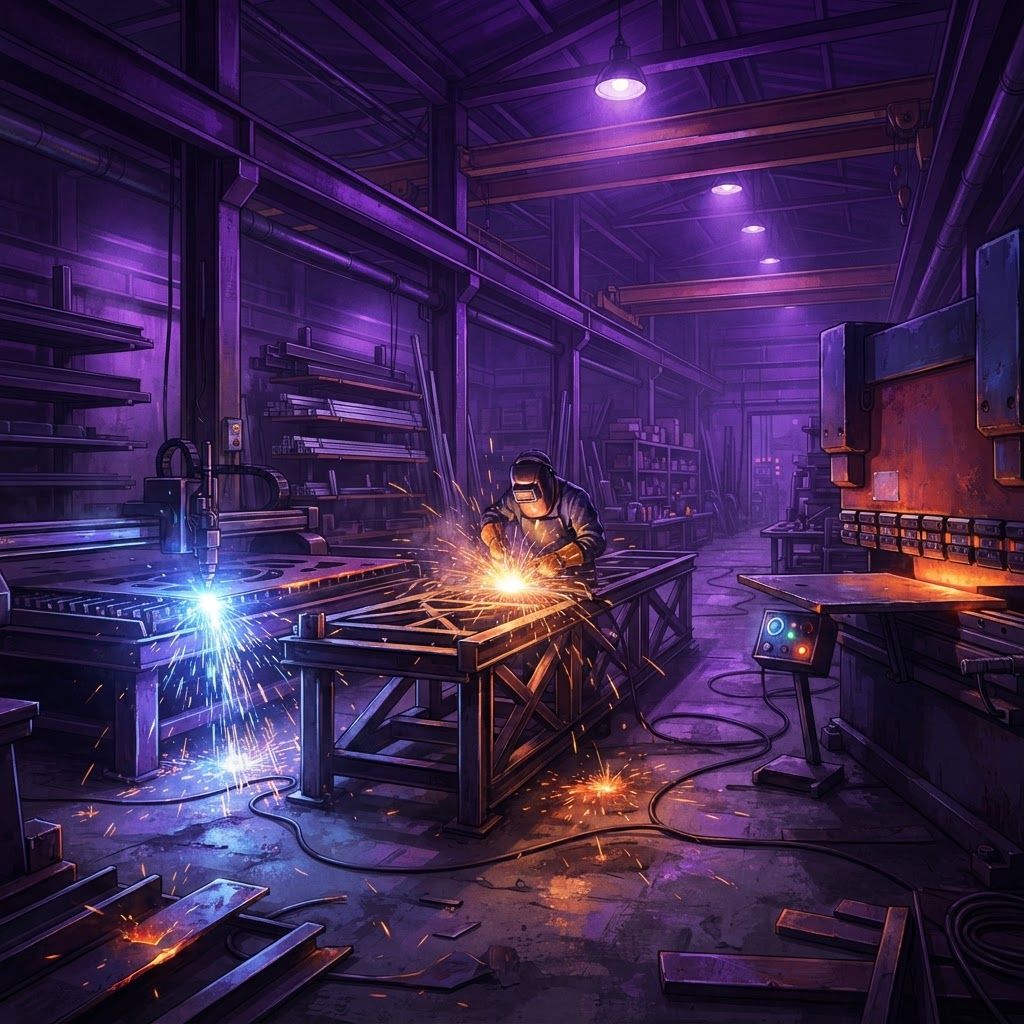
Metal Fabrication in a Corrosive Climate
Metalworking in Hialeah is defined by two forces: stringent structural requirements and an environment that attacks unprotected steel. The High Velocity Hurricane Zone provisions applied across Miami-Dade County mean that railings, canopies, louvers, anchorage and structural connections face engineering scrutiny that fabricators elsewhere rarely encounter. At the same time, salt-laden humidity makes material and coating selection a durability question rather than an aesthetic one.
Experienced local fabricators therefore work differently. They specify 316 stainless rather than 304 where chlorides are present, they insist on hot-dip galvanizing or properly prepared multi-coat systems on structural steel, they avoid dissimilar-metal contact that causes galvanic corrosion, and they detail assemblies so water drains instead of pooling in a tube or channel. A shop that discusses these details unprompted is demonstrating the knowledge that keeps installations sound a decade later.
The Range of Local Capability
The sector splits into recognizable specialties. Structural steel fabricators produce beams, columns, stairs and framing from shop drawings. Sheet metal shops handle laser cutting, punching, forming and welding of enclosures, ductwork, panels and brackets. Precision machine shops run CNC turning and milling for components requiring tight tolerances. Ornamental and architectural metal shops produce gates, railings, screens and decorative features. Marine metalworkers fabricate stainless towers, rails, hardware and hardtops for the boating industry. Finishing operations provide powder coating, anodizing, plating and galvanizing.
Most projects touch more than one specialty, and the practical question is whether your fabricator performs the work in house or subcontracts it. Subcontracting is normal and often appropriate, but it affects lead time and accountability, so it is worth asking directly.
Ten Metalworks Companies Serving Hialeah
Biscayne Structural Steel Fabricators produces structural assemblies, stairs, platforms and miscellaneous metals for commercial and multifamily construction, working from engineered drawings with certified welding procedures.
Flagler Precision Machine Works operates CNC mills and lathes for close-tolerance components serving aerospace suppliers, industrial equipment builders and repair operations, including reverse engineering of obsolete parts.
Everglade Sheet Metal Industries combines laser cutting, press-brake forming and welding to produce enclosures, control panels, guards and custom brackets, with prototype-to-production capability under one roof.
Marine Stainless Craft of Miami fabricates 316 stainless towers, rails, hardtops and custom hardware for sportfishing and yacht customers, finishing welds to the mirror polish that marine clients expect.
Hialeah Ornamental Iron Company builds gates, fences, balcony railings and decorative screens, balancing design intent with the structural and anchorage requirements local inspection demands.
Palm Coast Aluminum Fabrication specializes in aluminum extrusion fabrication and welded assemblies for canopies, louvers, screen enclosures and architectural trim, where corrosion resistance and weight matter.
Okeechobee Welding and Industrial Repair provides mobile and in-shop repair welding for equipment, tanks, trailers and process piping, supporting manufacturers who cannot afford extended downtime.
Tropic Powder Coating and Finishing handles blasting, pretreatment and powder coating with attention to the surface preparation that determines whether a coating survives coastal exposure.
Sunstate Tank and Vessel Works fabricates tanks, hoppers, chutes and process vessels for food processing, water treatment and chemical handling customers, including sanitary stainless work.
Coral Way Metal Design Studio serves architects and designers with feature staircases, sculptural elements, perforated facades and mixed-metal installations, offering in-house drafting and mockup fabrication.
How to Evaluate a Fabricator
Begin with welding qualifications. Ask which welding codes the shop works to, whether welders are currently certified for the processes and positions your project requires, and whether written welding procedure specifications exist. For structural work, confirm the shop's familiarity with special inspection requirements and whether it has been through third-party shop inspection before.
Then examine drawing capability. Detailing errors cause more field problems than welding errors. A shop with in-house detailers who produce shop drawings for approval will catch conflicts before material is cut. Request to see a set of shop drawings from a comparable project and check whether connections, anchorage and finishes are fully specified rather than left to the field.
Inspect finished work in person. Look at weld consistency, whether grinding has been used to hide poor fit-up, how edges are treated before coating, and whether stainless has been contaminated by carbon steel tooling. Cross-contamination is a common cause of rust staining on otherwise correct stainless installations, and shops that separate stainless fabrication from carbon steel work take the issue seriously.
Coatings, Corrosion and Long-Term Cost
Coating decisions dominate lifecycle cost in this market. Hot-dip galvanizing offers strong protection for structural steel but changes dimensions slightly and requires design allowances for drainage and venting. Powder coating produces an attractive, durable finish when pretreatment is thorough, but performs poorly over inadequately prepared surfaces. Duplex systems that combine galvanizing with a topcoat provide the longest service life for exposed exterior steel. For truly aggressive exposure, moving to aluminum or 316 stainless often costs less over time than repeatedly recoating steel.
Lead Times, Capacity and Scheduling
Fabrication schedules are driven by mill material availability, drawing approval turnaround and shop backlog. Clarify whether the quoted schedule starts at purchase order or at approved drawings, because that gap frequently consumes several weeks. Ask what portion of the work is subcontracted, particularly finishing, since a coating backlog can delay an otherwise complete order. For phased construction, negotiate delivery in sequences that match erection rather than accepting a single bulk delivery that must be stored and rehandled.
Technology Raising the Baseline
Fiber laser cutting, CNC press brakes, tube benders and 3D modeling have raised precision expectations across mid-sized shops. Many Hialeah fabricators now accept 3D model files directly, which reduces transcription errors and enables clash detection before fabrication. Robotic welding has appeared in higher-volume production, improving consistency on repetitive assemblies. For buyers, the practical benefit is tighter fit-up in the field and fewer modifications during installation.
Final Thoughts
Hialeah's metalworks companies bring genuine depth in structural, precision, architectural and marine fabrication, backed by hard-won understanding of hurricane code and corrosion behavior. Choose a shop whose core specialty matches your scope, verify welding qualifications and detailing capability, inspect prior work with attention to weld quality and surface preparation, and treat coating specification as a durability decision rather than a cosmetic one. Those steps consistently separate installations that last from those that need rework.