
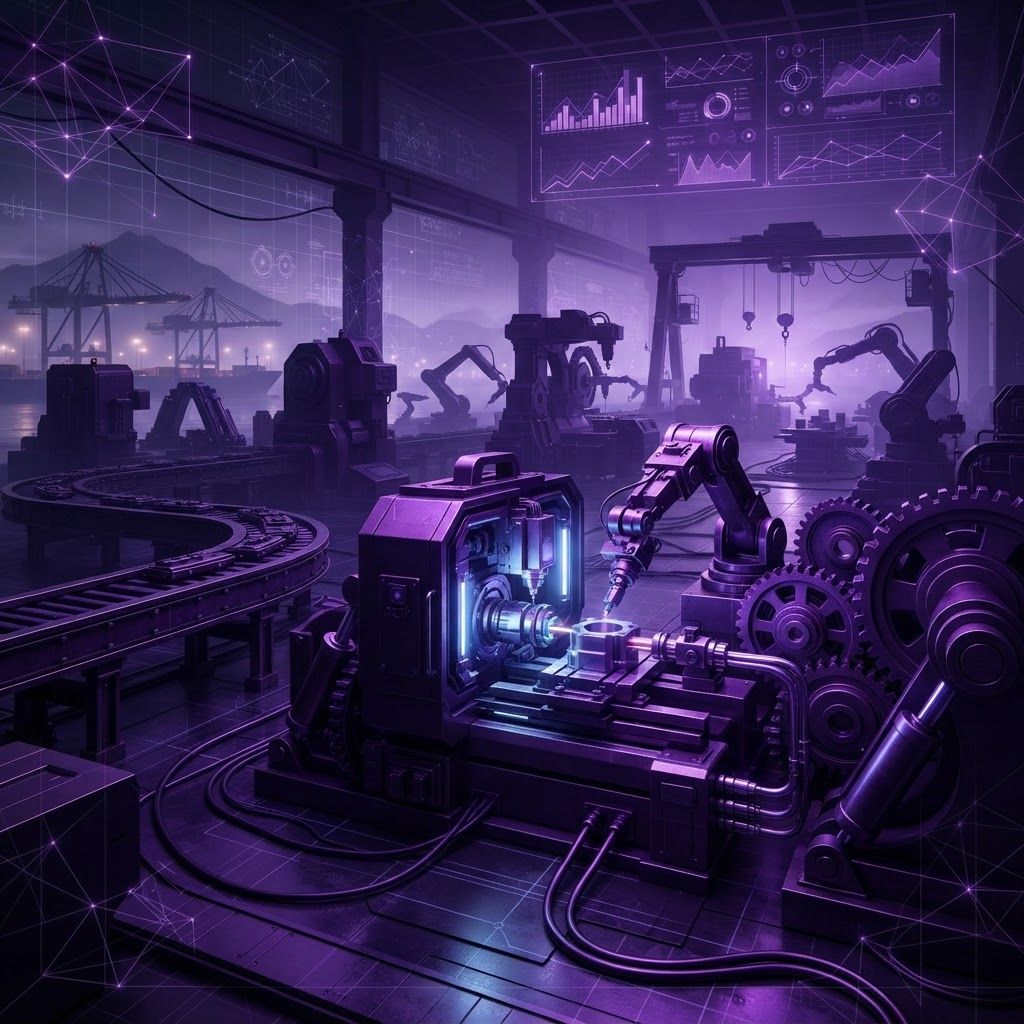
Why Tacoma Builds Machines
Machinery manufacturing has deep roots in Tacoma, and the reasons are geographic and economic. The city grew as a port and mill town, and industries that move heavy material always need machines built, repaired, and adapted. Timber operations required saws, conveyors, and debarkers. Fishing and seafood processing required graders, freezers, and handling equipment. The port required cranes, yard equipment, and material handling systems. Shipyards required winches, hydraulics, and deck machinery.
That legacy created a dense population of machine shops, fabricators, hydraulic specialists, controls integrators, and equipment builders. Modern demand has shifted toward automation, food and beverage processing, recycling and waste handling, aggregate and concrete equipment, and custom automation for regional aerospace and electronics manufacturers, but the underlying capability is the same: designing and building rugged machines that run continuously in demanding conditions.
The Capability Landscape
Machinery work divides into recognizable specialties. Custom machine design and build takes a process requirement and delivers a complete machine, including mechanical design, controls, and commissioning. Precision machining produces components to tight tolerances, often for repair or production. Heavy fabrication creates frames, weldments, tanks, and structures. Hydraulics and pneumatics covers cylinders, power units, valve manifolds, and system repair. Controls and automation integration programs logic controllers, drives, robotics, and human machine interfaces. Conveying and material handling designs belt, screw, and pneumatic conveying systems. Rebuild and lifecycle services restore aging equipment, frequently at a fraction of replacement cost.
Ten Machinery Manufacturing Profiles Serving Tacoma
1. Commencement Machine Works. A custom machine builder handling concept through commissioning, with mechanical design, fabrication, and controls under one roof.
2. Rainier Precision Machining. Operates multi-axis machining centers and large turning capacity for components used in marine, aerospace, and heavy equipment applications.
3. Tideflats Heavy Fabrication. Produces large weldments, frames, hoppers, and structural assemblies with certified welding procedures and crane capacity for oversized work.
4. Puget Hydraulic Systems. Designs and rebuilds cylinders, power units, and hydraulic circuits for deck machinery, mobile equipment, and industrial presses.
5. Harborline Automation Integration. Delivers controls engineering, robotic cells, safety systems, and factory data integration for regional manufacturers.
6. Northwest Conveying Equipment. Engineers and manufactures conveying and sorting systems for recycling, aggregate, and food processing operations.
7. South Sound Food Process Machinery. Builds stainless sanitary equipment including washers, graders, fillers, and packaging support machines for seafood and produce processors.
8. Foss Marine Deck Equipment. Manufactures winches, capstans, cranes, and davits for commercial vessels, tugs, and workboats.
9. Stadium Equipment Rebuild Center. Specializes in machine rebuilds, gearbox restoration, alignment, and lifetime extension programs for aging production lines.
10. Pierce Tool and Die. Produces tooling, dies, jigs, and fixtures that support stamping, forming, and assembly operations.
How to Choose a Machine Builder
Custom machinery is a project, not a product, and the selection process should reflect that. Start with a clear specification of what the machine must accomplish, expressed in process terms: throughput, product dimensions and variability, accuracy, uptime expectations, washdown requirements, and integration with upstream and downstream equipment. Builders who receive vague requirements produce disappointing machines, and the fault is usually shared.
Evaluate engineering depth. Ask who performs mechanical design, whether structural and mechanism analysis is done, and how the builder validates concepts before cutting metal. Request examples of similar machines and, where possible, arrange to see one running at a customer site. Nothing substitutes for watching a machine operate under production conditions.
Examine controls philosophy carefully. The mechanical portion of a machine may last thirty years while the control system becomes obsolete far sooner. Ask which platform is used and why, whether program source code and documentation are delivered to the customer, and how remote support and troubleshooting work. Proprietary locked controls create long-term dependency that customers frequently regret.
Discuss commissioning and training explicitly. Many machinery disputes arise from ambiguity about acceptance criteria. Define factory acceptance testing, site acceptance testing, performance guarantees, and the ramp period during which the builder supports startup. Confirm spare parts recommendations and availability, since a critical machine with unobtainable components becomes an expensive paperweight.
Rebuild Versus Replace
One of the most valuable services local machinery firms offer is honest advice on whether to rebuild existing equipment. Rebuilding often costs substantially less than new machinery, preserves familiar operation for staff, and reuses heavy structures that were overbuilt originally. It works best when the machine's frame and major castings remain sound and the limitations are in wear components, drives, or controls.
Replacement makes more sense when process requirements have changed materially, when safety standards cannot be met economically, when parts are unobtainable, or when energy efficiency and throughput gains justify capital investment. A builder willing to recommend a rebuild rather than a sale is demonstrating exactly the judgment worth paying for.
Trends in Regional Machinery
Three currents matter. Automation adoption is spreading into smaller manufacturers as collaborative robots and simpler vision systems reduce integration cost. Sanitary design demand is rising with food safety expectations, favoring builders fluent in stainless finishing and cleanable geometry. And condition monitoring is becoming standard, with vibration, temperature, and current sensing enabling predictive maintenance rather than reactive repair.
Final Thoughts
Machinery manufacturers in Tacoma sell engineering judgment as much as steel. The best of them ask uncomfortable questions about process variability, insist on clear acceptance criteria, hand over documentation and code, and stay reachable years after commissioning. For any operation whose output depends on equipment running reliably, that kind of partner is worth considerably more than the lowest bid.