
The Backbone Industry Few People Notice
Machinery manufacturers build the equipment that other manufacturers use. It is a business of engineering depth rather than consumer visibility, and the St. Louis region has been good at it for well over a century. The city's early industrial base in brewing, milling, chemicals, shoes, and rail equipment created demand for specialized machinery, and the firms that met that demand developed capabilities that outlasted the industries that spawned them.
Today the region's machinery sector serves food and beverage processing, packaging and labeling, material handling and conveyance, agriculture, water and wastewater treatment, plastics processing, metal forming, mining and aggregates, pharmaceutical and life science production, and industrial automation. Many of these companies are privately held, employ between fifty and five hundred people, export globally, and are almost unknown outside their customer base.
Categories of Machinery Production
Standard product manufacturers design and build catalog equipment: conveyors, mixers, pumps, hoists, crushers, filling machines, palletizers, dust collection systems, and heat exchangers. They benefit from repeatable engineering, spare parts revenue, and dealer or representative networks.
Custom machine builders and system integrators engineer to order. A customer describes a process problem, and the builder designs, fabricates, assembles, programs, and commissions a solution. This work demands strong mechanical design, controls engineering, and project management, and it typically involves close collaboration with the end user's operations team.
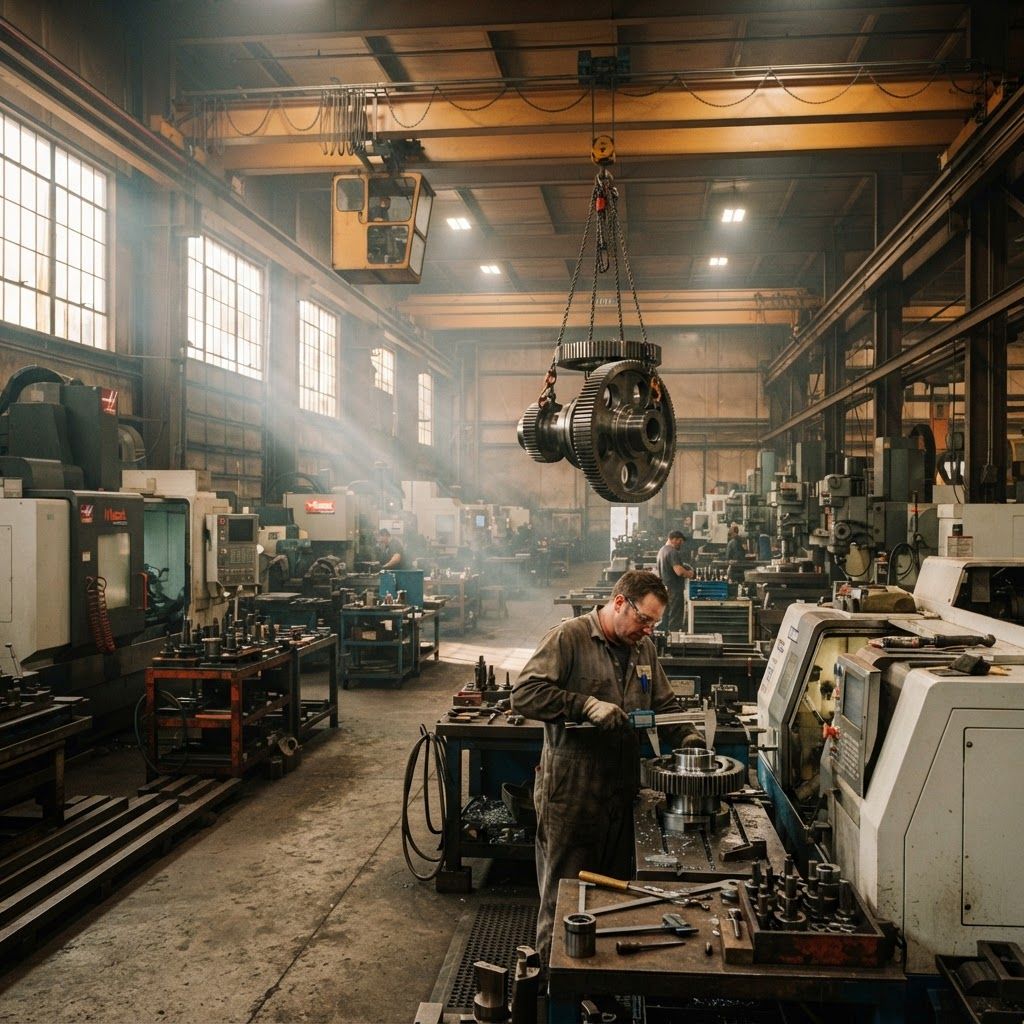
Contract fabricators and machine shops supply the components: precision machined parts, welded frames and weldments, sheet metal enclosures, gearing, and hydraulic assemblies. Their capability determines what the builders above can actually deliver. Rebuilders and retrofitters extend the life of existing equipment through overhaul, controls modernization, and safety upgrades, a segment that grows whenever capital budgets tighten.
Finally, service organizations provide field installation, preventive maintenance, alignment and vibration analysis, spare parts management, and operator training. For capital equipment with a twenty-year life, this aftermarket relationship often matters more than the initial purchase price.
What Distinguishes an Excellent Machinery Builder
Engineering capability leads. Strong builders employ mechanical designers who model in three dimensions with proper tolerance analysis, controls engineers fluent in the programmable logic controller and human-machine interface platforms their customers standardize on, and process engineers who understand the physics of the application rather than just the mechanism. They perform finite element analysis where loads are critical and they document design decisions.
Manufacturing quality follows. Certified welders working to recognized procedures, machining with verified in-process inspection, proper surface preparation and coating for the operating environment, and clean assembly practices all determine whether equipment runs for two years or twenty. Sanitary design capability, including proper drainage, cleanable surfaces, and appropriate materials, is essential for food, beverage, and pharmaceutical applications.
Project execution is the third differentiator, and often the weakest link across the industry. The best builders hold formal design reviews, provide realistic schedules with visible milestones, run factory acceptance testing before shipment, deliver complete documentation including electrical schematics and spare parts lists, and commission with trained field personnel rather than sending an engineer who has never installed the machine.
Trends Reshaping Machinery Manufacturing
Automation demand has surged, driven by labor availability rather than labor cost. Manufacturers struggling to staff repetitive positions increasingly automate them, which favors builders who can integrate robotics, vision systems, and end-of-arm tooling into practical cells. Collaborative robots have widened the range of applications where automation is economically viable at low volumes.
Digitalization has changed both product and process. Machines now ship with condition monitoring, remote diagnostics, and data outputs that integrate into plant historians and enterprise systems. Builders that offer secure remote support resolve issues in hours rather than days. Internally, digital twin simulation and virtual commissioning shorten startup time considerably.
Sustainability has become a purchasing criterion. Energy consumption per unit of output, water use, material yield, and waste reduction now appear in equipment specifications. Regulatory attention to machine safety has intensified as well, with functional safety standards, risk assessment documentation, and proper guarding and interlock design expected as standard practice rather than optional additions.
Supply chain realities continue to bite. Long lead times on motors, drives, gearboxes, controls, and specialty steel require builders to plan procurement earlier and design with sourcing flexibility. Those who standardized components across product lines weathered recent disruptions far better.
How to Select a Machinery Partner
Define the process outcome, not the machine. Specify throughput, product characteristics and variability, available floor space, utilities, cleaning requirements, uptime expectations, and integration points with upstream and downstream equipment. Builders who receive a clear functional specification produce better proposals and fewer change orders.
Evaluate references at operating sites, ideally speaking with maintenance staff rather than only management, since maintenance knows the truth about reliability and parts availability. Visit the shop to assess engineering depth, assembly space, and whether the company builds or merely assembles purchased subsystems.
Structure the contract carefully. Address performance guarantees tied to measurable criteria, acceptance testing procedures, payment milestones, spare parts pricing, warranty scope and duration, training deliverables, documentation requirements, and intellectual property in custom designs. Ambiguity in acceptance criteria is the most common source of capital project disputes.
Total Cost of Ownership
Purchase price is a fraction of lifetime cost. Energy consumption, changeover time, consumable wear parts, maintenance labor, downtime risk, and eventual retrofit potential dominate the economics. A machine that costs fifteen percent more but reduces changeover from ninety minutes to fifteen can pay for the difference within months in a high-mix operation. Insisting on quantified estimates for these factors during evaluation produces far better capital decisions.
The Regional Outlook
Machinery manufacturing in St. Louis benefits from a skilled trades workforce, strong engineering education, central logistics for shipping oversized equipment by truck, rail, or barge, and proximity to the agricultural and food processing customers that anchor Midwestern demand. As automation adoption spreads and existing plants modernize, capable builders in the region are positioned for durable growth, particularly those combining mechanical craftsmanship with genuine controls and data expertise.