
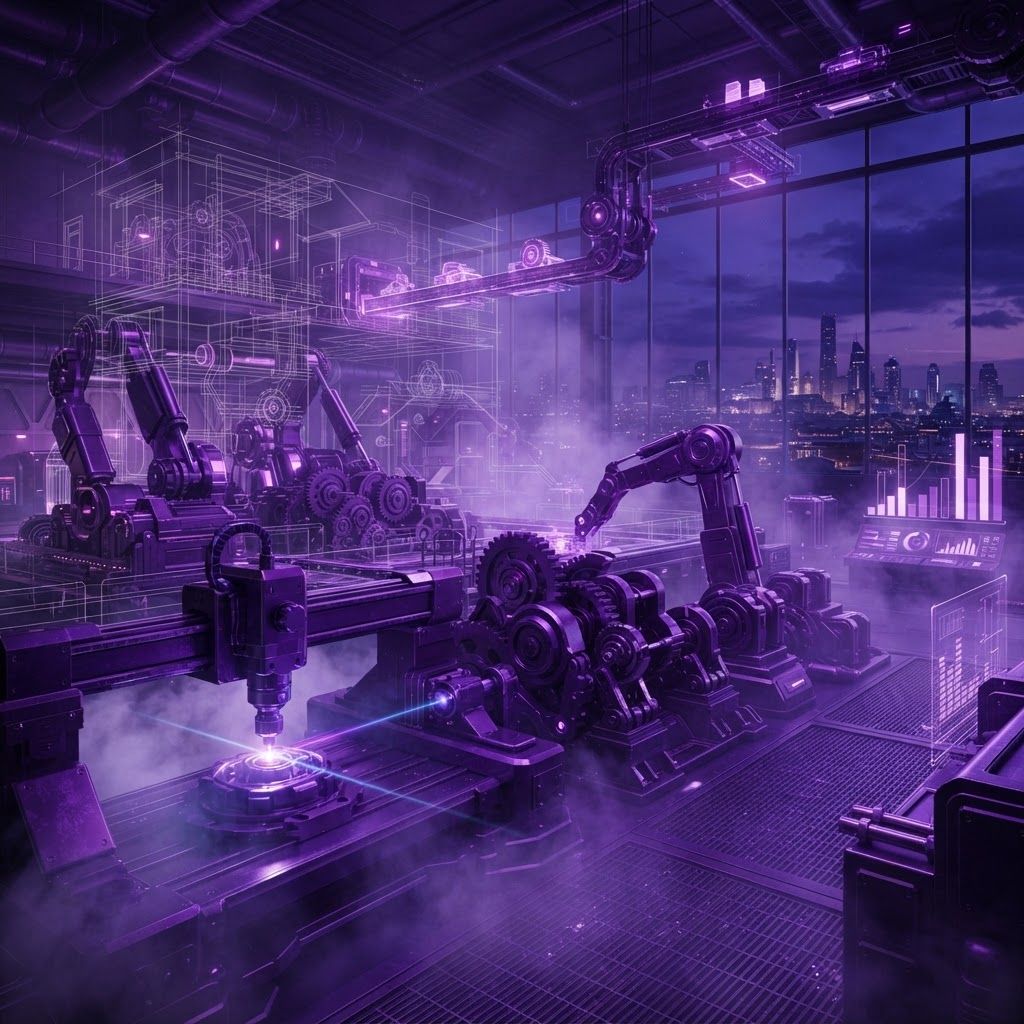
Why Machinery Manufacturing Thrives in Sioux Falls
Machinery manufacturing sits at the center of the Sioux Falls industrial economy, and the reason is straightforward: the region's dominant industries all consume heavy equipment. Agriculture requires tillage, planting, harvesting, grain handling, and livestock systems. Food processing requires conveying, cutting, packaging, and sanitation equipment built to withstand constant washdown. Construction requires aggregate handling and material processing machinery. Energy requires fabricated structures and process equipment.
Proximity to customers matters enormously in machinery. When a grain dryer fails during harvest or a processing line stops mid-shift, the cost of downtime is measured in thousands of dollars per hour. A manufacturer located within a few hours can dispatch a technician, fabricate a replacement part, and restore operation the same day. That responsiveness is not something a distant supplier can replicate at any price.
The region also carries deep skilled-trades capability. Welders, machinists, millwrights, hydraulic technicians, and controls engineers are available in numbers that surprise companies accustomed to labor scarcity elsewhere, and turnover tends to be low.
Categories of Local Machinery Production
Agricultural equipment leads by volume. Grain handling systems including augers, conveyors, legs, and bins; livestock equipment such as gates, chutes, and feeding systems; tillage and planting implements; and grain drying and aeration equipment all originate in the region.
Food processing machinery is a specialized field requiring sanitary design, stainless steel construction, and compliance with food safety standards. Weld finish, drainage geometry, and cleanability are engineered rather than incidental, and the discipline is quite different from general industrial fabrication.
Material handling and industrial automation covers conveyors, palletizing systems, robotic cells, and integrated controls. Regional manufacturers increasingly deliver complete automated lines rather than individual machines.
Custom machine building and contract fabrication serves customers who need a machine that does not exist commercially. This work combines mechanical design, machining, welding, hydraulics, and controls programming, and it represents the highest-skill end of the sector.
Top 10 Machinery Manufacturers Serving Sioux Falls
1. Sioux Steel Company — A Sioux Falls institution manufacturing grain storage and handling systems, livestock equipment, and agricultural steel products, with a long history of engineering durable equipment for plains conditions.
2. Sioux Automation Center — Produces feed and material handling machinery including mixers, conveyors, and processing equipment for agricultural and industrial applications, with fabrication and controls capability in-house.
3. Trail King Industries — Manufactures heavy haul and specialty trailers alongside industrial fabrication, applying structural engineering expertise to equipment that must carry extreme loads reliably.
4. Dakota Fluid Power — Engineers hydraulic systems, cylinders, power units, and fluid power assemblies that drive machinery throughout the region, offering design, assembly, and field service.
5. Prairie Machine and Weldment — A contract manufacturer providing precision machining, structural weldments, and complete subassemblies for equipment original equipment manufacturers across multiple industries.
6. Midwest Controls and Automation — Designs and builds control panels, PLC automation systems, and integrated machine controls for grain handling, food processing, and industrial production lines.
7. Interstate Power Systems — Supplies and services engines, generators, drivetrain components, and power systems for industrial machinery, including remanufacturing that extends equipment life economically.
8. Angus Palm — Builds custom electromechanical assemblies, machine frames, and integrated systems for equipment manufacturers requiring engineering support alongside fabrication capacity.
9. Falls Industrial Fabrication — Provides heavy plate fabrication, machining, and assembly for process equipment, structural components, and custom machinery serving energy and food processing clients.
10. Novozymes Process Equipment Support — Supports the region's bioprocessing sector with specialized process machinery service and integration, reflecting the strong overlap between machinery capability and South Dakota's bioindustrial economy.
Trends in Machinery Manufacturing
Automation and robotics adoption has accelerated sharply, driven less by labor cost than by labor availability. Food processors and manufacturers who cannot fill positions are automating tasks that were previously manual, and regional machinery builders have expanded into robotic integration to meet that demand.
Precision agriculture continues transforming equipment design. Variable rate application, section control, automated steering, and yield mapping require machinery that integrates sensing and software with mechanical function. Equipment builders now employ software engineers alongside mechanical designers.
Predictive maintenance is changing service models. Vibration monitoring, thermal sensing, and connected controls allow manufacturers to detect a bearing failure before it stops a line, and service contracts built around monitoring rather than repair have become a growing revenue stream.
Sanitary design requirements keep tightening in food processing, pushing more work toward manufacturers who genuinely understand hygienic engineering. Meanwhile, energy efficiency in motors, drives, and hydraulic systems has become a purchasing criterion as electricity and fuel costs receive closer scrutiny.
How to Evaluate a Custom Equipment Builder
Begin with engineering capability. Ask whether design work is performed in-house, what software is used, and whether the manufacturer will provide detailed drawings and documentation as a deliverable. Machines without documentation become unmaintainable liabilities.
Assess relevant experience directly. A builder skilled in grain handling may lack sanitary food processing expertise, and the gap will show up in weld finish and drainage design. Request references from installations in your specific industry and, ideally, visit one in operation.
Clarify commissioning and training. A machine delivered without operator training and a startup period will underperform regardless of build quality. Confirm spare parts availability, typical lead times for critical components, and whether the manufacturer stocks wear items locally.
Discuss service response explicitly, including hours of availability, travel time, and whether remote diagnostic access is supported. During harvest or a production peak, response time is the specification that matters most. Finally, address warranty terms and what constitutes a covered failure versus normal wear.
Final Thoughts
Machinery manufacturing in Sioux Falls is a mature, capable sector grounded in the practical needs of agriculture, food processing, and construction. The combination of skilled trades depth, engineering capability, and genuine service responsiveness gives regional builders advantages that price comparison alone will not reveal. For any operation where downtime is expensive, those advantages usually prove decisive.