
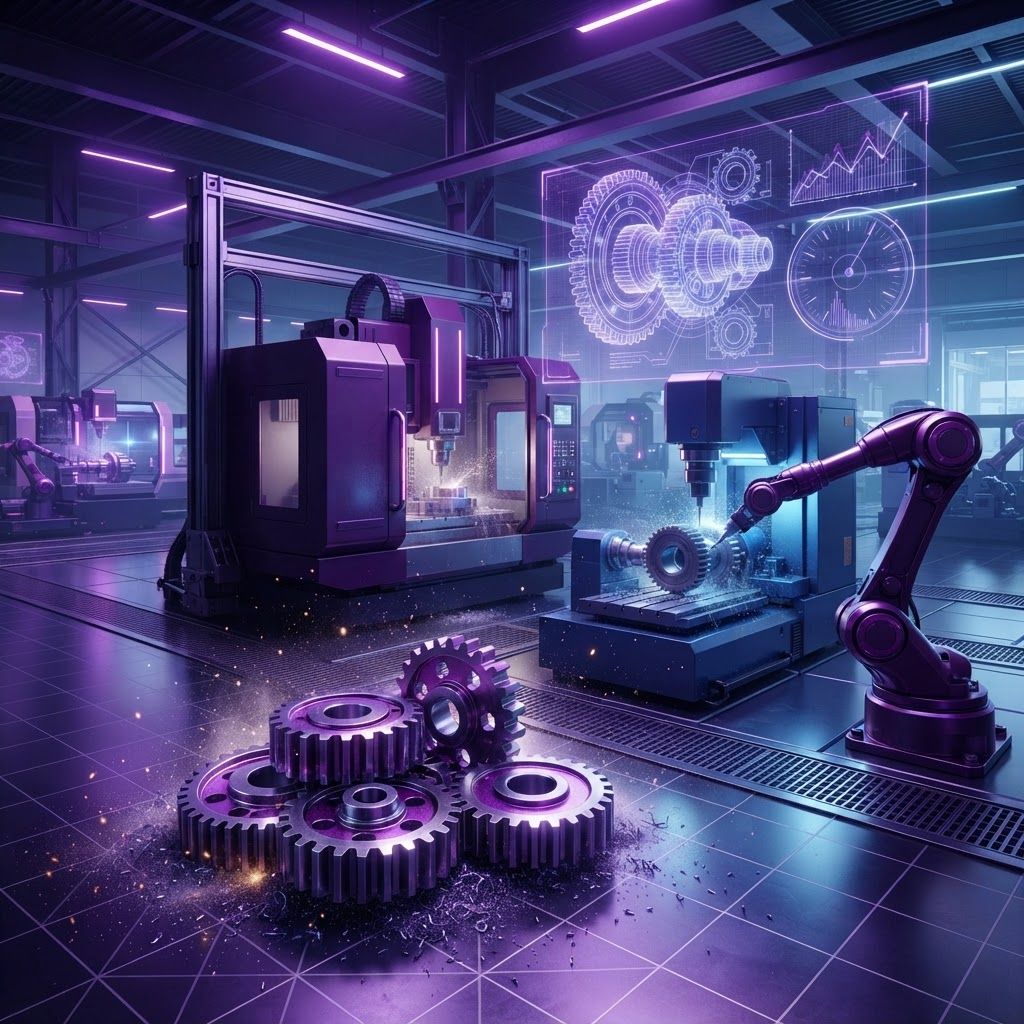
The Machines Behind the Machines
Every manufacturing economy depends on companies that build production equipment, and Rochester has been unusually good at it for more than a century. Machinery manufacturing is a demanding business: products are complex, volumes are low, engineering content is high, and customers expect decades of service life and support. Those characteristics reward exactly the kind of deep technical workforce the Rochester region developed through its optics, imaging, and precision manufacturing history.
The result is a machinery sector that punches well above the region's population. Local companies build gear production systems, packaging and filling lines, automation cells, measurement and calibration equipment, material handling systems, and custom process machinery shipped to customers around the world. Much of this work is invisible to the public because the end products carry someone else's brand, but the export value is substantial.
Categories of Machinery Built in the Region
Metal forming and cutting equipment is the most established category, including gear cutting, grinding, and inspection systems. Packaging and food processing machinery is another strength, supported by the region's substantial food and beverage industry. Automation and robotics integration constitutes a growing segment, with system builders assembling robotic cells, vision-guided handling, and end-of-line automation.
Test and measurement equipment is a Rochester specialty, spanning optical metrology, calibration systems, and specialized instrumentation. Finally, custom machine building serves companies with processes that no catalog equipment addresses, a category that requires close collaboration between customer and builder.
Ten Machinery Manufacturers in the Rochester Region
1. Gleason Corporation. A global leader in gear production technology headquartered in Rochester, producing gear cutting, grinding, and inspection machines along with tooling and software used by automotive, aerospace, and industrial manufacturers worldwide.
2. QED Technologies. Rochester-based maker of magnetorheological finishing and subaperture stitching interferometry systems, technology that transformed how precision optics are polished and measured.
3. Optimation Technology. An engineering, automation, and fabrication company serving process industries with custom machinery, control systems, and integrated production equipment.
4. Sydor Technologies. Manufacturer of advanced diagnostic and measurement instrumentation for research, defense, and industrial applications, combining optics, electronics, and precision mechanics.
5. Transcat. Headquartered in Rochester, it provides calibration services and distributes test and measurement instrumentation critical to machinery accuracy and regulatory compliance.
6. Ultrafab. Beyond its sealing products, the Farmington company operates substantial in-house machine design and build capability to produce its specialized manufacturing lines.
7. Pactiv and regional packaging equipment builders. Packaging machinery suppliers serving Western New York's food processing sector design filling, sealing, labeling, and case packing systems.
8. E2b and regional robotic integrators. Automation integrators around Monroe County design and commission robotic welding, palletizing, and inspection cells for manufacturers across the Northeast.
9. Rochester Gauges and precision instrument makers. Producers of gauges, sensors, and monitoring devices supply the components that industrial machinery relies on for control and safety.
10. Rochester Institute of Technology and Monroe Community College manufacturing programs. These institutions provide applied research, prototyping facilities, and the mechatronics and machining talent pipeline the sector requires.
Trends in Machinery Manufacturing
Digitalization is the dominant theme. Modern machines ship with embedded sensors, condition monitoring, and remote diagnostics, allowing builders to sell service contracts and predictive maintenance alongside hardware. That shift changes business models, turning a one-time capital sale into an ongoing relationship.
Automation demand continues to rise as manufacturers respond to persistent labor shortages. Machinery builders that can deliver flexible, quickly reconfigurable systems have an advantage over those offering rigid high-volume equipment, since customers increasingly need to run varied products on shared lines.
Sustainability requirements are also entering machine specifications. Energy consumption, material waste, coolant handling, and end-of-life recyclability now feature in procurement evaluations, particularly for European customers subject to stricter regulation.
Lead times and component sourcing remain a challenge. Electrical components, drives, and controls have experienced extended availability issues, prompting builders to standardize on fewer platforms and hold strategic inventory.
How to Evaluate a Machinery Supplier
Specify the process outcome, not just the machine. Good builders will interrogate throughput targets, product variability, uptime expectations, changeover frequency, and quality tolerances before proposing a design, and a supplier who quotes without asking those questions is a warning sign.
Review factory acceptance testing procedures, spare parts availability, documentation standards, and training programs. Ask about installed base and request references from customers running similar equipment for several years, since machinery reveals its weaknesses over time rather than at commissioning. Clarify controls platform choices, because standardizing on a familiar programmable logic controller and human machine interface across a plant dramatically reduces maintenance burden.
Final Thoughts
Machinery manufacturing is one of Rochester's quiet strengths, exporting sophisticated capital equipment from a mid-sized American city to global customers. For manufacturers seeking automation, precision processing, or custom production systems, the regional supplier base offers engineering depth, proximity for commissioning and service, and a long track record of solving problems that catalog equipment cannot.