
The Machine-Building Tradition
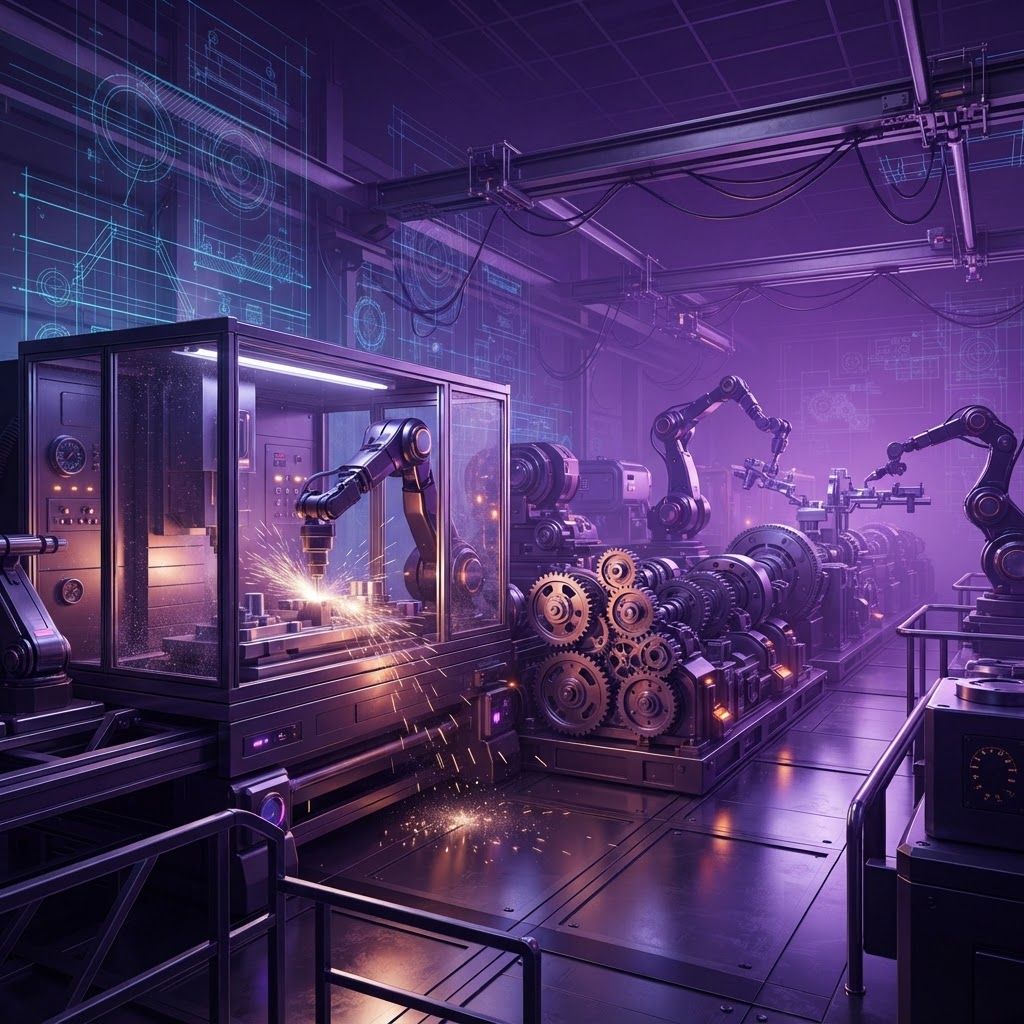
Before Providence was known for textiles, it was known for the machines that made textiles. The machine tool and equipment building trades that grew alongside the mills created a deep reservoir of mechanical skill, and that tradition never fully disappeared. Today the region's machinery manufacturers build custom automation, precision assembly equipment, packaging machinery, test systems, and specialized production tooling for customers across many industries.
The economics favor this work locally. Custom machinery is engineered to order, involves close collaboration with the customer, and cannot be commoditized. A builder who can meet with a client's engineers, understand a process in detail, and iterate on a design holds an advantage that distance erodes.
Types of Machinery Producers
Custom automation integrators design and build machines that perform specific production tasks: assembling components, dispensing adhesives, testing finished parts, or packaging products. Each system is engineered for a particular application.
Precision machine tool builders produce equipment for machining, grinding, and finishing operations, often serving specialized niches where general-purpose equipment cannot meet requirements.
Robotics and material handling specialists deploy industrial robots, collaborative robots, conveyors, and automated storage systems, handling mechanical integration and programming together.
Packaging machinery manufacturers build filling, sealing, labeling, and cartoning equipment for food, pharmaceutical, and consumer products customers.
Test and measurement equipment builders create systems that verify product performance, including leak testing, dimensional inspection, functional test stands, and environmental chambers.
Tooling, die, and fixture makers produce the molds, dies, jigs, and fixtures that make production possible, work that requires exceptional precision and material knowledge.
Medical and laboratory equipment manufacturers build instruments and production equipment for the region's substantial life sciences sector, operating under appropriate quality systems.
Marine and industrial equipment producers serve shipbuilding, port operations, and heavy industry with winches, handling systems, and specialized machinery.
Controls and systems engineering firms develop the programmable logic controllers, human machine interfaces, motion control, and safety systems that make modern machinery function.
Rebuild and retrofit specialists modernize existing equipment with new controls, drives, and safety systems, extending useful life at a fraction of replacement cost.
What Machine Building Actually Involves
A custom machinery project follows a disciplined sequence. It begins with requirements definition covering cycle time, part variation, quality criteria, footprint, utilities, operator interaction, and maintenance access. Ambiguity at this stage causes nearly every downstream problem.
Concept design follows, often with multiple approaches evaluated for cost, risk, and performance. Detailed mechanical and electrical design produces fabrication drawings, bills of material, and control architecture. Fabrication and assembly then proceed, followed by debug, where the machine's actual behavior is reconciled with its intended behavior.
Factory acceptance testing demonstrates performance at the builder's facility before shipment, and site acceptance testing verifies operation in the customer's environment with real production conditions. Training and documentation complete the delivery.
Experienced builders manage this sequence with formal design reviews and change control. Scope changes are inevitable, but undocumented changes destroy schedules and budgets.
Technology Shaping the Industry
Simulation has changed machine design fundamentally. Motion studies, finite element analysis, and full digital twins allow builders to validate cycle times, detect interferences, and optimize designs before cutting metal. This reduces debug time significantly.
Controls have become the differentiating discipline. Modern machines integrate servo motion, vision systems, force sensing, safety-rated components, and network connectivity. Data collection enables predictive maintenance, where vibration and current signatures indicate developing problems before failure.
Collaborative robotics has expanded automation into applications where fixed guarding was impractical, particularly for smaller manufacturers with high product variety and moderate volumes.
Additive manufacturing now supports machine building through rapid production of fixtures, grippers, and low-volume components with geometry that machining cannot achieve economically.
Procuring Capital Equipment Successfully
Write a thorough specification. Define throughput requirements with realistic assumptions about uptime, changeover, and material variation. Specify acceptance criteria quantitatively, because ambiguous performance language leads to disputes at acceptance testing.
Evaluate builders on relevant experience rather than general capability. Ask to see machines they have built for similar processes and speak with those customers about reliability, support, and how problems were handled.
Understand the total cost of ownership. Purchase price is only part of it. Consider spare parts availability, maintenance requirements, energy consumption, operator training, and the cost of downtime if support is slow.
Structure payment around milestones tied to demonstrated progress, including design approval, factory acceptance, and successful site acceptance. This aligns incentives and protects both parties.
Plan for the long term. Industrial machinery often operates for decades, so ask about component obsolescence, controls platform longevity, and whether documentation is sufficient for future modification by someone other than the original builder.
Workforce and the Future
The central constraint facing machinery manufacturers is skilled labor. Machinists, toolmakers, controls engineers, and mechanical designers are in persistent short supply, and the workforce skews older. Regional manufacturers have responded with apprenticeship programs, partnerships with technical schools, and internal training pipelines.
For Providence, machinery manufacturing represents exactly the kind of high-skill, high-wage industrial employment that regional economies need. It cannot be easily offshored because it depends on collaboration, and it builds capability that supports every other manufacturing sector in the area.