
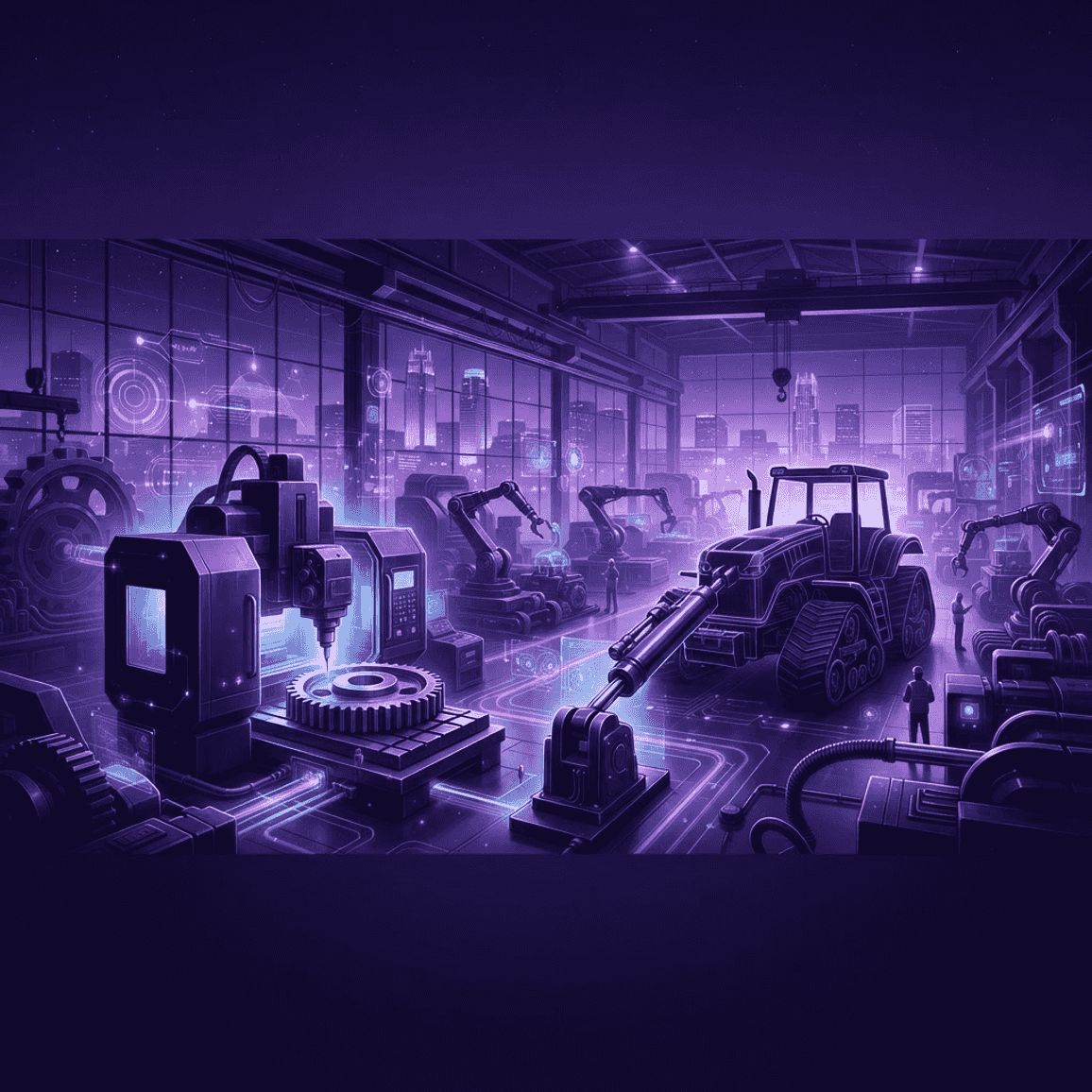
Machinery Manufacturing at the Center of the Country
Machinery manufacturing is arguably Omaha's most authentic industrial strength. The metro sits inside one of the world's most productive agricultural regions, surrounded by grain handling, livestock, food processing and irrigation operations that all require heavy, reliable equipment. That demand has produced a mature cluster of machinery builders whose products range from center pivot irrigation systems and grain conveyors to custom automation cells, hydraulic power units and precision machined assemblies.
What distinguishes Omaha machinery firms is a practical engineering culture. Equipment built here is designed for operators who repair their own machines, often in a field or a dusty plant aisle rather than a clean maintenance bay. Grease points are accessible, fasteners are standard, wear parts are replaceable and documentation tends to be genuinely usable. That philosophy has earned local manufacturers customers well beyond Nebraska.
Why the Omaha Region Supports Machinery Production
Proximity to end users is the first advantage. When a machinery builder's customers operate within a few hours' drive, field feedback reaches engineering quickly and design revisions actually reflect real conditions. Service response times also improve dramatically, which matters when downtime during harvest or a processing shift costs thousands of dollars per hour.
The second advantage is the surrounding supply base. Omaha and its neighboring communities host steel service centers, foundries, gear shops, heat treaters, hydraulic distributors, powder coaters and electrical panel builders. A machinery manufacturer can source nearly every input regionally, which shortens build cycles and reduces the freight cost embedded in large fabricated assemblies. Add competitive industrial power rates and a workforce comfortable with welding, machining and assembly, and the economics work well.
How These Manufacturers Were Selected
Rankings considered engineering depth, manufacturing capability, quality reputation, aftermarket parts and service support, and the significance of each company within its niche. Preference went to organizations with demonstrated longevity, investment in modern machine tools and controls, and a record of standing behind equipment years after delivery.
The Top 10 Machinery Manufacturers in Omaha
1. Lindsay Corporation
Headquartered in the Omaha area, Lindsay Corporation is a global leader in mechanized irrigation and a genuine flagship for regional machinery manufacturing. Its center pivot and lateral move systems combine heavy structural engineering with sophisticated controls and remote management technology. Lindsay's dealer network, parts availability and continual investment in water-efficiency technology make it a reference point for the entire industry.
2. Valmont Industries
Valmont's Omaha headquarters oversees infrastructure and agricultural machinery operations spanning multiple continents. The company's galvanizing capacity, structural engineering expertise and irrigation product lines give it exceptional breadth, while its process discipline across dozens of plants sets a high standard for manufacturing consistency in the region.
3. Behlen Manufacturing
Based in nearby Columbus and heavily engaged with Omaha-area customers, Behlen Manufacturing builds grain systems, livestock equipment, steel buildings and custom fabrications. Its vertically integrated approach, which includes roll forming, galvanizing and extensive welding capacity, allows it to deliver very large fabricated systems on predictable schedules.
4. Omaha Machine & Tool
A precision job shop with heavy machining capability, Omaha Machine & Tool produces large turned and milled components, gearboxes, shafts and rebuild parts for industrial equipment. The company is often called when an obsolete component must be reverse engineered from a worn sample, and its measurement and documentation practices make those projects reliable rather than experimental.
5. Midwest Conveyor Systems
Specializing in bulk material handling, Midwest Conveyor Systems designs and manufactures belt conveyors, drag chains, screw conveyors and bucket elevators for grain, feed, fertilizer and aggregate operations. Its engineers focus on throughput calculations, dust control and maintenance access, and its ability to retrofit equipment into existing plants without extended shutdowns is widely respected.
6. Heartland Industrial Equipment
Heartland Industrial Equipment builds custom automation cells, indexing tables, part handling systems and turnkey work stations for manufacturers across Nebraska and Iowa. Projects typically combine mechanical design, pneumatics, servo motion and control programming, and the company's willingness to take responsibility for the complete system rather than only the mechanics appeals to plants with lean engineering staffs.
7. Papio Machine Works
Papio Machine Works serves food processing, packaging and light industrial customers with stainless steel machinery, sanitary conveyors and washdown-rated equipment. Sanitary fabrication demands specialized welding and finishing skills, and the shop's understanding of cleanability requirements makes it a natural partner for regional food producers.
8. Missouri River Hydraulics
This company manufactures hydraulic power units, custom cylinders and integrated hydraulic systems for machinery builders and end users. It also provides cylinder rebuilding, pump testing and system troubleshooting, which gives it unusual insight into why hydraulic designs fail in the field and how to build them so they do not.
9. Cornhusker CNC Solutions
Cornhusker CNC Solutions focuses on high-precision multi-axis machining for machinery components, tooling and fixtures. Investment in probing, tool monitoring and coordinate measuring inspection lets the shop hold tight tolerances repeatably, and its engineering staff regularly suggests design adjustments that reduce machining time without compromising function.
10. Elkhorn Fabrication & Machinery
Rounding out the list, Elkhorn Fabrication & Machinery combines heavy plate fabrication, welding and assembly to produce frames, hoppers, chutes, platforms and complete machine bases. Certified welding procedures, large-envelope capacity and in-house finishing allow the company to deliver structurally demanding assemblies ready for installation.
Trends Shaping Machinery Manufacturing in Omaha
Connectivity is the most visible change. Customers increasingly expect machinery to report runtime, faults and performance data, which pushes builders to integrate sensors, controllers and gateways as standard rather than optional content. Water and energy efficiency is a second driver, particularly in irrigation and processing, where incremental gains translate directly into operating savings. Third, labor scarcity has intensified interest in automation retrofits, with plants asking machinery builders to eliminate manual handling steps rather than replace whole lines. Finally, lifecycle service is becoming a differentiator, as buyers evaluate parts availability and technical support as carefully as purchase price.
How to Choose a Machinery Manufacturer
Begin with a clear specification that describes duty cycle, throughput, environment and maintenance expectations, not just dimensions. Ask for references from customers running similar equipment for several years, and ask specifically what has worn out and how quickly parts arrived. Review the manufacturer's approach to documentation, including drawings, spare parts lists and electrical schematics, because incomplete documentation quietly raises the total cost of ownership. Visit the shop and evaluate whether the fabrication and assembly quality you see matches the standard you need. Finally, confirm who will support commissioning and training, since even excellent machinery underperforms when operators are never properly taught to run it.
Final Thoughts
Omaha's machinery manufacturers succeed because they build equipment for people they know and conditions they understand. That grounding produces machines that are serviceable, durable and honest about their capabilities. Buyers who invest time in specification and supplier evaluation will find the metro offers an impressive range of engineering and fabrication talent, capable of everything from a single custom fixture to a complete production system.