
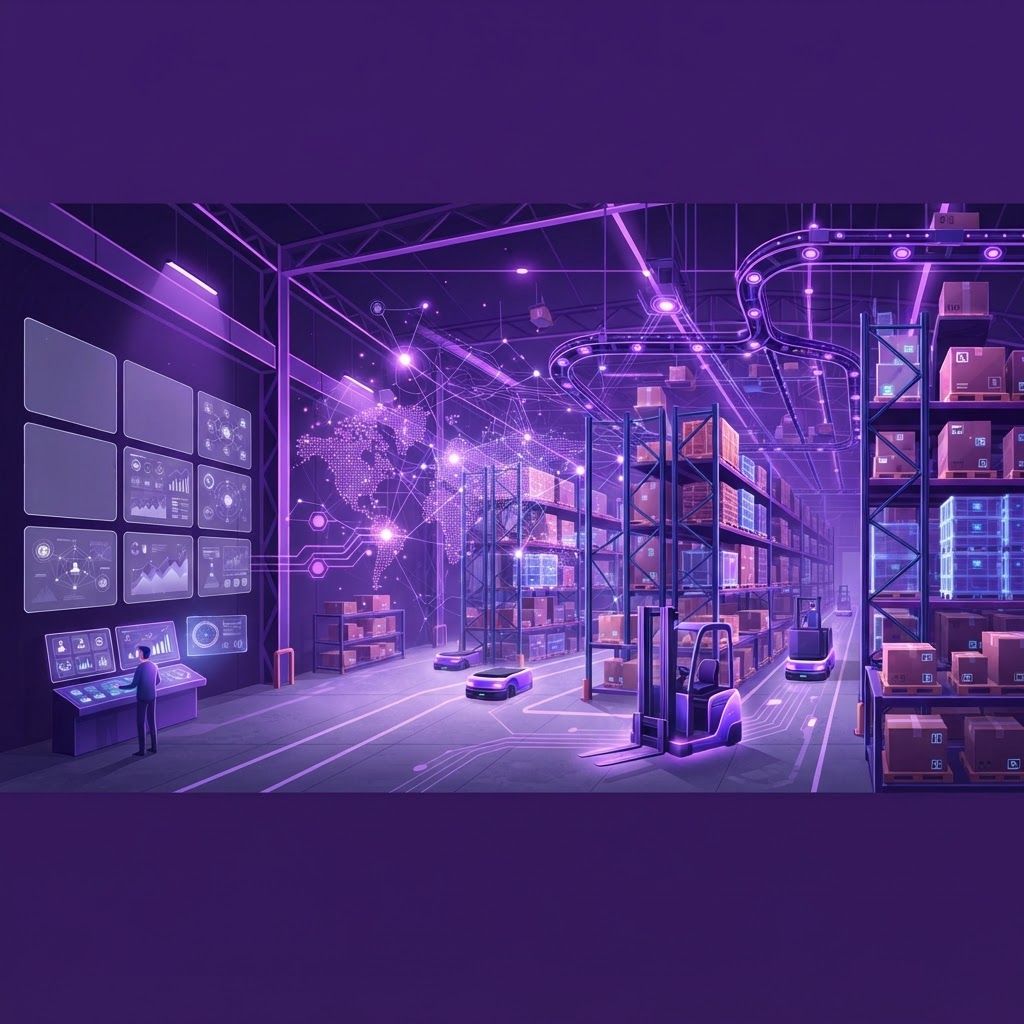
The Inland Empire as a Logistics Capital
The Inland Empire, with Fontana near its center, has become one of the most significant logistics markets on earth. The reason is straightforward: roughly forty percent of containerized imports entering the United States arrive through the Ports of Los Angeles and Long Beach, and those containers need somewhere to be unpacked, sorted, stored and redistributed. Coastal land is scarce and expensive, so the function migrated inland along the freeway and rail corridors, and Fontana was positioned perfectly to absorb it.
What resulted is an ecosystem rather than simply a collection of warehouses. Third-party logistics providers, freight forwarders, customs brokers, drayage operators, cross-dock facilities, fulfillment centers, cold storage and transportation management specialists all operate within a compact geography, which allows even small businesses to assemble sophisticated supply chains locally.
Ten Logistics Companies Operating in the Fontana Area
DHL Supply Chain is among the largest contract logistics providers globally, operating warehousing, fulfillment, transportation management and value-added services at scale. Its Inland Empire operations serve retail, technology and industrial clients, and its strength is process discipline across large, complex accounts.
XPO Logistics combines asset-based freight operations with brokerage and last-mile services, supported by proprietary technology. Companies with heavy or bulky goods requiring specialized delivery frequently use its last-mile network.
C.H. Robinson is one of the largest freight brokerage and third-party logistics firms in the world, with a non-asset model that sources capacity across thousands of carriers. Its advantage is flexibility during capacity disruptions and breadth of mode coverage, including global forwarding and customs brokerage.
Expeditors International specializes in global freight forwarding and customs brokerage with a reputation for compliance rigor and service consistency. Importers moving goods through the Southern California ports and into Inland Empire warehouses rely on providers of this type to manage documentation and clearance.
Kuehne+Nagel operates one of the largest global forwarding networks across sea, air, road and contract logistics, with strong capability in complex international shipments and specialized sectors including pharmaceuticals and aerospace.
DB Schenker provides integrated forwarding and contract logistics with substantial technology investment in supply chain visibility. Its multimodal capability suits shippers coordinating international inbound with domestic distribution.
Ryder System combines dedicated transportation, fleet leasing and maintenance with warehousing and e-commerce fulfillment. Its dedicated fleet model is particularly relevant for companies that need guaranteed daily capacity and branded delivery vehicles without operating their own fleet.
NFI Industries is a major North American third-party logistics provider with a significant Southern California footprint spanning distribution, dedicated transportation, drayage and intermodal. Its port drayage capability is directly relevant to Fontana's import-driven activity.
GEODIS delivers contract logistics, freight forwarding and e-commerce fulfillment, with omnichannel distribution capability that supports both retail replenishment and direct-to-consumer shipping from the same facility.
Regional Inland Empire third-party logistics providers complete the list. Independent operators headquartered in Fontana, Ontario, Rancho Cucamonga and Riverside offer flexible warehousing, transloading, kitting, labeling and fulfillment with shorter contract terms and more responsive account management than global providers typically extend to smaller shippers.
Understanding Third-Party Logistics Models
Asset-based providers own warehouses, trucks and equipment, offering greater control and consistency but less flexibility to scale beyond their own capacity. Non-asset providers, principally brokers and forwarders, source capacity from a network, which gives them flexibility during disruptions but less direct operational control.
Contract logistics involves dedicated facilities and staff serving a single client under multi-year agreements, appropriate for stable, high-volume operations. Shared or multi-client warehousing distributes fixed costs across several customers, which suits growing businesses and seasonal operations that cannot justify dedicated space.
Fourth-party logistics providers manage other logistics providers on a client's behalf, acting as an integrator. Larger shippers with multiple regional providers use this model to gain unified visibility and accountability.
Core Services Available Locally
Warehousing and distribution covers receiving, storage, inventory management, order picking, packing and outbound shipping, with facilities in the Fontana area ranging from older mid-century buildings to modern high-clearance distribution centers with automated systems.
Transloading and cross-docking transfer freight between modes or consolidate shipments without long-term storage, a function driven directly by container flows from the ports. Fulfillment services handle direct-to-consumer order processing with same-day or next-day pick and pack, increasingly with returns processing integrated.
Value-added services include kitting, assembly, labeling, repackaging, quality inspection and customization, which allow companies to postpone final configuration until closer to the customer. Transportation management provides carrier selection, rate negotiation, load planning, tracking and freight audit, either as software or as a managed service.
How Logistics Pricing Works
Warehousing typically bills on a combination of storage and handling. Storage is charged per pallet position, per square foot or per cubic foot, monthly or by shorter period. Handling covers receiving, put-away, picking and loading, charged per unit, per pallet or per order.
Fulfillment providers usually price per order with additional charges per line item and per unit, plus packaging materials and shipping cost passed through. Transportation is billed at negotiated rates by mode and lane, often with a management fee or margin on top for brokered capacity.
Look carefully at minimums, since monthly minimum charges are common and can make a low unit rate expensive at modest volume. Also examine onboarding and integration fees, system access charges, cycle count and inventory audit costs, and long-term storage surcharges for slow-moving inventory.
Selecting a Provider
Start with fit rather than size. A global provider optimized for hundred-million-dollar accounts will not give a growing brand the attention it needs, while a small regional operator may lack the systems to support rapid expansion. Ask directly about the size range of their typical client.
Evaluate technology and integration seriously. Warehouse management systems, inventory visibility, order status feeds and connections to your commerce platform or enterprise system determine how much manual work your team absorbs. Request specifics on integration methods and timelines rather than accepting general assurances.
Ask for performance metrics: order accuracy, on-time shipping, inventory accuracy, receiving turnaround and claims rates, with references in your industry. Understand the contract term, exit provisions and what happens to your inventory if the relationship ends, which is a detail many shippers discover too late.
Trends Shaping Fontana Logistics
Automation continues to spread, with goods-to-person systems, robotic picking and automated sortation improving throughput and reducing labor dependence in a market where warehouse labor competition is intense. Sustainability requirements are tightening, particularly around drayage emissions and building standards, which is reshaping both facility design and carrier selection.
Nearshoring and supply chain diversification are shifting some inbound volume, though the Southern California port complex remains dominant. And demand for faster delivery continues to push inventory closer to consumers, which paradoxically strengthens Fontana's position as the natural distribution point for the Western United States population.