
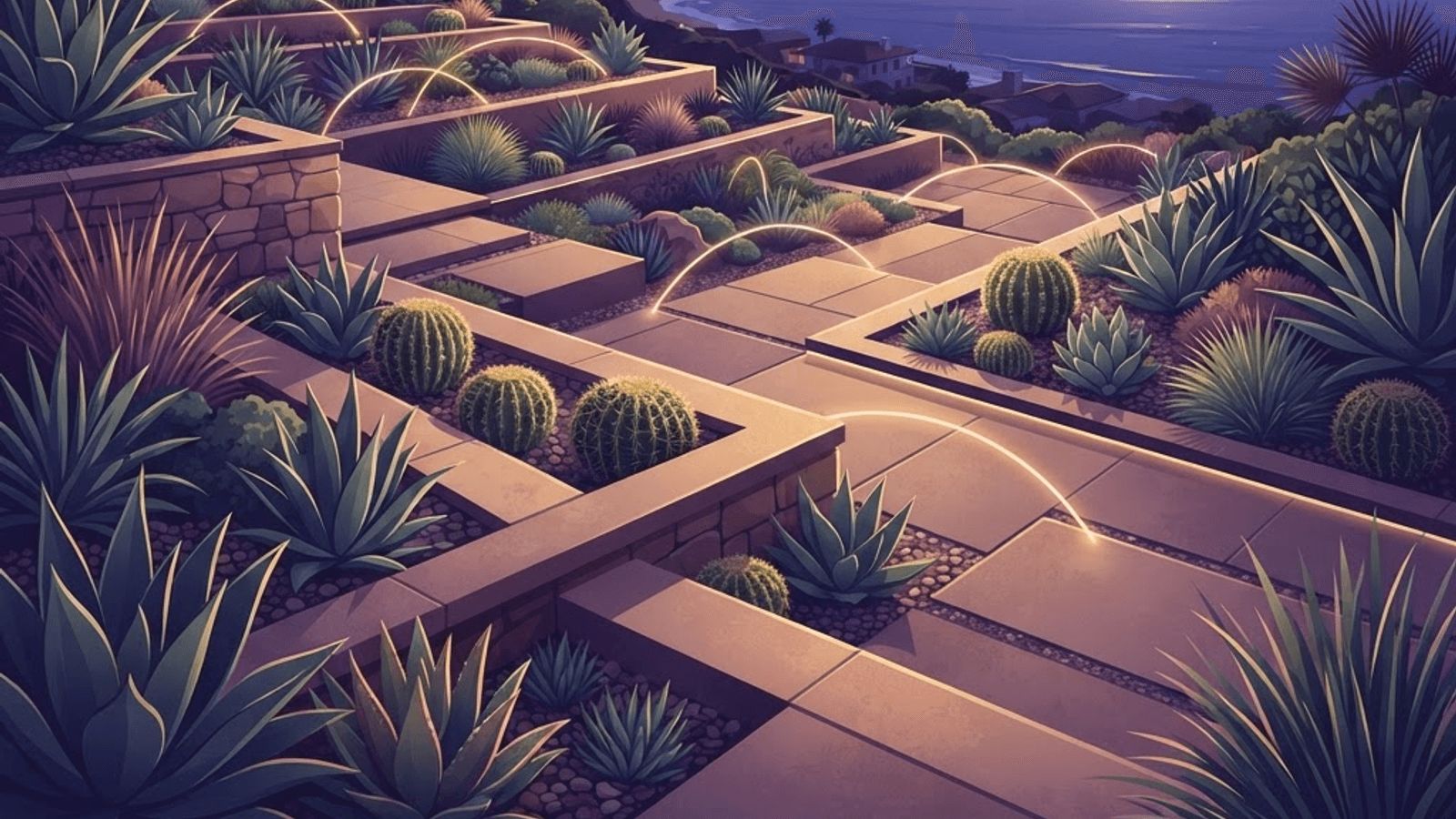
Landscaping in Oceanside operates under a distinct set of conditions. The climate supports outdoor living virtually year-round, which raises expectations for how usable a yard should be. At the same time, water availability, salt-laden coastal wind, sandy or clay-heavy soils depending on the neighborhood, and California water regulations all constrain what can realistically be planted and maintained.
Designing for a Coastal Mediterranean Climate
The most successful local landscapes work with these conditions rather than against them. Mediterranean and California native plantings thrive here because they evolved under similar rainfall patterns. Species such as manzanita, ceanothus, salvia, agave, and a wide range of ornamental grasses perform well with modest irrigation once established.
Proximity to the ocean adds another layer. Salt spray damages sensitive foliage, and wind exposure on bluff-facing properties can desiccate plants quickly. Experienced designers place salt-tolerant species on exposed perimeters and create wind buffers that protect more delicate plantings behind them.
Soil preparation matters just as much. Compacted soil sheds water rather than absorbing it, defeating even the best irrigation design. Quality contractors amend and decompact before planting, which dramatically improves long-term plant health.
What Separates the Best Landscaping Companies
Strong landscaping firms operate across three disciplines: design, installation, and maintenance. Design involves understanding how a family will actually use the space, not simply arranging plants attractively. Installation requires competence in grading, drainage, irrigation, hardscape, and lighting. Maintenance determines whether the investment looks good in year five as well as year one.
Licensing for landscape contracting, proof of insurance, and familiarity with local water use regulations are baseline requirements. Beyond that, look for firms that provide planting plans identifying species by name, irrigation schematics with zone breakdowns, and written maintenance expectations so that homeowners understand what the landscape will require.
The Top 10 Landscaping Companies in Oceanside
1. Coastal Terrain Landscape Design
A design-build firm known for drought-tolerant residential landscapes that balance native planting with usable outdoor living space. Their planting plans are noted for long-term maintainability.
2. Harbor Gardens Landscape Co.
Focused on full property transformations including grading, drainage correction, and hardscape, they are frequently hired for properties with slope or runoff issues.
3. Pacific Native Plantings
Specializing in California native and pollinator-friendly gardens, this company appeals to homeowners prioritizing habitat value and minimal irrigation.
4. North County Hardscape Builders
Concentrating on patios, retaining walls, pavers, fire features, and outdoor kitchens, they complement planting-focused designers on larger projects.
5. Mission Ridge Irrigation Systems
Irrigation specialists offering system audits, smart controller installation, and drip conversions that significantly reduce water consumption.
6. Seabreeze Grounds Maintenance
Providing recurring maintenance for residential and HOA properties, recognized for consistent crews and detailed seasonal care schedules.
7. Blue Horizon Outdoor Living
Focused on creating fully realized outdoor rooms with shade structures, integrated seating, lighting, and entertainment areas suited to year-round use.
8. Rancho Del Oro Tree Care
Certified arborist services including pruning, health assessment, root management, and safe removal, an important specialty in neighborhoods with mature trees.
9. Tidewater Turf and Synthetic Lawns
Installing both low-water turf varieties and high-quality synthetic lawn systems for households wanting usable green space with minimal irrigation.
10. Oceanside Garden Studio
A boutique operation focused on smaller urban lots, courtyards, and container-driven designs, praised for making compact spaces feel generous.
Trends Shaping Local Landscaping
Water efficiency continues to dominate. Turf replacement programs, drip irrigation conversions, and weather-based smart controllers that adjust watering according to real conditions have all moved from optional to standard. Many homeowners have replaced conventional lawn with a combination of permeable hardscape, gravel, and drought-adapted planting beds.
Habitat-conscious design is also growing. Pollinator gardens, native plant palettes, and reduced pesticide use reflect broader environmental awareness and generally produce landscapes that require less intervention over time.
Outdoor living investment remains strong. Given the climate, homeowners increasingly treat patios, shade structures, and outdoor cooking areas as extensions of interior square footage rather than optional amenities. Low-voltage landscape lighting has become nearly universal on quality installations, extending usability into the evening.
Planning a Landscape Project
Begin with a clear program. Decide how the space will be used, whether that means play area, entertaining, gardening, privacy, or simply low-maintenance curb appeal. Establish a realistic budget range early, because design decisions such as retaining walls and hardscape materials have significant cost implications.
Address drainage and grading before aesthetics. Water that pools against a foundation or runs onto a neighboring property creates problems no amount of planting will solve. Phase the work if necessary, completing infrastructure such as irrigation and hardscape first and adding planting or lighting in later stages.
Finally, plan for maintenance honestly. A landscape that looks effortless in photographs may require regular pruning and seasonal attention. Selecting a design matched to the care you are willing to provide is the single best predictor of long-term satisfaction.
Final Thoughts
A thoughtfully designed landscape improves daily life and adds measurable value to a property. The companies profiled here have earned their standing in Oceanside by understanding coastal conditions, respecting water constraints, and designing spaces that remain attractive and functional as they mature. With clear goals and the right partner, an outdoor space can become the most used part of a home.