
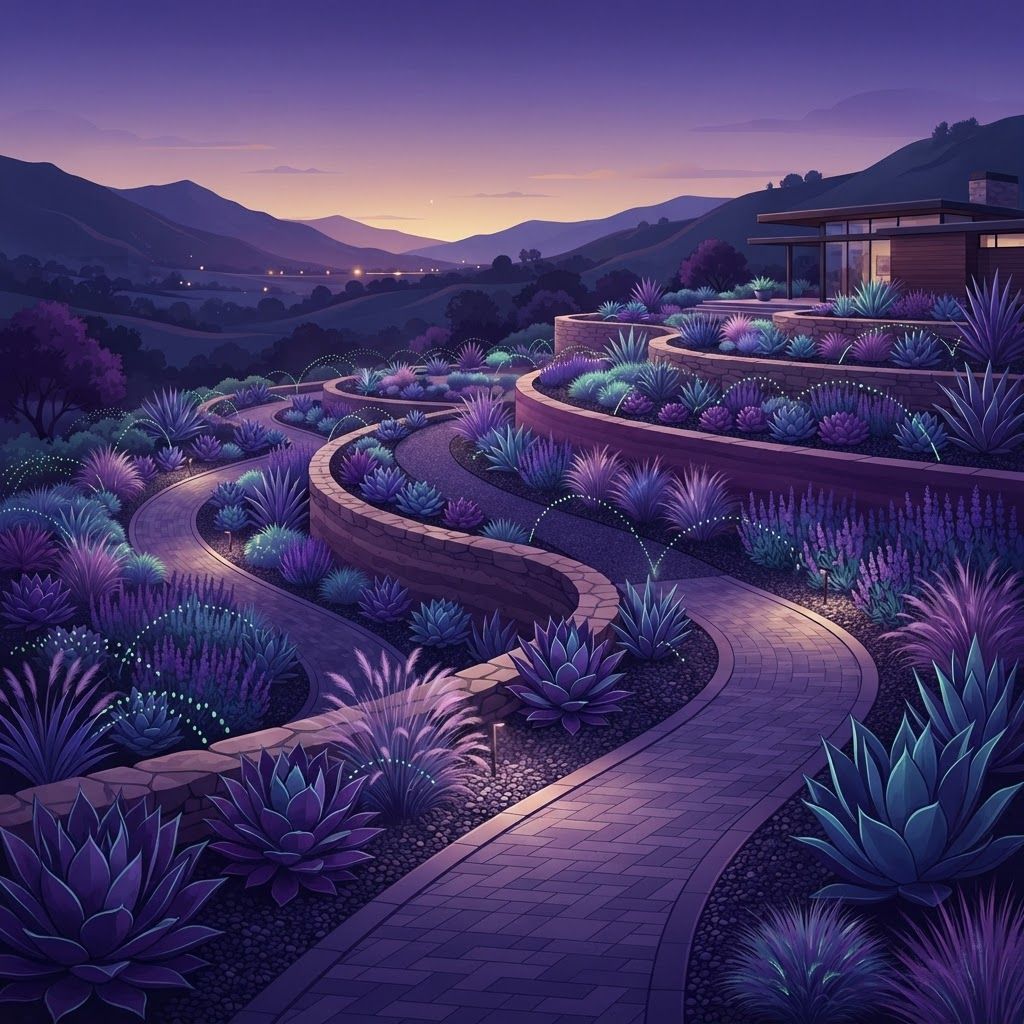
Landscaping Has Fundamentally Changed Here
A generation ago, the default Southern California yard was a rectangle of cool-season turf with a few shrubs at the perimeter. That model has largely collapsed under the weight of water costs, drought regulation, and the simple reality that maintaining a lawn through a Moreno Valley summer requires enormous irrigation. What replaced it is more interesting: layered plantings of climate-adapted species, thoughtful hardscape, and shade structures that make outdoor space usable during the hottest months.
This shift has raised the skill requirement for landscape contractors. Installing sod and pop-up sprinklers is straightforward. Designing a planting palette that looks intentional year-round, remains attractive on limited water, and matures gracefully requires genuine horticultural knowledge and design sense.
What Landscaping Companies Provide
Design services cover site analysis, planting plans, hardscape layout, lighting design, and irrigation engineering. Installation covers grading and drainage, soil preparation and amendment, planting, irrigation systems, hardscape construction, lighting installation, and mulching.
Maintenance is a separate ongoing service including mowing where turf remains, pruning, fertilization, irrigation adjustment and repair, seasonal color rotation, weed management, and pest monitoring. Some companies offer all three; others specialize.
Ten Landscaping Companies Serving Moreno Valley
Valley Verde Landscape offers full design-build service with an emphasis on drought-tolerant planting palettes and efficient irrigation, handling projects from concept drawings through installation.
Sunnymead Landscape and Design is a long-established local company known for water-wise landscape conversions, including turf removal and replacement with climate-appropriate plantings and permeable surfaces.
Inland Hardscape Specialists concentrates on the built elements: pavers, concrete, retaining walls, seat walls, outdoor kitchens, and fire features engineered for the local soil and climate.
Box Springs Irrigation Services focuses on irrigation design, repair, and efficiency retrofits including smart controllers, drip conversion, and pressure regulation that measurably reduce consumption.
Heacock Commercial Grounds Management serves business parks, warehouses, and multifamily properties with maintenance contracts and large-scale installation capability.
Alessandro Native Plant Landscapes specializes in California native and Mediterranean-climate plantings, creating habitat value alongside low water requirements.
Cactus Ridge Outdoor Living designs and builds patios, pergolas, shade structures, and outdoor entertaining areas that extend usable outdoor season in a hot climate.
March Field Tree Care handles tree planting, structural pruning, health assessment, and removal, an important specialty given the mature trees across the city's older neighborhoods.
Ironwood Landscape Maintenance provides recurring maintenance for residential and small commercial clients with consistent crews and scheduled irrigation audits.
Perris Basin Landscape Contractors is a versatile general landscaper covering installation, maintenance, and repair with competitive pricing on straightforward scopes.
Plants That Perform in This Climate
Successful plantings here share traits: heat tolerance, low water need once established, and resistance to reflected heat from walls and paving. Ornamental grasses such as deer grass and muhly provide movement and soft texture. Succulents and agaves offer strong architectural form with minimal irrigation. Shrubs like Texas ranger, rosemary, lantana, and salvia deliver flowering interest through hot months.
For trees, species with proven regional performance include desert willow, palo verde, Chinese pistache, and California sycamore in locations with adequate space. Shade trees deserve priority placement on west and south exposures, where they reduce cooling load and make patios usable.
Avoid the temptation to fill a yard entirely with gravel and a few accent plants. That approach saves water but increases reflected heat substantially and looks stark. Layered plantings with meaningful canopy actually cool the space and are far more pleasant to occupy.
Irrigation Efficiency Is Where the Savings Are
Outdoor use dominates household water consumption in this climate, so irrigation efficiency delivers the largest possible savings. Drip irrigation applies water directly at the root zone with minimal evaporation loss, outperforming spray heads dramatically for shrubs and trees.
Smart controllers that adjust schedules based on weather data prevent the common problem of systems running the same duration in October as in July. Pressure-regulating heads and check valves eliminate misting and low-head drainage that waste water invisibly.
Hydrozoning — grouping plants with similar water requirements on the same valve — prevents the compromise of overwatering drought-tolerant plants to satisfy thirstier neighbors. This is a design decision that pays out over the entire life of the landscape.
Hardscape, Drainage, and Grading
Hardscape defines how a yard functions. Patios, pathways, and seating areas turn a viewing space into a living one. Material selection matters in this climate: light-colored pavers stay significantly cooler underfoot than dark concrete, and permeable systems allow rainfall infiltration rather than runoff.
Drainage deserves serious attention despite low annual rainfall, because when rain does arrive it often comes hard. Positive grading away from the structure, area drains at low points, and swales that direct flow safely prevent the foundation and hardscape damage that poorly graded yards suffer.
Choosing a Landscaping Company
Verify the contractor holds an active C-27 landscaping license for installation work, along with insurance and workers' compensation. Review a portfolio of installations that are several years old rather than newly planted, because that reveals how their designs mature.
Ask about plant warranties and establishment care. New plantings need attentive irrigation for the first year, and a contractor who explains that clearly and offers a maintenance transition period is setting the project up to succeed rather than simply finishing an installation.
Final Thoughts
A well-designed landscape in Moreno Valley reduces water bills, moderates temperature around the home, and creates outdoor space that is genuinely usable rather than merely visible. The shift toward climate-appropriate design has produced more visually interesting yards than the lawns they replaced, and local contractors have developed real expertise in that idiom. Invest in design, prioritize irrigation efficiency, plant for shade, and choose a company whose mature installations look the way you want your yard to look in five years.