
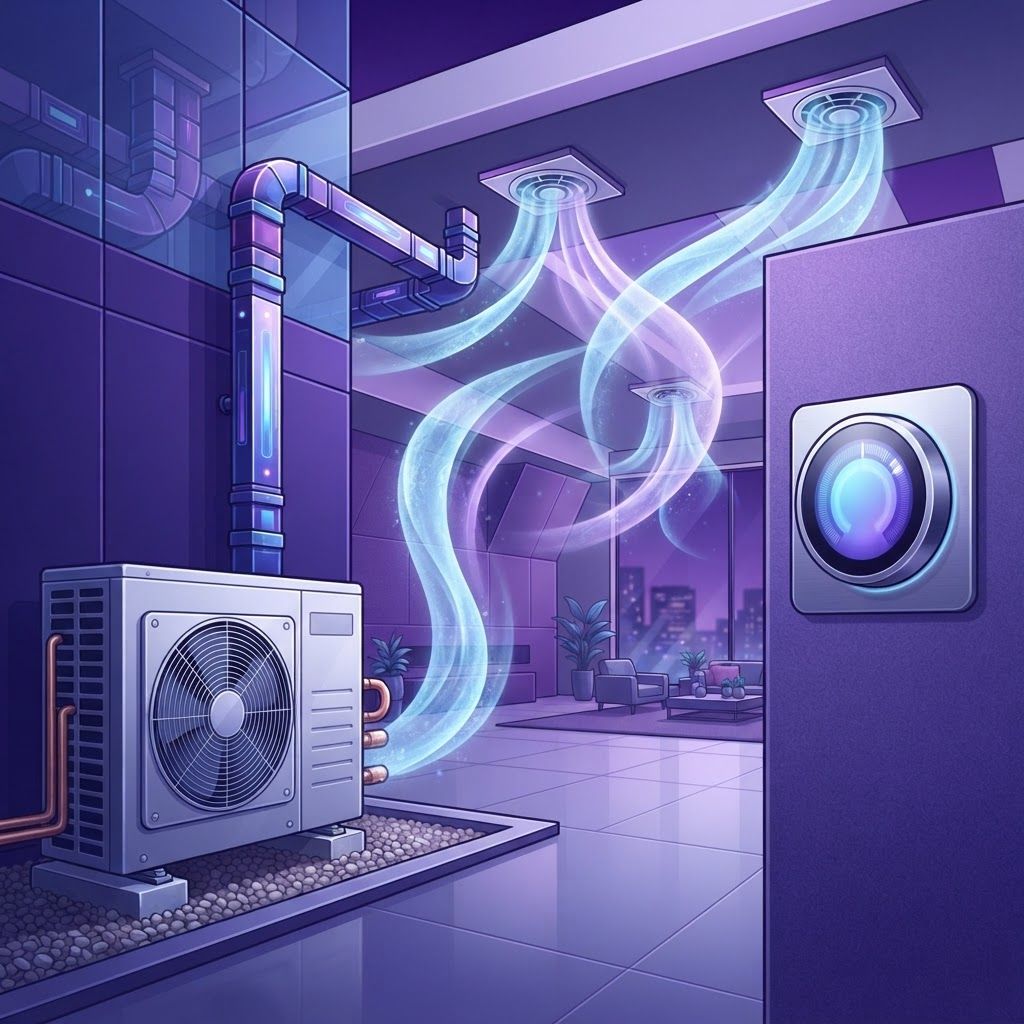
Why HVAC Performance Matters So Much Here
Central North Carolina presents a genuinely challenging climate for heating and cooling equipment. Summers combine high temperatures with sustained humidity, meaning an air conditioner must remove substantial moisture in addition to lowering temperature. Winters are mild enough that heat pumps perform efficiently but cold enough that supplemental heat is occasionally necessary. Shoulder seasons swing between both extremes within a single week.
The consequence is that HVAC systems in Cary run for a large share of the year, and equipment selection and installation quality translate directly into comfort and operating cost. Poorly installed systems are common, and industry studies have long shown that installation errors reduce real-world efficiency well below rated performance.
Equipment Options Worth Understanding
Heat pumps dominate the market in this region and for good reason. They provide both heating and cooling from a single system and operate efficiently in the moderate winter temperatures typical here. Modern variable-speed and inverter-driven heat pumps maintain comfort far more consistently than older single-stage units, running longer at lower capacity rather than cycling on and off.
Gas furnaces paired with air conditioners remain common in homes with existing gas service, offering strong heating performance during cold snaps. Ductless mini-split systems serve additions, bonus rooms, garages, and sunrooms where extending ductwork is impractical, and they allow zoned control that reduces energy waste. Dual-fuel systems combine a heat pump with a gas furnace, switching between them based on outdoor temperature and relative operating cost.
The Top 10 HVAC Companies in Cary
1. Triangle Climate Services. A full-service contractor performing Manual J load calculations on every installation rather than sizing by square footage, which is the single strongest predictor of long-term satisfaction.
2. Cary Comfort Systems. Known for high-efficiency heat pump installations and for correcting duct problems as part of equipment replacement rather than reusing inadequate existing ductwork.
3. Cornerstone Heating and Air. A long-established firm offering twenty-four hour service, maintenance agreements, and transparent flat-rate repair pricing.
4. Bluewater HVAC Company. Specializes in ductless mini-split and multi-zone systems, a valuable capability for additions, home offices, and older homes without ductwork.
5. Northgate Air Solutions. Focused on indoor air quality including whole-house dehumidification, filtration upgrades, and ventilation systems tailored to humid conditions.
6. Pinnacle Mechanical Services. A commercial contractor handling rooftop units, building automation, and preventive maintenance contracts for offices and retail properties.
7. Heritage Heating and Cooling. Serves older homes, frequently redesigning duct layouts that were inadequate from the original construction rather than simply swapping equipment.
8. Summit Comfort Group. Known for detailed system commissioning, including airflow measurement and refrigerant charge verification documented and provided to the homeowner.
9. Oakline Climate Control. A mid-size family business valued for honest repair-versus-replace recommendations rather than defaulting to replacement on every service call.
10. Cardinal HVAC Services. Offers competitive pricing on standard replacements with solid workmanship, popular with homeowners seeking dependable equipment without premium features.
The Sizing Mistake That Causes Most Problems
Oversized air conditioning is the most widespread HVAC error in residential construction. An oversized unit cools the air quickly, satisfies the thermostat, and shuts off before it has run long enough to remove humidity. The house feels cold and clammy rather than comfortable, and short cycling wears components prematurely while wasting energy.
Correct sizing requires a load calculation accounting for square footage, insulation levels, window area and orientation, air leakage, ceiling height, and occupancy. Any contractor who determines system size by looking at the old equipment or applying a rule of thumb per square foot is guessing. Insist on a written load calculation before accepting a replacement proposal.
Ductwork Deserves Equal Attention
Duct systems in many homes leak substantially, losing conditioned air into attics and crawl spaces. Undersized returns restrict airflow, straining equipment and creating pressure imbalances between rooms. Replacing equipment without addressing these issues delivers far less improvement than homeowners expect.
Quality contractors inspect ductwork, measure static pressure, seal accessible joints with mastic, and recommend modifications where airflow is inadequate. This work is unglamorous and rarely featured in advertising, but it frequently produces larger comfort gains than upgrading to a higher efficiency rating.
Maintenance and Indoor Air Quality
Twice-yearly maintenance, before cooling season and before heating season, extends equipment life and preserves efficiency. Essential tasks include coil cleaning, condensate drain clearing, refrigerant charge verification, electrical connection inspection, and filter replacement. Clogged condensate drains are a leading cause of water damage in attic-mounted systems and are trivially preventable.
Indoor air quality has drawn increasing attention. Whole-house dehumidifiers maintain comfortable humidity during mild, damp weather when the air conditioner runs little. Higher-efficiency media filters capture finer particles than basic filters without restricting airflow the way undersized high-MERV filters can. Fresh air ventilation is increasingly relevant as homes are built tighter.
Final Thoughts
HVAC is one of the few home systems where installation quality matters as much as the equipment purchased. Prioritize contractors who calculate loads, evaluate ductwork, commission systems with measurements, and document what they did. The companies above have earned strong reputations in Cary by treating heating and cooling as an engineering problem rather than a box swap.