
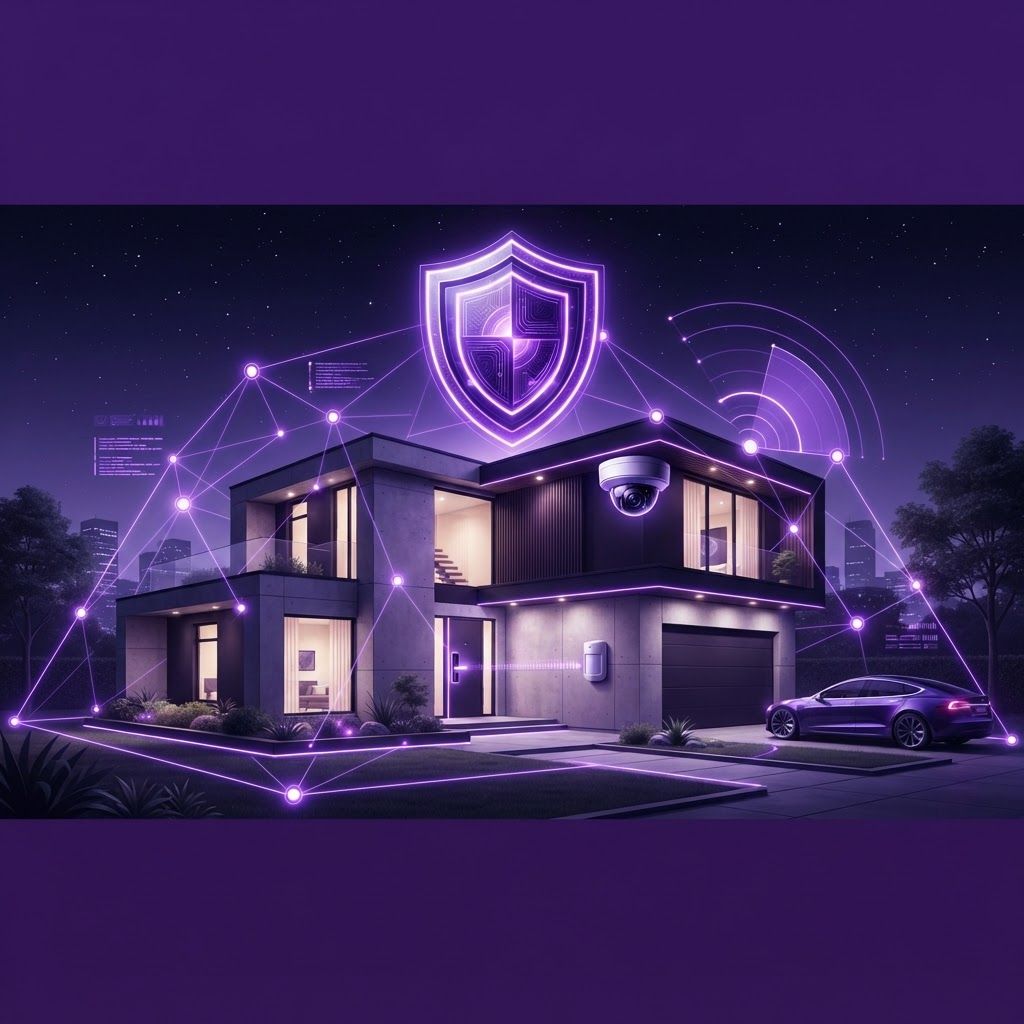
Security as Layered Protection
Effective home security is rarely about a single device. It works through layers, each addressing a different stage of a potential intrusion. The outermost layer deters, discouraging an intruder from selecting the property at all. The next layer delays, making entry slow and difficult. The third detects, alerting occupants or a monitoring service. The final layer documents, providing evidence for investigation.
Households frequently invest heavily in one layer while neglecting the others. Installing several cameras while leaving a weak rear door secured only by a basic lock produces good documentation of an intrusion that could have been prevented. A balanced approach across all four layers delivers considerably better protection for the same budget.
Components of a Modern Security System
Video surveillance remains the most visible component. Contemporary systems offer high-resolution imaging, infrared night vision, motion-triggered recording and cloud or local storage. Camera placement matters more than camera count, with entry points, approach paths and blind corners taking priority over broad general views.
Intrusion detection uses door and window contacts, motion sensors and glass-break detectors to identify entry attempts. These integrate with alarm sounders and notification systems.
Access control covers smart locks, video door phones and gate automation, allowing residents to verify and admit visitors without opening a door. Video door phones with recording capability have become popular in Salem apartments and independent houses alike.
Monitoring and notification connect the system to residents through mobile applications, and in some cases to professional monitoring services that respond to alerts. Perimeter security including boundary walls, gates, grilles and lighting forms the foundation beneath all of this.
Ten Home Security Companies in Salem
Salem Secure Systems provides integrated residential security combining cameras, sensors and access control under a single coordinated design.
Kongu Surveillance Solutions specialises in camera systems for homes and small businesses with attention to placement and coverage planning.
Annai Smart Security focuses on smart home integrated security, connecting locks, cameras and sensors into a unified application.
Bharath Safety Systems handles alarm systems and intrusion detection alongside fire and smoke detection for comprehensive household safety.
Everest Access Control works on gate automation, biometric access and video door phone systems for residences and gated communities.
Green Field Security Technologies emphasises solar-powered and low-consumption security equipment suited to locations with supply interruptions.
Vaigai CCTV Services provides installation and maintenance of surveillance systems with structured servicing to prevent silent equipment failure.
Meenakshi Home Automation and Security combines security with broader home automation including lighting and appliance control.
Sakthi Monitoring Services offers monitored alarm arrangements with response protocols for residential clients.
Sri Murugan Security Solutions rounds out the list with locks, grilles, safes and physical security hardware alongside electronic systems.
Planning a System That Actually Works
Begin with an honest assessment of vulnerabilities. Walk the property and identify how someone would realistically attempt entry. Rear and side access points, ground floor windows, poorly lit approaches and boundary walls with convenient climbing aids are typical weaknesses.
Address physical security before electronics. Quality locks on all external doors, secure window fastenings, a solid main door and adequate external lighting provide more practical protection per rupee than additional cameras. Motion-activated lighting is particularly effective as a deterrent.
Position cameras purposefully. Cover every entry point at a height and angle that captures faces rather than the tops of heads. Ensure the approach path is covered so an intruder is recorded before reaching the door. Protect the recording device itself in a concealed, secure location, since an unprotected recorder can simply be removed.
Verify that the system remains functional during a power cut. Battery backup for cameras, recorders and network equipment is essential, as an outage is precisely when a system most needs to work.
Privacy and Practical Considerations
Camera placement should respect neighbours' privacy, avoiding views into adjacent private spaces. Within the home, avoid placing cameras in private areas, and secure the system with strong, unique credentials.
Default passwords on network cameras are a well-documented vulnerability. Change them immediately, keep firmware updated and place devices on a network segment separated from personal computers where possible.
Plan for maintenance. Cameras accumulate dust and spiderwebs that degrade images, lenses lose focus over time and storage drives fail. A system nobody checks often turns out to have stopped recording months earlier, discovered only when footage is needed.
Trends in Home Security
Wireless and battery-powered cameras have simplified installation considerably, particularly for retrofitting existing homes. Cloud storage with local backup has become common, protecting footage even if on-site equipment is stolen.
Video analytics including person detection and zone-based alerts reduce false notifications from moving vegetation or passing vehicles, which is the main reason households eventually ignore alerts.
Integration with broader home automation is growing, allowing lighting to respond to detected motion and creating occupancy simulation when residents are away.
Final Thoughts
Home security in Salem works best when planned as a system rather than assembled from individual purchases. Strengthen physical barriers first, light the property well, position detection and cameras deliberately, and maintain the installation so it functions when needed. Companies that survey the property and explain their reasoning deliver far better outcomes than those who simply quote for a fixed number of cameras.