
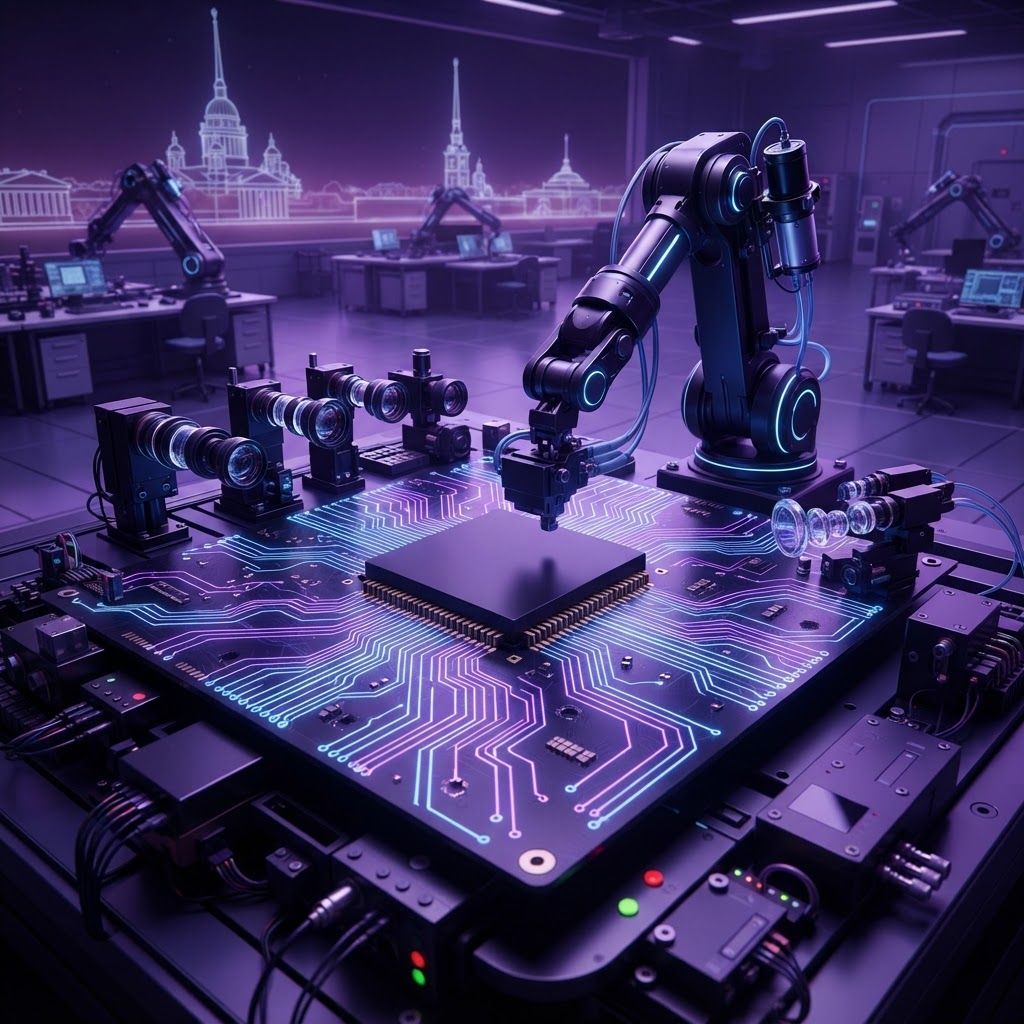
An Industrial City With an Engineering Memory
Long before software, St. Petersburg was an engineering city. Shipbuilding, instrument making, optics and electrical machinery built an industrial culture that still shapes local manufacturing: strong metrology, tolerance for long development cycles and comfort with complex mechanical-electronic integration. That inheritance matters, because precision hardware cannot be improvised by teams without institutional experience.
Today the local hardware landscape mixes long-established enterprises with newer entrants in computing and electronics assembly. Buyers can find optics, sensors, power electronics, navigation instruments, electronic components and server systems within a single metropolitan area, which shortens supply chains and simplifies technical collaboration.
Ten Manufacturers Shaping Local Hardware
LOMO is one of the city's most recognisable names, with a long history in optical and optoelectronic instruments including microscopes, telescopes, medical optics and specialised imaging systems. Optical manufacturing depends on accumulated craft in grinding, coating and alignment that is very difficult to replicate quickly.
Svetlana has deep roots in electronic components and semiconductor devices, historically producing vacuum devices and later semiconductor products. Component manufacturers of this lineage typically serve industrial, energy and specialist equipment markets where longevity and supply continuity outweigh consumer trends.
Avangard works in microelectronics, sensor systems and electronic module assembly, and has been active in developing sensor and monitoring solutions for infrastructure. Sensor manufacturing sits at the intersection of physics and production engineering, demanding careful calibration and environmental testing.
YADRO maintains substantial research, development and engineering activity in the city, focused on servers, storage systems and computing platforms. Designing enterprise storage and server hardware requires firmware, thermal, mechanical and reliability engineering to advance in parallel, which is a rare combination.
Concern CSRI Elektropribor is a leading institution in navigation and gyroscopic systems, producing high-precision inertial instruments used in marine and aerospace applications. Inertial navigation is among the most demanding fields in instrument engineering, where nanoscale drift matters.
Kirovsky Zavod represents heavy engineering, manufacturing machinery, power equipment and industrial systems. Its relevance to modern technology buyers lies in industrial automation components and the integration of control electronics into large mechanical systems.
Elektrosila continues the city's tradition in electrical machine building, producing generators, turbogenerators and large electrical equipment for the energy sector. Power engineering hardware demands extraordinary reliability, since failures affect entire grids.
Zvezda manufactures diesel engines and power units, with an engineering focus on high power density and marine duty cycles. This is classic mechanical-industrial manufacturing where materials science and thermal engineering dominate.
Rossiyskaya Elektronika enterprises in the region collectively produce electronic components, radio equipment and specialised modules. Buyers of components typically care most about qualification documentation, lifecycle guarantees and second-source availability.
Contract electronics manufacturers in the St. Petersburg cluster complete the list, offering printed circuit board assembly, testing and box build services for hardware startups and industrial customers. Access to competent local assembly dramatically reduces iteration time during product development.
What to Assess When Sourcing Hardware
Hardware procurement differs fundamentally from software. Lead times are long, changes are expensive, and quality problems surface after deployment. Start with qualification evidence: environmental testing, electromagnetic compatibility, vibration and thermal cycling results appropriate to your application. Ask for failure rate data and warranty history rather than accepting general reliability claims.
Examine supply chain resilience. Which components are single sourced, what are their lifecycle statuses, and what is the plan when a part goes end of life? A manufacturer with disciplined component management protects you from redesign costs years later. Confirm production capacity honestly, including whether your volumes are a priority or a rounding error for the supplier.
Design Collaboration and Intellectual Property
When commissioning custom hardware, agree the boundary between the manufacturer's existing intellectual property and newly created designs before engineering begins. Specify who owns schematics, firmware, mechanical drawings and test fixtures, and secure the right to transfer manufacturing if the relationship ends. Insist on documentation quality as a deliverable, since undocumented hardware is effectively unmaintainable.
Plan the prototype sequence realistically. Engineering samples, verification builds and pilot production each serve different purposes, and compressing them rarely saves time overall. Building in a design review after each stage catches problems while they are still cheap to fix.
Trends in Local Hardware Manufacturing
Several shifts are visible. Localisation of electronics assembly has accelerated, increasing demand for regional contract manufacturing and component supply. Computing hardware development has grown, with server and storage engineering expanding in the city. Sensor and industrial internet of things products are being integrated into infrastructure monitoring, from utilities to transport. Meanwhile the convergence of software and hardware roles continues, with firmware quality increasingly determining product competitiveness.
Final Thoughts
St. Petersburg's hardware sector combines historical depth in optics, instruments and electrical machinery with newer strength in computing and electronics assembly. Buyers benefit most by engaging manufacturers early, insisting on rigorous qualification evidence, and treating documentation and supply chain planning as first-class requirements. Hardware rewards patience and precision, and the city's engineering culture is well suited to both.