
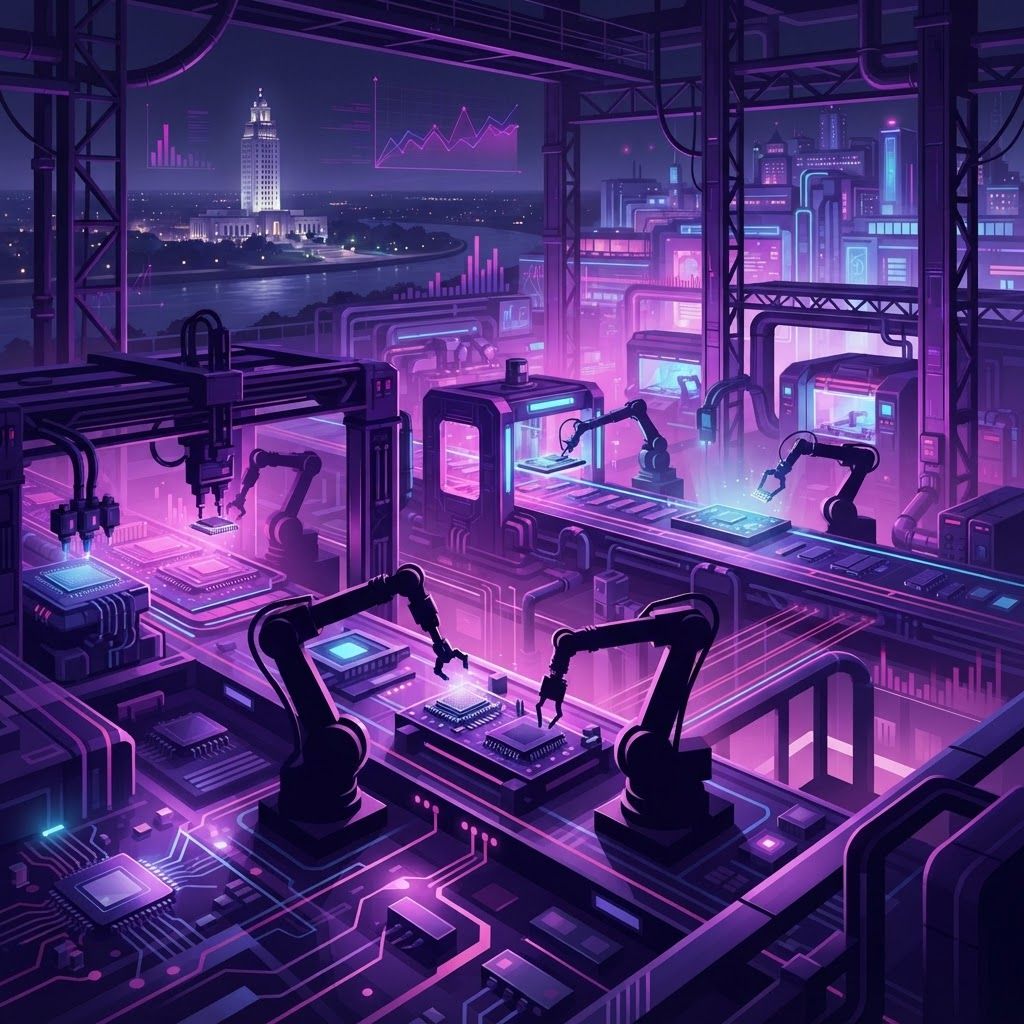
Why Baton Rouge Is a Serious Hardware Manufacturing City
Baton Rouge is often described through the lens of its refineries and river commerce, but the capital region has built something more layered than that. Decades of petrochemical investment along the Mississippi River corridor created a deep bench of fabricators, machinists, instrumentation specialists, and controls engineers. That talent pool now supports a much wider range of hardware manufacturing, from precision metal components and modular process skids to electrical assemblies, control panels, and automation hardware used across North America.
The city's advantages are structural rather than accidental. Deepwater port access on the Mississippi River, intersecting interstate corridors, competitive industrial power costs, and a steady pipeline of engineering graduates from Louisiana State University and Baton Rouge Community College give manufacturers a genuine cost and logistics edge. Louisiana's industrial tax exemption programs and workforce training initiatives have also encouraged companies to expand fabrication capacity locally instead of outsourcing it.
What Separates a Great Manufacturer From an Average One
Buyers evaluating hardware manufacturers in Baton Rouge tend to weigh four things: certified quality systems, in-house engineering depth, schedule reliability, and safety performance. Certifications such as ISO 9001, ASME code stamps, AWS-qualified welding procedures, and UL listings for electrical assemblies signal that a shop can document its work, not just produce it. Engineering depth matters because most industrial buyers arrive with a performance requirement rather than a finished drawing set, and the strongest local shops can take a project from concept through detailed design, fabrication, testing, and field installation.
Schedule reliability is the quiet differentiator. In a market where a delayed turnaround can idle an entire process unit, manufacturers that hold delivery dates earn repeat business for decades. Safety performance carries similar weight, since major industrial clients screen suppliers on recordable incident rates before a quote is ever reviewed.
The Top 10 Hardware Manufacturers in Baton Rouge
1. Turner Industries
Turner Industries is one of the largest industrial contractors and fabricators headquartered in Baton Rouge, with extensive pipe fabrication, structural steel, and modular assembly capabilities. Its scale allows it to handle multi-thousand-ton fabrication packages while maintaining code compliance and rigorous quality documentation. Turner is frequently chosen for large capital projects where fabrication, maintenance, and specialty services need to come from a single accountable source.
2. Cajun Industries
Cajun Industries is a Baton Rouge-based heavy industrial firm known for civil construction paired with strong fabrication and equipment manufacturing capacity. The company produces structural steel assemblies, tanks, and custom industrial hardware, and it is widely respected for self-performing difficult scopes rather than subcontracting them. Its reputation rests on engineering-driven problem solving in demanding riverfront and refinery environments.
3. ISC Constructors
ISC Constructors specializes in electrical, instrumentation, and control systems, including the manufacture of custom control panels, motor control centers, and pre-engineered electrical buildings. For clients modernizing legacy plants, ISC combines panel shop production with systems integration expertise, which shortens commissioning timelines considerably. Its Baton Rouge operations serve industrial, power generation, and infrastructure customers throughout the Gulf Coast.
4. Performance Contractors
Performance Contractors is a major Baton Rouge industrial firm with fabrication shops supporting pipe, structural, and vessel work. The company is valued for its ability to mobilize large craft workforces quickly and for the consistency of its shop-fabricated deliverables. Clients often cite predictable quality and disciplined project controls as the reasons they return.
5. Coastal Bridge Company
Coastal Bridge Company manufactures and installs heavy structural and infrastructure components, including bridge girders, precast elements, and specialty steel assemblies. Its Baton Rouge base gives it direct river and highway access, an important advantage when moving oversized fabricated hardware. The firm has become a dependable partner for public infrastructure and private industrial foundations alike.
6. Excel Group
Excel Group provides fabrication, mechanical, and specialty industrial services with shop capabilities covering piping spools, skid packages, and equipment refurbishment. It appeals strongly to mid-market manufacturers that need responsive engineering support without the overhead of a mega-contractor. Turnaround speed and hands-on project management are its notable strengths.
7. Gulf Coast Machine and Fabrication Partners
Baton Rouge supports a cluster of precision machine and fabrication shops that produce shafts, flanges, custom fittings, wear components, and replacement parts for process equipment. These shops thrive on tight-tolerance CNC machining, reverse engineering of obsolete parts, and emergency production runs during unplanned outages. For plants running decades-old equipment, this local capability is often the difference between a short repair and a long shutdown.
8. Industrial Instrumentation and Sensor Assemblers
A growing segment of Baton Rouge hardware manufacturing focuses on instrumentation assemblies, sensor housings, analyzer shelters, and calibration hardware. These producers pair electronics assembly with rugged enclosure fabrication designed for humid, corrosive, and classified environments. Their work underpins the process automation and emissions monitoring systems that modern facilities depend on.
9. Modular Process Skid Builders
Modular construction has reshaped capital project delivery, and several Baton Rouge fabricators now specialize in building complete process skids and equipment modules in controlled shop conditions. Shop assembly improves weld quality, reduces field labor risk, and compresses schedules. Buyers choose these manufacturers when site congestion or weather exposure makes stick-built construction impractical.
10. Electronics and Technology Hardware Startups
The newest layer of the local ecosystem consists of small technology hardware companies emerging from the LSU research and entrepreneurship community. These teams design IoT sensor devices, ruggedized computing enclosures, environmental monitoring hardware, and agricultural technology products. They are small by revenue but strategically important, because they diversify a manufacturing base historically tied to a single industry.
Industry Trends Shaping Local Production
Three trends dominate conversations among Baton Rouge manufacturers. First, automation adoption is accelerating, with robotic welding cells, CNC plasma cutting, and digital fabrication tracking becoming standard in competitive shops. Second, energy transition projects such as hydrogen, carbon capture, and renewable fuels are creating demand for new equipment configurations and higher-specification materials. Third, workforce development has become a board-level concern, prompting deeper partnerships with technical colleges and expanded apprenticeship programs.
How to Choose the Right Manufacturing Partner
Start by matching project complexity to shop capability rather than defaulting to the largest available vendor. Request documented quality procedures, welder qualification records, and recent project references in your specific industry. Visit the shop floor if possible, since housekeeping, material traceability practices, and equipment condition reveal more than a capability brochure. Finally, clarify how change orders, inspection holds, and delivery logistics will be handled before work begins.
Final Thoughts
Baton Rouge offers an unusually deep manufacturing bench for a city its size, spanning heavy industrial fabrication, precision machining, electrical assembly, and emerging technology hardware. The companies above represent the range of that capability, from multi-billion-dollar contractors to specialized shops solving narrow but critical problems. For buyers, the practical takeaway is that most hardware requirements can be sourced locally, with shorter lead times and closer engineering collaboration than distant suppliers can realistically provide.