
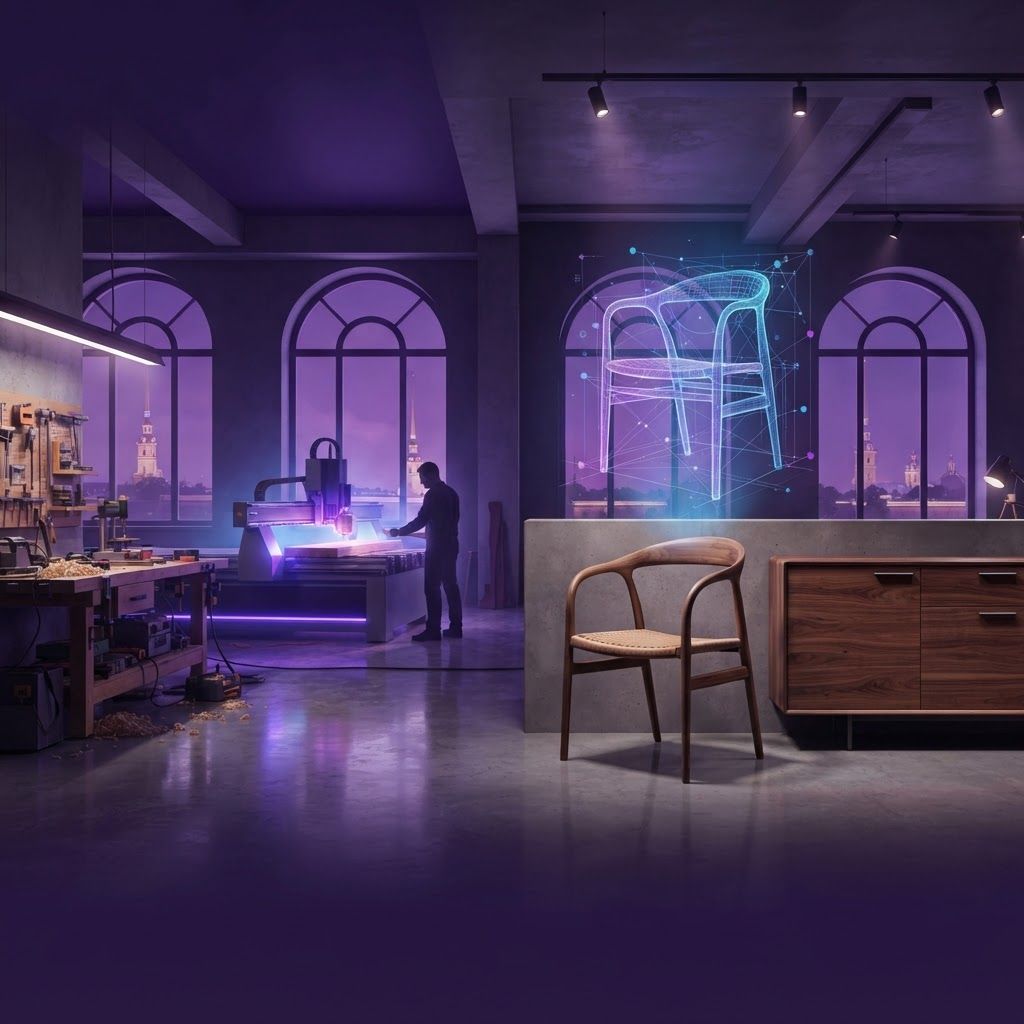
Craft Tradition Meeting Contract Scale
Furniture making in St. Petersburg carries a distinctive inheritance. A city filled with palaces, grand apartments and historic interiors created generations of demand for skilled joinery, veneering, gilding and upholstery. Much of that knowledge survives, and it explains why the city still supports restoration workshops and bespoke cabinetmakers that would struggle to exist in a purely volume-driven market.
Alongside that craft layer sits a thoroughly modern contract furniture industry. Hotels, offices, universities and healthcare facilities across the region need durable, standards-compliant furniture in quantity, and local manufacturers with CNC machining, edge-banding lines and industrial finishing capacity serve that demand. The two worlds occasionally overlap, particularly on heritage hotel projects where new furniture must sit convincingly alongside restored originals.
How to Judge Furniture Quality
Most buyers evaluate furniture visually, which is exactly how poor construction gets sold. The meaningful indicators are structural. In case goods, look at joinery: dowelled and glued or dovetailed joints outlast staples and knock-down fittings by years. Check whether drawer bottoms sit in grooves or are simply pinned to the underside, and whether the back panel is recessed into a rebate or nailed flat.
In upholstery, the frame determines lifespan. Kiln-dried hardwood frames with corner blocking survive decades; softwood frames with stapled joints loosen within a few years of commercial use. Ask about seat suspension — eight-way hand-tied springs, sinuous springs and webbing all behave differently — and about foam density, expressed as a number rather than as the word firm.
For contract projects, certification is non-negotiable. Fire performance of upholstery, structural test ratings for seating and formaldehyde emission classes for panel products are all commonly specified, and manufacturers accustomed to contract work will supply test reports without hesitation.
Ten Furniture Manufacturers Worth Knowing
Neva Furniture Factory is among the largest local producers of case goods and wardrobes, combining panel processing automation with a broad standard range and configurable options.
Baltic Contract Interiors concentrates on hospitality and office fit-out, delivering coordinated packages of casegoods, seating and joinery to project timelines rather than as catalogue orders.
Petrograd Cabinetmakers represents the bespoke end, producing hand-finished veneered furniture and architectural joinery, including work for heritage properties requiring period-appropriate techniques.
Northern Upholstery Works specialises in sofas and soft seating, offering frame construction options and a substantial fabric library alongside contract-grade fire compliance.
Admiralty Marine Furniture builds fixed and modular furniture for vessels and offshore accommodation, where weight, fixing method and fire performance are tightly constrained.
Fontanka Design Studio Furniture works with architects and designers on limited-run contemporary pieces, bridging design intent and manufacturability.
Vyborg Solid Wood Products focuses on solid timber furniture — tables, chairs and beds — with careful attention to moisture content and seasonal movement.
Ladoga Office Systems produces desking, storage and acoustic partitioning for workplaces, including height-adjustable systems now standard in most office specifications.
Kolpino Panel Furniture operates at volume in flat-pack and ready-to-assemble products, supplying retailers and housing developers where cost and packaging efficiency dominate.
Aurora Restoration Workshop handles conservation and restoration of antique furniture, combining traditional finishing skills with modern analytical assessment of original materials.
Trends Influencing the Industry
Sustainability now shapes specification meaningfully. Certified timber, low-emission adhesives, water-based finishes and design for disassembly appear routinely in tender documents. Manufacturers able to document material origin and end-of-life recyclability increasingly win contract work over those who cannot.
Flexible and hybrid workplace design has changed office furniture demand fundamentally. Fixed rows of desks have given way to reconfigurable settings, acoustic pods and softer collaborative furniture, favouring manufacturers with modular systems rather than fixed product ranges.
Digital fabrication is the third shift. CNC nesting, automated edge-banding and digital cut optimisation have narrowed the cost gap between standard and customised products, making short-run bespoke furniture viable at prices that would have been impossible with purely manual methods.
Practical Advice Before You Commit
Request a sample or prototype for any order of consequence, and use it hard. Sit in the chair for an hour, open and close the drawers a hundred times, and inspect the finish under strong light. For contract projects, agree a control sample that becomes the quality benchmark for the whole delivery.
Clarify lead times honestly and understand what drives them — imported fabric and specialist veneer are common causes of delay. Confirm delivery and installation scope, particularly for buildings with restricted access, which is a frequent complication in the city's historic centre. Finally, check warranty terms and the availability of replacement parts, since a broken mechanism should not require replacing an entire item.
Final Thoughts
St. Petersburg's furniture manufacturers offer both genuine craftsmanship and industrial contract capability, often within a short distance of each other. Judge construction rather than appearance, insist on certification for commercial projects, and match the manufacturer's specialism to whether you need a hundred identical desks or one irreplaceable cabinet.