
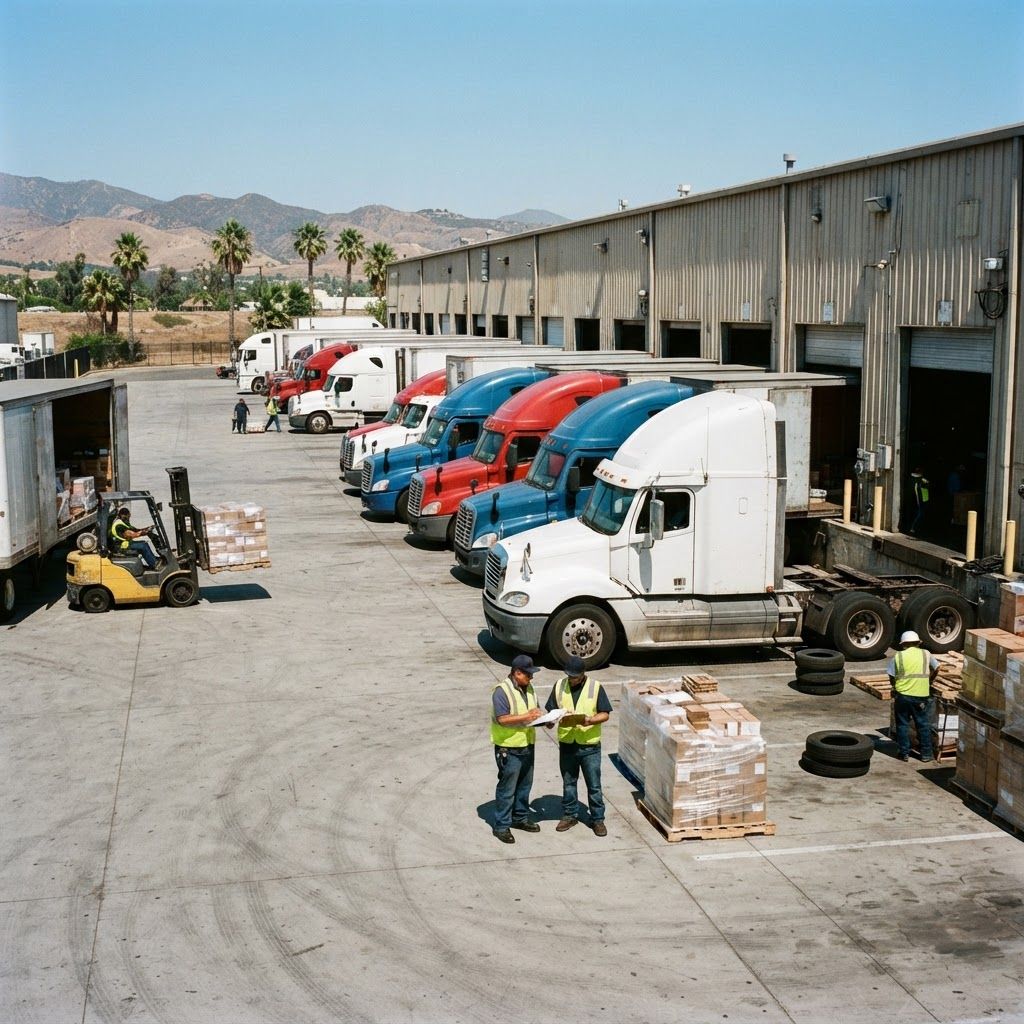
Chula Vista's Place in the Freight Economy
Few American cities sit at a more consequential freight crossroads than Chula Vista. To the south lies one of the busiest land border crossings in the Western Hemisphere, feeding a manufacturing corridor that produces electronics, medical devices, and automotive components. To the north sits the Port of San Diego and the metropolitan consumer market. Interstate 5 and Interstate 805 run straight through, and rail links connect the region to national networks. The result is a dense freight ecosystem where carriers must handle cross-border documentation, port drayage, temperature-controlled loads, and last-mile distribution, sometimes on the same shipment.
For shippers, this density is an advantage. Competition has pushed local freight companies to invest in technology, compliance expertise, and specialized equipment. But it also means selection matters, because a carrier optimized for long-haul dry van work may struggle with a time-critical cross-border medical shipment.
What Separates a Strong Freight Partner
The best freight companies in the region share several traits. They provide genuine visibility, not just a tracking number but proactive exception alerts when a load is at risk. They maintain compliant, well-inspected equipment and stable driver rosters. They understand customs and border processes deeply enough to prevent delays rather than merely explain them. And they price transparently, with clear accessorial schedules so invoices match quotes.
1. South Bay Freight Systems
South Bay Freight Systems is a full-truckload specialist with a strong regional lane network and a reputation for on-time tender acceptance. The company runs a modern tractor fleet with telematics-based maintenance scheduling, which keeps roadside breakdowns rare. Shippers frequently mention its account management model, where a named representative owns problem resolution end to end.
2. Border Logistics Freight Group
Cross-border freight is a discipline of its own, and Border Logistics Freight Group has built its business around it. In-house customs brokerage coordination, bonded transportation capability, and bilingual operations staff allow the company to move loads between Mexican production facilities and U.S. distribution points with minimal dwell time. Manufacturers with just-in-time assembly schedules rely on that predictability.
3. Otay Cargo Carriers
Otay Cargo Carriers focuses on drayage and short-haul shuttle work, moving containers and trailers between border yards, warehouses, and rail ramps. Its strength is throughput: a large yard footprint and chassis availability let it absorb volume surges that strand smaller carriers. Clients with unpredictable inbound schedules value that elasticity.
4. Pacific Rim Freight Forwarding
Pacific Rim Freight Forwarding handles international ocean and air freight, arranging consolidation, documentation, and inland delivery. The company's advantage lies in routing expertise, particularly for importers balancing cost against transit time. Its consolidation program gives smaller importers access to container economics they could not achieve alone.
5. Eastlake Expedited Transport
When a production line is down or a hospital needs a component today, Eastlake Expedited Transport steps in. The operator specializes in time-critical freight with team drivers, sprinter vans, and around-the-clock dispatch. Pricing is premium, but for high-consequence shipments the calculus favors speed and certainty.
6. Sweetwater Bulk Haulers
Sweetwater Bulk Haulers serves construction, agriculture, and industrial clients with dump trailers, pneumatic tankers, and flatbed equipment. Bulk freight rewards operators who understand weight distribution, permitting, and site access, and this company has developed deep competence in all three. Its safety record in a segment with elevated risk is a notable differentiator.
7. Harbor Reefer Lines
Temperature-controlled freight leaves no room for error, and Harbor Reefer Lines built its reputation on cold-chain integrity. Continuous temperature logging, pre-cooled trailers, and documented handling procedures support produce, pharmaceutical, and prepared-food shippers. The company's willingness to share full temperature histories with receivers reduces claims disputes considerably.
8. Third Avenue LTL Services
Not every shipment fills a trailer. Third Avenue LTL Services provides less-than-truckload consolidation for small and mid-size businesses, with regional terminals that keep transit times short. Careful freight-class guidance helps clients avoid reclassification surprises, one of the most common sources of unexpected LTL costs.
9. Bayview Heavy Haul
Bayview Heavy Haul moves oversize and overweight loads such as machinery, modular structures, and energy equipment. The work demands route surveys, permits, escort coordination, and engineering judgment about load securement. The company's project managers handle those requirements as a packaged service, which is why industrial contractors return to it.
10. Chula Vista Freight Brokerage
Operating as a non-asset intermediary, Chula Vista Freight Brokerage matches shipper demand with vetted carrier capacity across a broad network. Its value is flexibility and market intelligence, especially during capacity crunches or seasonal peaks. Rigorous carrier vetting, including insurance and authority verification, distinguishes it from lower-quality brokers.
Trends Reshaping Freight in the South Bay
Nearshoring is the dominant force. As companies shorten supply chains, production has shifted toward the Baja California manufacturing corridor, raising cross-border freight volumes and elevating the value of carriers with customs fluency. Second, visibility technology has moved from differentiator to requirement, with shippers expecting API-level integration into their transportation management systems. Third, emissions regulation is reshaping fleet economics, pushing carriers toward newer engines and zero-emission drayage equipment. Fourth, warehouse capacity constraints have made carrier-affiliated storage and transloading increasingly valuable.
How to Select and Manage a Freight Carrier
Begin with a clear profile of your freight: commodity, weight, dimensions, temperature requirements, origin-destination pairs, and service expectations. Request evidence of insurance and safety ratings, and ask how the carrier handles exceptions rather than only how it handles normal operations. Establish measurable expectations such as on-time pickup and delivery percentages, tender acceptance, and claims ratios, then review performance quarterly. Where volumes justify it, negotiate contract lanes for stability while retaining spot capacity for surges.
Final Thoughts
The freight companies serving Chula Vista range from specialized cross-border experts to bulk and heavy-haul operators, and the market is competitive enough that shippers can find a genuinely strong fit. Focus on operational discipline, communication quality, and segment-specific expertise rather than headline rates alone. In freight, the cheapest quote and the lowest total cost are rarely the same thing.