
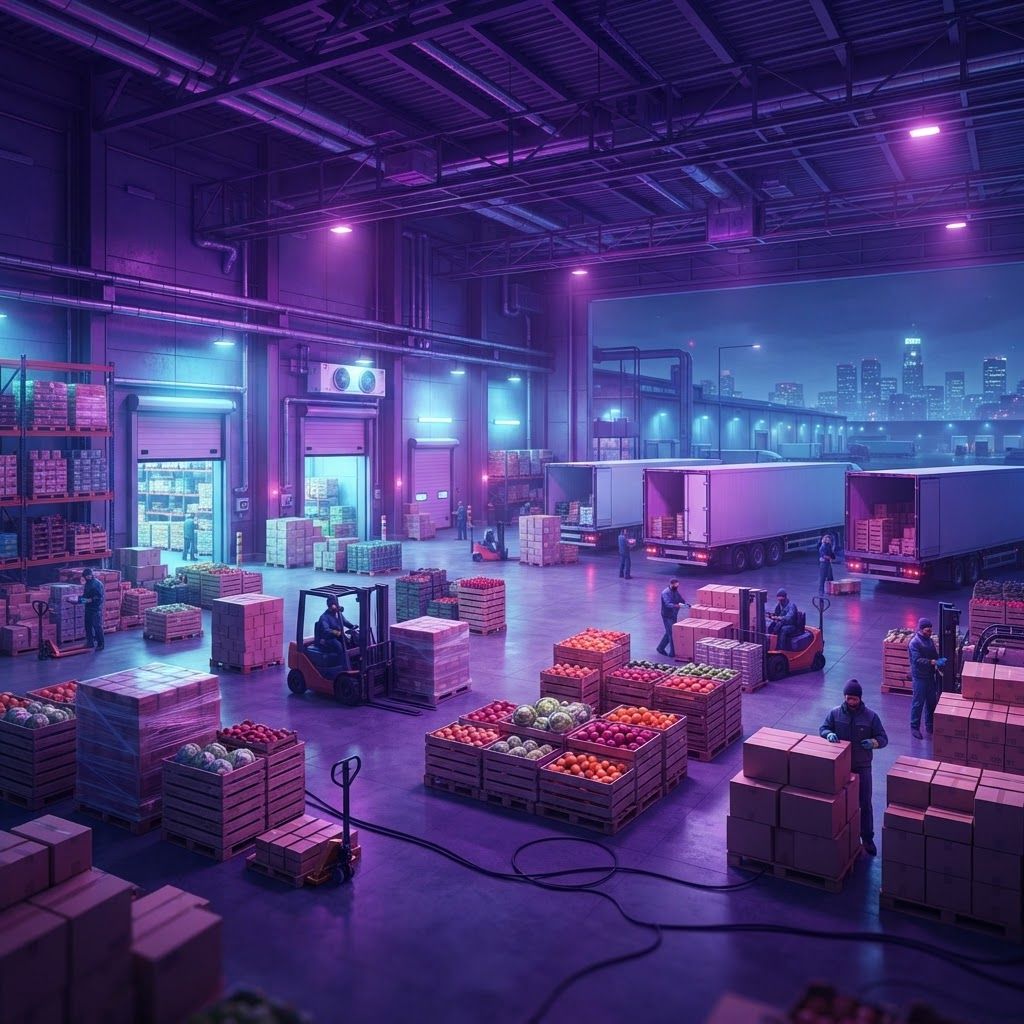
The Backbone of Richmond's Food Economy
Richmond's restaurant scene has earned national attention over the past decade, and that visibility rests on an unglamorous foundation: dependable food distribution. Behind every well-reviewed kitchen is a network of wholesalers delivering produce before dawn, holding proteins at precise temperatures, and finding a substitute when a shipment falls short. When distribution fails, menus change and reputations suffer.
Central Virginia gives local wholesalers real advantages. Agricultural production in the surrounding counties supplies produce, dairy, poultry, and specialty crops within a short drive. Chesapeake Bay and coastal fisheries provide seafood. Interstate access supports overnight replenishment from national suppliers. The combination allows Richmond distributors to blend genuinely local sourcing with the breadth a full-service kitchen requires.
Food Safety and Cold Chain Fundamentals
Food safety is where evaluation should begin. Ask whether a wholesaler operates under a Hazard Analysis and Critical Control Points plan, holds third-party certification recognized by the Global Food Safety Initiative, and can produce recent audit results. Certification alone is not proof of daily discipline, but a supplier who cannot discuss its own audit findings is a risk.
Cold chain integrity deserves direct questions. How are refrigerated trailers monitored and logged? What happens if a temperature excursion is detected mid-route? Are multi-temperature compartments genuinely separated? Continuous temperature logging with documented corrective action is the standard worth insisting on for proteins, dairy, and ready-to-eat items.
Traceability is the third pillar. In a recall, a distributor should be able to identify every affected lot and every customer who received it within hours. Ask how lot codes are captured at receiving and whether that information flows onto invoices. Finally, evaluate fill rate and on-time delivery percentage, because a supplier averaging ninety percent fill rate is forcing your kitchen to improvise on one order in ten.
The Top 10 Food Wholesalers in Richmond
1. James River Food Distributors
James River Food Distributors is among the region's most comprehensive broadline suppliers, carrying proteins, produce, dry goods, dairy, frozen items, and disposables. Its appeal for independent restaurants is order flexibility: reasonable minimums and multiple weekly delivery windows rather than rigid national account structures. The company's sales staff typically comes from kitchen backgrounds, which shows in how substitutions are handled during shortages.
2. Shockoe Produce Company
Shockoe Produce Company specializes in fresh fruits and vegetables, combining Virginia farm sourcing with national and imported programs to maintain year-round availability. Chefs value the early morning delivery schedule and the willingness to fill small, precise orders of specialty items. Its buyers walk the cooler daily and communicate honestly when quality on a given item is not worth ordering, which builds unusual trust.
3. Capital City Meat and Provisions
Capital City Meat and Provisions operates as a custom protein house, offering center-of-plate cutting to specification alongside portioned and value-added products. The differentiator is precision: consistent portion weights, defined trim standards, and documented aging programs. For steakhouses and banquet operations, that consistency directly protects food cost and plate presentation.
4. Tidewater Seafood Wholesale
Tidewater Seafood Wholesale connects Richmond kitchens to Chesapeake Bay and Atlantic harvests, with daily availability lists driven by actual landings rather than static catalogs. It handles finfish, shellfish, and crab products with strong attention to handling temperature and species labeling accuracy. Sustainability documentation and harvest-area transparency have made it a preferred source for chefs who describe sourcing on their menus.
5. Old Dominion Dairy Distributors
Old Dominion Dairy Distributors supplies milk, cream, butter, cheese, and cultured products to restaurants, bakeries, cafés, and institutions. Its cold chain discipline is rigorous, and it carries both commodity dairy and a growing artisan cheese program from regional creameries. Reliable early delivery windows suit bakeries and coffee operations that need product before opening.
6. Broad Street Bakery Supply
Broad Street Bakery Supply focuses on flours, sugars, chocolate, leaveners, fillings, and packaging for commercial and retail bakeries. Technical support is the standout feature, with staff who understand protein content, absorption, and how formula changes behave at production scale. That expertise saves bakers from expensive trial and error when reformulating.
7. Virginia Natural and Organic Foods
Virginia Natural and Organic Foods serves independent groceries, co-ops, cafés, and health-focused retailers with certified organic, non-genetically modified, and allergen-conscious products. The company maintains thorough certification documentation, which matters because organic claims require an unbroken paper trail. Its plant-based and gluten-free assortments are among the deepest in the region.
8. Southside Foodservice Group
Southside Foodservice Group concentrates on institutional accounts including schools, healthcare facilities, senior living, and corrections. Its strengths are nutritional documentation, compliance with child nutrition program requirements, and consistent pricing across long contract periods. Institutional buyers rely on the detailed product specification sheets it provides for menu compliance.
9. Fan District Specialty Imports
Fan District Specialty Imports supplies Italian, Spanish, Asian, Middle Eastern, and Latin American ingredients to restaurants and specialty grocers. It fills the gaps that broadline distributors leave, from specific chile varieties to authentic cured products and regional pantry staples. Chefs describe it as the source that makes a concept possible rather than approximate.
10. Richmond Beverage and Coffee Wholesale
Richmond Beverage and Coffee Wholesale distributes coffee, tea, syrups, juices, and non-alcoholic beverages, along with equipment service support. Bundling roasted coffee supply with grinder and brewer maintenance solves a persistent operational headache for cafés and hotels. Its local roasting relationships give customers fresher product than national programs typically deliver.
Trends Reshaping Food Distribution
Local sourcing has moved from marketing language to operational practice, with distributors formalizing farm relationships and publishing origin details. Labor pressure in kitchens has increased demand for value-added preparation such as pre-cut produce and portioned proteins, shifting work upstream to distributors. Technology adoption is accelerating too, with online ordering, live inventory, and usage analytics helping operators control food cost. Packaging sustainability is under real scrutiny as well, particularly for high-volume disposable items.
Choosing the Right Mix of Suppliers
Most successful Richmond kitchens use a primary broadline distributor for breadth plus two or three specialists for produce, protein, and seafood or specialty goods. That structure balances purchasing efficiency against quality in the categories customers notice most. Negotiate honestly about volume, keep receiving standards consistent, and document quality issues with photographs and lot codes so problems can actually be corrected.
Above all, treat delivery reliability as a hard requirement rather than a preference. A slightly higher price from a distributor that arrives on time with complete orders costs far less than the operational chaos of chasing missing product during service.