
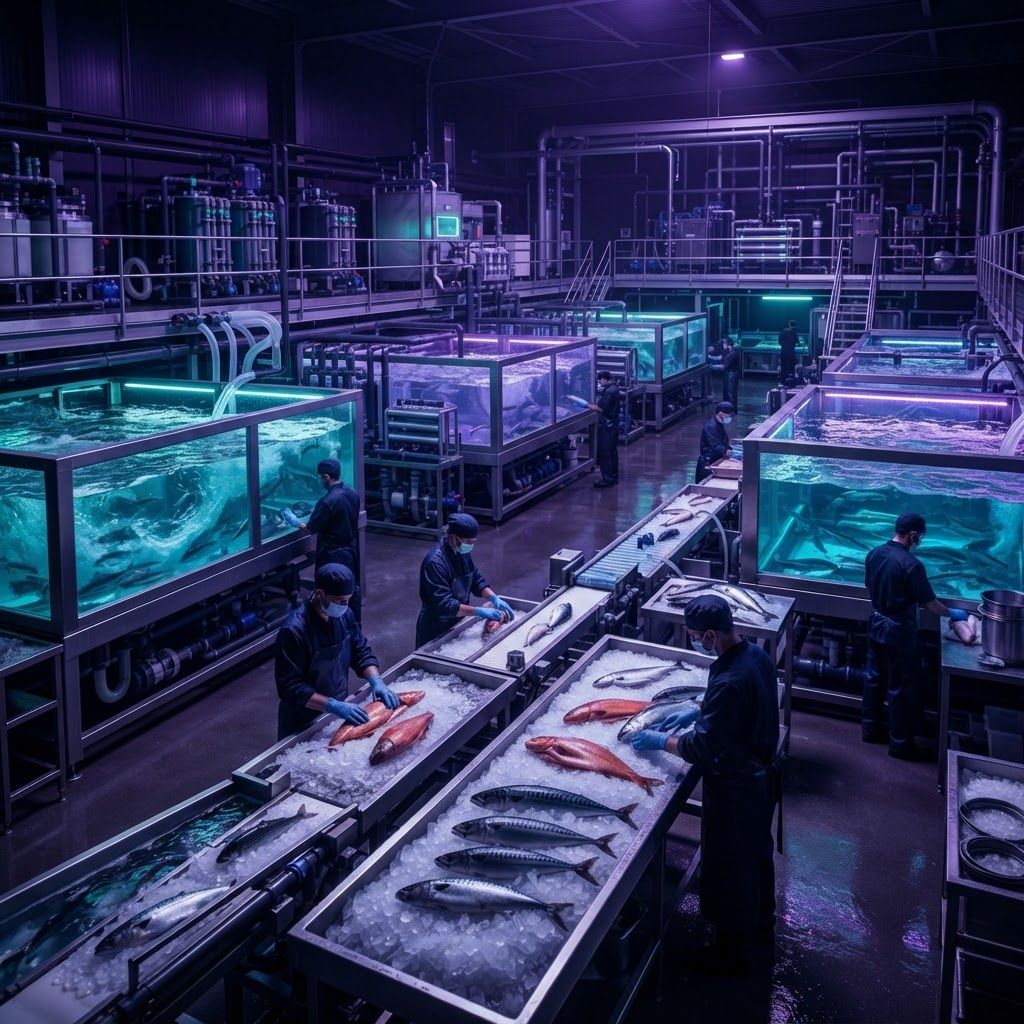
Understanding the Fishery Sector in an Inland Valley
Santa Clarita is roughly thirty miles from the Pacific coast, which means it has no commercial fishing fleet. What it does have is a functioning fishery economy of a different kind: seafood distribution and processing serving the valley's restaurants and retailers, land-based aquaculture and aquaponics operations, ornamental and aquarium trade businesses, fish stocking and pond management services for the region's lakes and reservoirs, and aquatic habitat conservation work along the Santa Clara River.
This inland model is increasingly representative of where the industry is heading. Wild capture fisheries face biological limits, while land-based recirculating aquaculture can be sited near consumers rather than near water bodies. Southern California's large seafood market and the valley's industrial infrastructure make it a plausible location for exactly this kind of production.
Segments of the Local Fishery Economy
Seafood distribution moves fresh and frozen product from coastal landings and international suppliers to restaurants, retailers, and institutions. Processing and value-added operations portion, package, smoke, and prepare seafood products. Recirculating aquaculture raises finfish in controlled tank systems with filtration and water reuse. Aquaponics combines fish production with hydroponic plant growth in an integrated nutrient loop. Ornamental aquatics supplies aquarium fish, plants, and equipment. Fisheries management and conservation services handle stocking, habitat restoration, and monitoring for public and private waters.
Ten Fishery Companies and Aquatic Businesses Serving Santa Clarita
1. Valencia Seafood Distributors — Fresh and frozen seafood distribution to restaurants and specialty grocers, with daily coastal sourcing, traceability documentation, and species availability guidance for chefs.
2. Santa Clarita Aquaculture Systems — Land-based recirculating aquaculture producing finfish in tank systems with water reuse, filtration, and controlled feed management for consistent year-round harvest.
3. Soledad Aquaponics Farm — Integrated fish and vegetable production where nutrient-rich water from tilapia culture feeds hydroponic greens, delivering two crops from a single water input.
4. Newhall Fish Processing Company — Portioning, filleting, vacuum packaging, and smoking operations serving foodservice and retail customers with value-added seafood products.
5. Canyon Country Aquarium Supply — Ornamental fish, aquatic plants, filtration equipment, and livestock for hobbyists, retailers, and commercial aquarium installations.
6. Placerita Pond & Lake Management — Fish stocking, aeration system installation, aquatic vegetation control, and water quality monitoring for private ponds, golf courses, and community lakes.
7. Bouquet Canyon Fisheries Consulting — Environmental consulting on aquatic habitat assessment, fish passage, and regulatory permitting for development projects near waterways.
8. Rye Canyon Aquatic Feeds — Distribution of aquaculture feed and nutritional supplements, including formulations with reduced dependence on wild-caught fishmeal.
9. Golden Valley Sushi Supply — Specialized distribution of sushi-grade seafood, prepared products, and Japanese pantry items for the valley's sushi restaurants and grocery counters.
10. Sierra Highway River Restoration Group — Habitat restoration and native species conservation work along the Santa Clara River corridor, including riparian planting and monitoring of sensitive aquatic species.
Sustainability and Sourcing Standards
Seafood is the category where sourcing claims most require verification. Responsible buyers ask for species identification by scientific name, catch or farm location, harvest method, and certification status. Recognized certification programs exist for both wild capture and aquaculture, and while no certification is perfect, documented programs provide substantially more assurance than unverified assertions.
Species substitution and mislabeling remain persistent industry problems. Distributors who can trace product to a specific vessel or farm, and who provide consistent documentation, are worth prioritizing. For restaurants making sustainability claims on menus, this documentation is not merely good practice — it is protection against misrepresentation exposure.
Cold chain integrity is equally critical. Seafood degrades faster than nearly any other food product. Verify that distributors maintain temperature monitoring through transport, deliver on refrigerated vehicles, and can document receiving temperatures. Reject product arriving outside safe ranges rather than accepting it as a courtesy.
The Case for Land-Based Aquaculture
Recirculating aquaculture systems represent the most significant technical development in the sector. By raising fish in controlled tanks with biological filtration and water recirculation, these systems use a fraction of the water that flow-through systems require, eliminate escape and disease transfer risks associated with open net pens, allow siting near urban markets, and enable precise control over water quality, temperature, and feed conversion.
The challenges are real: capital intensity, energy consumption, and the operational expertise required to manage biological filtration reliably. But for inland locations near large consumer markets — a description that fits Santa Clarita precisely — the model is increasingly viable, particularly for species commanding premium prices.
Aquaponics and Integrated Production
Aquaponics extends the recirculating concept by using fish waste as plant nutrition. The result is two marketable products from one water and feed input, with nutrient discharge largely eliminated. Local operations have found success with tilapia paired with leafy greens and herbs, selling into farmers markets, restaurants, and subscription programs where the story and freshness both command premiums.
Scaling aquaponics requires balancing two biological systems with different optimal conditions, which is why most successful operations remain intensive rather than extensive. For growers in a water-constrained valley, though, the water efficiency is difficult to match.
Looking Ahead
Demand for seafood continues to rise while wild capture remains flat, which means aquaculture will supply nearly all growth. Consumer interest in traceability and sustainability is strengthening, favoring operations that can document their practices. Alternative feed ingredients including insect protein and algae are reducing aquaculture's dependence on wild-caught inputs. And local production near consumption centers reduces both transport emissions and time to market.
For Santa Clarita businesses and consumers, the practical guidance is consistent: ask where seafood comes from, insist on documentation, prioritize suppliers who maintain the cold chain rigorously, and support the local aquaculture operations proving that responsible fish production does not require an ocean view.