
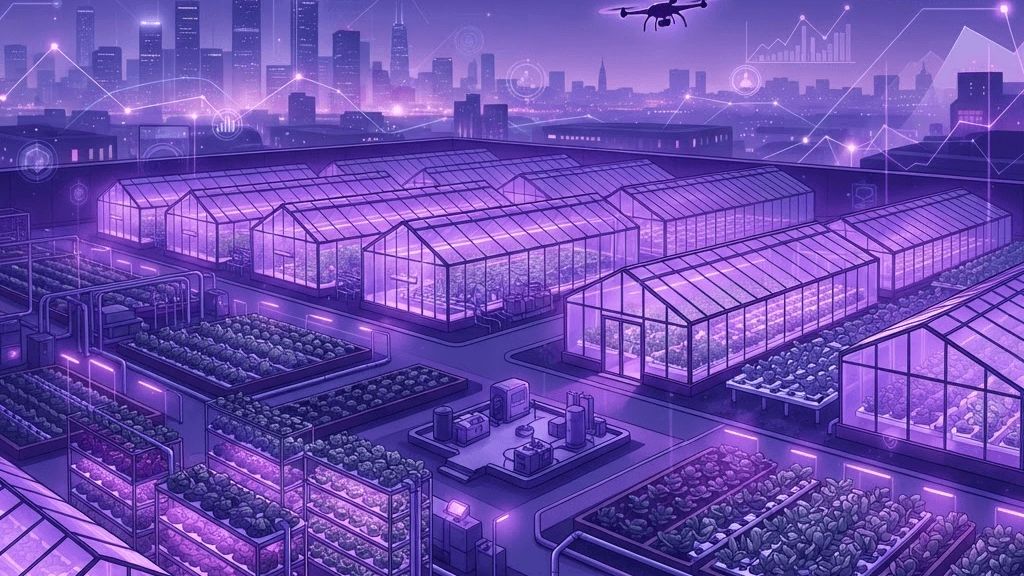
Farming in a city of nearly two hundred thousand people sounds improbable until you look closely. Yonkers has become a genuine centre of urban agriculture, with controlled-environment greenhouses, rooftop growing systems, hydroponic and aquaponic facilities, community farms, and specialty producers supplying restaurants and markets. What makes this work is not romance about growing food but engineering: controlled environments, efficient water use, vertical space utilisation, and proximity to customers who value freshness.
Why Urban Farming Makes Economic Sense Here
Conventional agriculture competes on cost per acre. Urban agriculture cannot, so it competes on freshness, transport distance, and crop selection. Leafy greens, herbs, microgreens, mushrooms, and delicate produce lose quality quickly in transit, which means a grower located within minutes of a restaurant kitchen can deliver a product that no distant farm can match regardless of scale.
Yonkers also offers structural advantages: available warehouse and industrial buildings suitable for indoor growing, flat rooftops, vacant parcels appropriate for soil-based farming, and a market of millions of consumers nearby. Municipal and state interest in food access and local resilience has supported these operations, particularly where they also address neighbourhood food availability.
Evaluation Criteria
Operations were assessed on production consistency and yield reliability, product quality and post-harvest handling, resource efficiency in water and energy, food safety practices, market relationships with chefs and retailers, community and educational contribution, and demonstrated operational sustainability over multiple seasons.
The Top 10 Farming Companies Serving Yonkers
1. Hudson Valley Hydroponic Farms
Hudson Valley Hydroponic Farms operates controlled-environment greenhouses producing lettuces, herbs, and leafy greens year-round. Recirculating nutrient systems use a fraction of the water conventional field production requires, and consistent climate control allows the farm to promise restaurants a specific volume every week regardless of weather, which is exactly what kitchens need to build menus.
2. Nepperhan Rooftop Farming Company
Nepperhan Rooftop Farming Company converts flat commercial rooftops into productive growing space using lightweight growing media and drip irrigation. The model produces vegetables while delivering building benefits including stormwater retention and improved roof insulation, and it uses space that would otherwise sit empty.
3. Yonkers Vertical Growing Systems
Yonkers Vertical Growing Systems operates indoor stacked production under controlled lighting, focusing on microgreens, baby greens, and herbs. Vertical density delivers high yield per square foot, and because the environment is fully enclosed, crops require no pesticides and harvest timing is entirely predictable.
4. Empire Urban Aquaponics
Empire Urban Aquaponics runs an integrated system in which fish and plants are grown together, with fish waste nutrients feeding plant growth and plants filtering the water. The operation produces both tilapia and vegetables from a single water system, and the closed loop appeals strongly to buyers focused on resource efficiency.
5. Palisade Community Farm Cooperative
Palisade Community Farm Cooperative cultivates soil-based plots with community participation, growing a diverse mix of vegetables for local distribution and neighbourhood programmes. Beyond production, the cooperative provides growing education and improves fresh food access in areas where retail options are limited.
6. Riverside Mushroom Cultivation
Riverside Mushroom Cultivation grows specialty mushrooms including oyster, shiitake, and lion's mane in climate-controlled indoor rooms. Mushrooms suit urban production well, requiring no sunlight and growing on agricultural byproducts, and chefs value the freshness that a same-day local harvest provides.
7. Getty Square Microgreens and Specialty Produce
Getty Square Microgreens and Specialty Produce supplies restaurants with microgreens, edible flowers, and specialty items harvested to order. Short crop cycles allow the operation to respond quickly to chef requests, and delivery within hours of cutting preserves the flavour and appearance these garnishes are bought for.
8. Ridge Hill Greenhouse Nursery and Plant Production
Ridge Hill Greenhouse Nursery and Plant Production grows ornamental plants, vegetable starts, herbs, and landscape material for garden retailers, landscapers, and municipal planting programmes. Seasonal timing is the operational discipline, since plants must be at the right stage precisely when planting season arrives.
9. Saw Mill Apiary and Pollinator Services
Saw Mill Apiary and Pollinator Services manages honeybee colonies across rooftops and green spaces, producing honey and supporting pollination for nearby gardens and farms. The company also handles swarm removal and hive management for property owners, and provides education on urban pollinator habitat.
10. Westchester Indoor Crop Technology
Westchester Indoor Crop Technology develops and supplies growing systems, lighting, nutrient delivery, and environmental controls to other urban farming operations. Its role is infrastructural rather than agricultural, and its technical support helps new growers avoid the equipment mistakes that end many first-year operations.
Trends in Urban Agriculture
Energy cost is the central economic constraint on indoor farming, and improvements in light-emitting diode efficiency and spectrum tuning continue to improve viability. Automation is expanding, with sensors, environmental controls, and mechanised seeding and harvesting reducing labour intensity. Crop selection has become more disciplined as operators concentrate on high-value, transport-sensitive products rather than attempting to compete on staple commodities. Direct relationships with chefs and consumers continue to strengthen margins by removing distribution layers. Finally, food security and resilience policy has increased institutional support for urban growing, including integration with schools and community health programmes.
How to Work With Urban Farms
For chefs and retailers, begin with a conversation about what the farm can reliably produce and in what volume, then build menus or assortments around that rather than requesting crops the operation is not designed for. Agree on delivery cadence and harvest timing, since freshness is the entire proposition. Confirm food safety practices, including water testing and handling protocols. Consider committing to a season in advance, which gives growers the planning certainty they need to plant correctly. For consumers, ask when produce was harvested rather than where it came from, because in urban agriculture the answer is often measured in hours.
Conclusion
Farming companies operating in and around Yonkers demonstrate that agriculture and dense urban life are compatible when production is engineered for the setting. By focusing on freshness, resource efficiency, and direct relationships, these operations supply genuine value to local kitchens and communities rather than merely offering a novelty.