
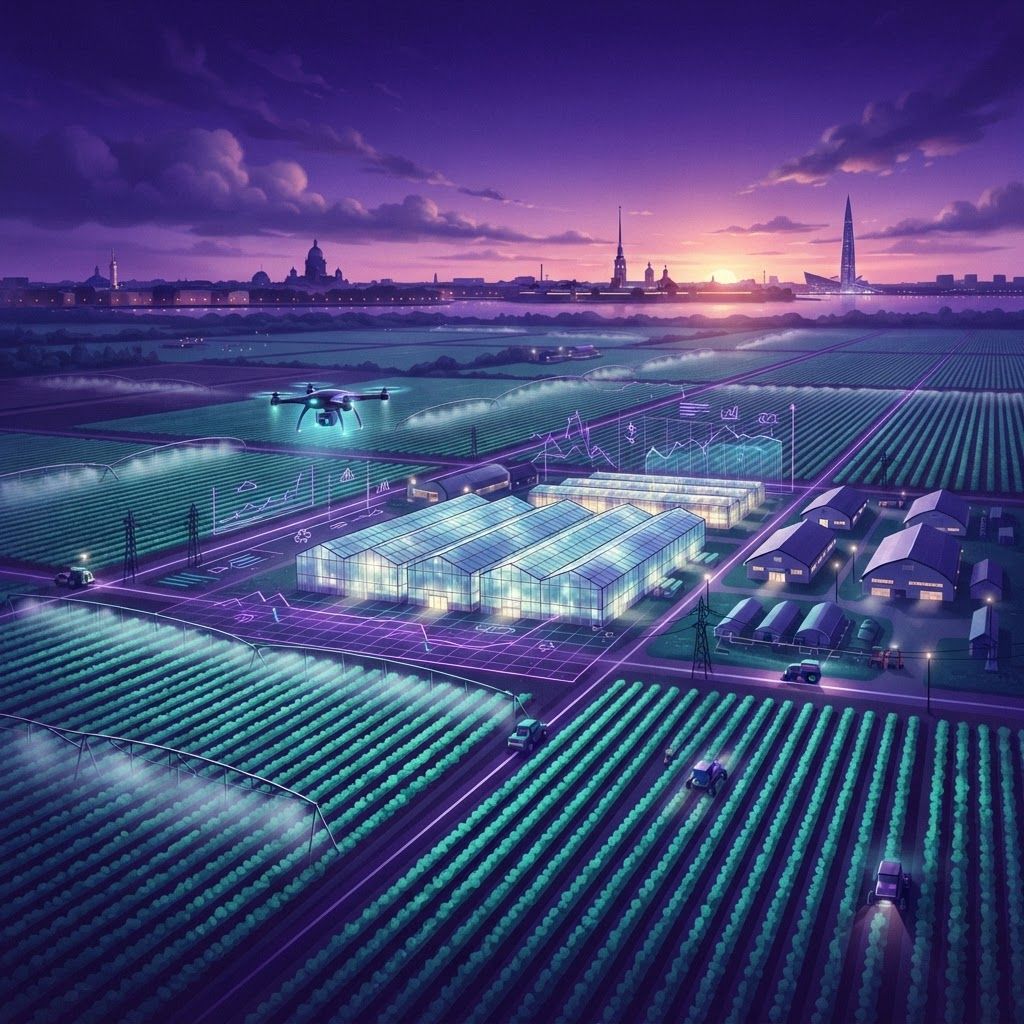
Farming at the Edge of the Growing Season
Agriculture around St. Petersburg operates under real constraints. The growing season is short, light levels in winter are low, soils are often acidic and poorly drained, and frost risk extends late into spring. Yet the Leningrad region is one of the most productive agricultural areas in the Russian northwest, and the reason is straightforward: a metropolitan market of over five million people sits directly adjacent to the farmland.
That proximity changes the economics. Perishable, freight-sensitive products become the natural specialisation. Milk, eggs, poultry, greenhouse vegetables, potatoes and leafy salads all benefit from being produced hours rather than days from the consumer. The region's farming companies have therefore built strength in intensive, technology-heavy production rather than extensive field cropping. The ten businesses below illustrate the main models.
1. Leningrad Dairy Holdings
Large dairy operations combine high-yielding herds, robotic or rotary milking parlours, and tight forage management. Northern dairy success depends on silage quality, since grazing seasons are short, and on herd health protocols that maintain yield through long housed periods. The best operators integrate forward into processing or hold long-term contracts with regional dairies.
2. Neva Poultry Complex
Poultry is the region's strongest livestock sector because feed conversion efficiency and short production cycles suit a climate where housed production is standard. Integrated complexes run hatcheries, rearing, processing and distribution, which gives them control over biosecurity and consistent supply into retail.
3. Baltic Greenhouse Vegetables
Protected cropping is the region's most technologically advanced agriculture. Modern glasshouses with supplementary lighting, hydroponics, climate control and combined heat and power produce tomatoes, cucumbers and peppers year-round despite the winter light deficit. Energy strategy is the single biggest determinant of profitability.
4. Ladoga Potato Growers
Potatoes suit the region's soils and cool summers well. Serious growers invest in certified seed, storage with controlled temperature and humidity, and grading and packing lines that let them supply retailers directly rather than selling into a commodity market at harvest.
5. Northwest Egg Producers
Egg production is capital-intensive and margin-thin, rewarding scale and operational discipline. Producers differentiate through housing systems, from enriched cage to barn and free range, and increasingly through packaging and brand work that captures retail premiums.
6. Priozersk Berry Farms
Soft fruit works well in the north because cool nights build flavour and acidity. Strawberries, raspberries and currants supply fresh markets in season and processing outlets beyond it. Labour availability at picking time is the recurring constraint.
7. Volkhov Grain and Forage
Arable operations here focus primarily on feed rather than milling quality, growing barley, oats and forage crops that underpin the livestock sector. Their commercial logic is tight integration with dairy and poultry demand nearby.
8. Gatchina Organic Cooperative
Certified organic producers serve a growing urban market willing to pay for provenance. Cooperative structures let smaller farms share certification costs, marketing and logistics that would be unaffordable individually.
9. Neva Salad and Herbs
Vertical and hydroponic leafy-green growers place production close to the city and harvest year-round with predictable quality. Their advantage is shelf life and consistency for food service customers who cannot tolerate supply gaps.
10. Vyborg Mixed Farming Estate
Diversified estates combine livestock, arable, forestry and agritourism. Spreading risk across enterprises smooths income volatility and makes better use of marginal land that would not justify specialised investment.
What Makes Northern Farming Work
Three factors dominate. First, controlled environments that remove weather and light from the equation. Second, proximity logistics, turning freshness into a competitive advantage rather than merely a cost saving. Third, integration, because farms that control processing, packing or distribution capture margin that pure commodity producers surrender.
Working With Regional Producers
Buyers should assess storage and cold chain capability as carefully as growing capacity, since post-harvest handling determines what actually reaches the shelf. Ask about seasonality plans and how supply gaps are covered. For long-term supply, understand each producer's energy exposure, which is the largest single cost variable in protected cropping.
Final Thoughts
Farming around St. Petersburg proves that climate constraints can be engineered around when the market is close enough to justify the investment. The region's strongest producers are those that treat agriculture as a controlled manufacturing process while retaining the agronomic judgement that biology still demands.