
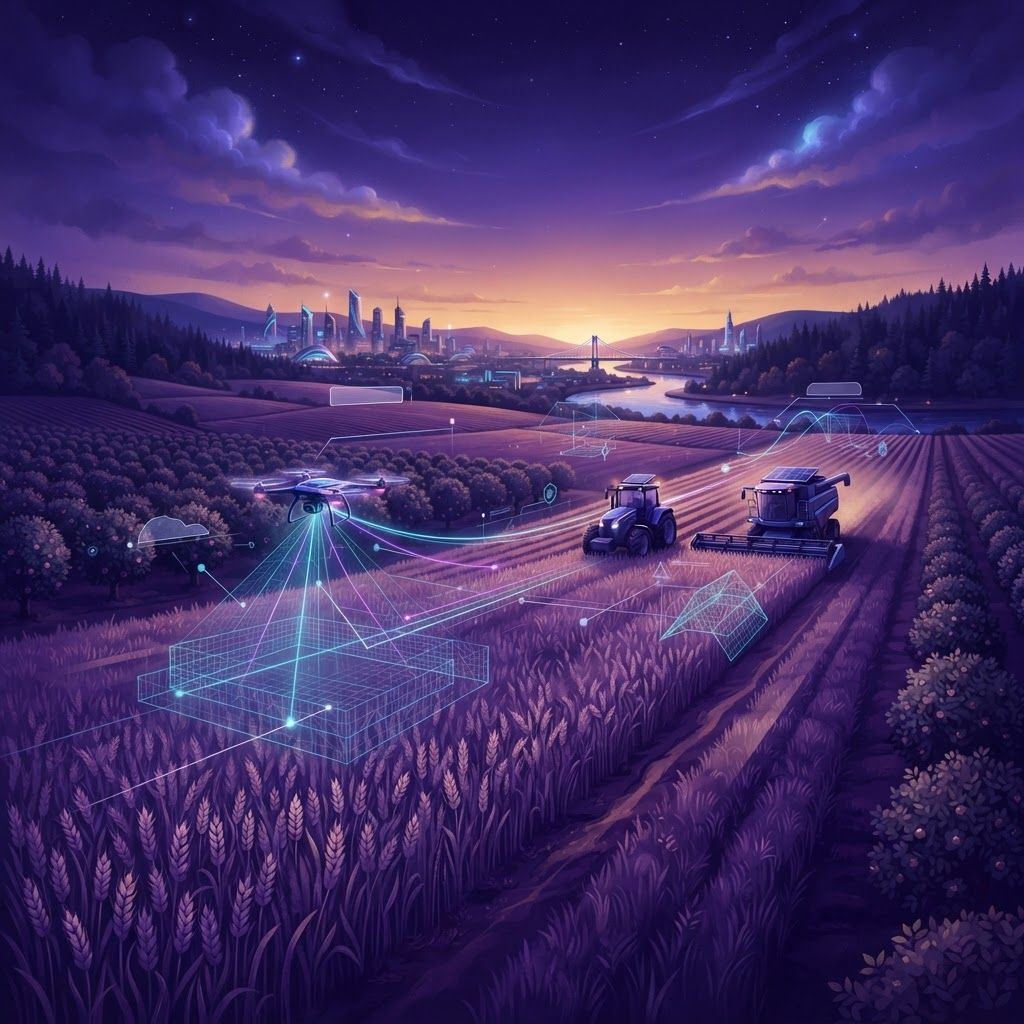
Agriculture at the Edge of the City
Drive twenty minutes in almost any direction from downtown Spokane and the landscape becomes agricultural. To the south lies the Palouse, some of the most productive dryland wheat country in the world. North of the city, Green Bluff supports orchards, berries and agritourism. To the west, irrigated ground grows alfalfa, hay and specialty crops. This proximity between city and farm has created an unusually strong local food and agribusiness ecosystem.
Farming companies in the region operate under real constraints: variable precipitation, a compressed growing season, soil erosion risk on steep loess hills and labor availability challenges. The operations that stand out are those that manage these pressures with disciplined agronomy and diversified revenue rather than relying on favorable weather.
The Ten Best Farming Companies in Spokane
1. Palouse Ridge Grain Farms
A multi-generational dryland operation producing wheat, barley and pulse crops. Direct-seed and reduced-tillage practices have improved soil retention on rolling ground, and rotation planning with legumes has reduced fertilizer dependence measurably.
2. Green Bluff Orchard Company
Apples, pears, cherries and stone fruit anchor this orchard, complemented by a strong direct-to-consumer season. On-farm sales, u-pick and seasonal events convert agricultural production into experience-based revenue, insulating the business from commodity swings.
3. Spokane River Valley Produce Growers
Supplying restaurants, grocers and farmers markets, this operation grows vegetables in succession plantings to extend availability. High tunnels and cover cropping stretch the season at both ends, which local chefs value highly.
4. Inland Northwest Cattle and Ranching Group
Managing grazing land across the region, this ranching business emphasizes rotational grazing and rangeland health. Direct beef sales alongside traditional market channels give it pricing stability and a loyal local customer base.
5. Cascade Dairy Farms
Herd health, milk quality and manure nutrient management define modern dairying. This operation invests in cow comfort and precision feeding, and it uses digestate and compost to reduce purchased fertilizer on its forage acres.
6. Lilac City Berry and Small Fruit Farms
Strawberries, raspberries, blueberries and currants require intensive labor and careful post-harvest handling. This farm has built a reputation for picking maturity and rapid cooling, which shows in shelf life at retail.
7. Northwest Organic Croplands
Certified organic production demands longer rotations, mechanical weed control and meticulous recordkeeping. This company has developed reliable systems for organic grains, legumes and forage, supplying processors seeking verified inputs.
8. Eastern Washington Hay and Forage Producers
Alfalfa and timothy hay from the region are exported widely and prized for quality. Precision irrigation, timely cutting and moisture-controlled baling determine value, and this producer treats those details as the core of the business.
9. Garland Urban Farm Collective
Operating on small parcels inside the city, this collective grows intensively for markets, restaurants and community programs. Its work also serves an educational role, training new growers in efficient small-scale production.
10. Spokane Valley Greenhouse and Nursery Farms
Bedding plants, vegetable starts, herbs and ornamental stock supply both retail garden centers and commercial landscapers. Controlled environment production allows a reliable spring supply regardless of unpredictable weather.
Trends Shaping Regional Agriculture
Soil health has become the organizing principle for progressive operations, with cover crops, reduced tillage and diverse rotations adopted for agronomic rather than ideological reasons. Water efficiency is under constant scrutiny, driving investment in soil moisture monitoring and improved irrigation scheduling. Direct marketing continues to grow as consumers seek local provenance, giving farms a higher-margin channel alongside commodity sales. Technology adoption, from satellite imagery to variable-rate application, is now common even on mid-sized farms because the payback period has shortened considerably.
What Distinguishes a Strong Farming Operation
Consistency is the clearest indicator. Farms that deliver predictable quality and volume, communicate honestly about crop conditions and plan a season ahead with their buyers tend to be well managed throughout. Diversification is another marker, whether across crops, channels or enterprises, because it reduces exposure to any single failure.
For buyers evaluating regional agricultural partners, ask about food safety practices, harvest scheduling flexibility and how the farm handles a shortfall. For those considering agricultural careers or investment in the area, note that the strongest operations invest continuously in equipment maintenance, employee retention and agronomic knowledge rather than treating any of them as discretionary.
Final Thoughts
Agriculture around Spokane blends large-scale grain production with orchards, livestock, dairy and intensive market farming. The best farming companies in the region succeed by managing soil, water and relationships with equal care, and their work continues to shape both the local economy and what appears on local tables.
Dryland Farming and Water Management
Agriculture around Spokane divides sharply between dryland and irrigated production, and the distinction shapes nearly every management decision. Dryland operations on the Palouse depend on stored soil moisture from winter precipitation, which makes fallow management, residue retention and minimum-till practices essential rather than optional. A single poorly timed tillage pass can cost yield that no later input recovers.
Irrigated ground faces a different discipline. Water rights, pumping energy cost and application efficiency drive economics, and the shift toward variable-rate irrigation, soil moisture monitoring and low-pressure delivery reflects genuine financial pressure alongside environmental responsibility.
Conservation and Soil Health
Erosion has historically been the region's defining agricultural challenge, with steep loess slopes vulnerable to both water and wind loss. Direct seeding, cover cropping, diverse rotations that include pulses, and contour management have measurably reduced soil movement over recent decades. The operations profiled here treat soil as a productive asset with a long horizon rather than a medium to be mined.
Rotation with legumes serves double duty, fixing nitrogen while breaking disease and weed cycles that continuous cereal cropping intensifies. The resulting reduction in purchased fertilizer and chemical inputs improves both margin and environmental outcomes.
Markets, Risk and Succession
Most of the region's wheat and pulse production ultimately moves to export markets, which exposes growers to currency movements, foreign trade policy and distant weather events. Marketing discipline, using forward contracts, options and staged selling rather than single-decision pricing, separates operations that survive volatile years from those that do not.
Succession planning is the quieter challenge. Farmland values, equipment capital requirements and the complexity of transferring an operation across generations demand deliberate planning well before retirement. Farms that address this early, with clear structures and honest family conversation, remain intact far more often than those that delay.