
Agriculture in a Changing Santa Clarita Valley
Farming in the Santa Clarita Valley looks different than it did a generation ago. Once dominated by ranching, orchards, and row crops across the Santa Clara River corridor, agriculture here has contracted under urban development pressure and constrained water supplies. What remains is more specialized, more efficient, and in many cases more profitable per acre than the extensive farming it replaced.
The valley's agricultural identity now centers on high-value specialty production: nursery and ornamental horticulture, orchard crops suited to the local microclimate, equestrian operations and their supporting forage production, small diversified farms serving direct markets, and an emerging controlled environment sector growing produce indoors with dramatically reduced water use. The Santa Clara River watershed and surrounding foothills still support genuine agricultural activity, and the operations that persist have earned their place through adaptation.
Conditions That Shape Local Farming
Three factors dominate agricultural decision-making in the valley. Water is the first and most consequential: groundwater management, allocation rules, and drought cycles determine what can be grown and at what scale. Climate is the second — hot dry summers, occasional frost in low-lying areas, and significant temperature swings favor drought-adapted and heat-tolerant crops. Land economics is the third, since proximity to residential development pushes farming toward high-value output per acre and away from commodity production.
Wildfire risk and the wildland-urban interface add operational complexity, affecting insurance, infrastructure design, and emergency planning. Successful operations plan for these realities rather than treating them as exceptions.
Ten Farming Operations and Agricultural Businesses in the Valley
1. Santa Clara River Valley Citrus Growers — Orchard operations producing citrus varieties suited to the valley's warm days and cool nights, supplying regional packers and direct-to-consumer channels.
2. Valencia Nursery & Ornamental Growers — Container nursery production of ornamental trees, shrubs, and drought-tolerant landscape plants serving landscape contractors and garden retailers throughout Southern California.
3. Placerita Canyon Family Farm — A diversified small farm growing seasonal vegetables, herbs, and stone fruit for farmers markets and community-supported agriculture subscriptions.
4. Bouquet Canyon Ranch Operations — Cattle grazing and rangeland management on foothill acreage, combining livestock production with vegetation management that supports fire risk reduction.
5. Sand Canyon Equestrian & Forage — Boarding, training, and hay production serving the valley's substantial equestrian community, integrating pasture management with feed supply.
6. Soledad Controlled Environment Farms — Greenhouse and indoor production of leafy greens, herbs, and microgreens using hydroponic systems that reduce water consumption dramatically compared with field production.
7. Canyon Country Apiary & Pollination Services — Beekeeping operations producing local honey while providing pollination services to orchards and nurseries across the region.
8. Newhall Olive & Specialty Orchards — Olive and specialty tree crop production suited to Mediterranean conditions, with small-batch oil pressing and direct sales to specialty food retailers.
9. Golden Valley Native Plant Farm — Propagation of California native and drought-adapted species for habitat restoration, municipal landscaping, and residential water-wise gardens.
10. Sierra Highway Agricultural Services — Custom farming services including tillage, planting, irrigation installation, and harvest support for landowners who lack their own equipment and labor.
Water Management as the Central Discipline
No topic matters more to Santa Clarita agriculture than water. Groundwater sustainability planning has formalized extraction limits, and growers must now manage water as a strictly finite input. The practical response has been comprehensive efficiency investment: drip and micro-sprinkler irrigation replacing flood and overhead systems, soil moisture sensing driving irrigation scheduling rather than fixed calendars, evapotranspiration-based scheduling using local weather data, and mulching to reduce evaporative loss.
Crop selection has shifted accordingly. Deep-rooted perennial crops with established drought tolerance, native and Mediterranean species, and controlled environment production all use less water per unit of output than conventional field vegetables. Several local operations have also invested in recycled water infrastructure and rainwater capture where regulations permit.
Direct Marketing and the Local Food Economy
Proximity to a large affluent population is Santa Clarita agriculture's greatest commercial asset. Farmers markets, community-supported agriculture subscriptions, farm stands, and direct sales to local restaurants capture retail rather than wholesale pricing, transforming the economics of small acreage. Agritourism — U-pick operations, farm dinners, educational tours, and seasonal events — adds revenue streams that field production alone cannot provide.
These channels require different skills than production farming. Marketing, customer service, food safety compliance for direct sales, and hospitality management all become relevant. The operations succeeding locally tend to be those that embraced this shift rather than resisting it.
Technology and Regenerative Practice
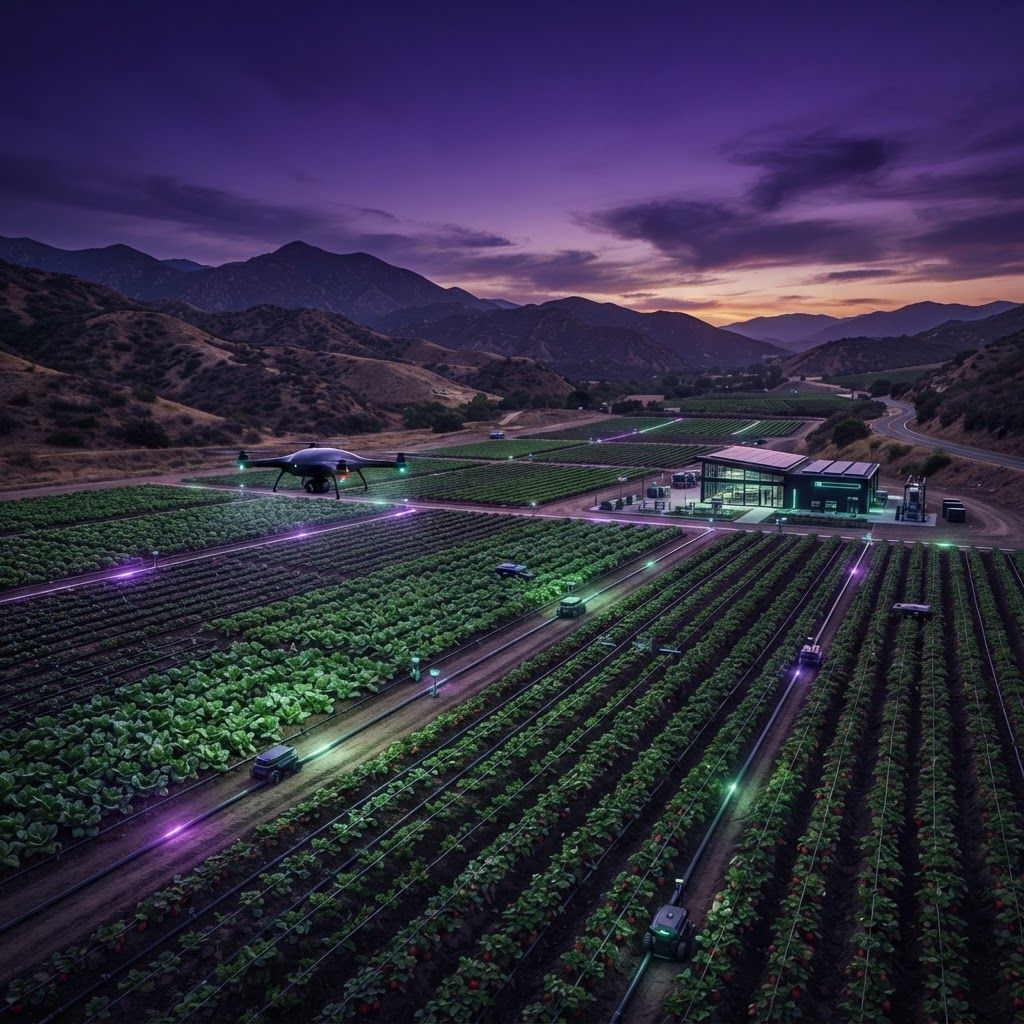
Precision agriculture has reached even modest operations. Soil testing guides targeted amendment rather than blanket fertilization. Drone and satellite imagery identifies stress before it is visible from the ground. Automated irrigation controllers respond to real-time conditions. Integrated pest management reduces chemical inputs through monitoring, beneficial insects, and targeted intervention.
Regenerative practices are gaining adoption for both agronomic and commercial reasons. Cover cropping, reduced tillage, compost application, and diversified rotation improve soil organic matter, water infiltration, and resilience to heat stress. These practices also support the sustainability narratives that direct-market customers increasingly value.
The Outlook for Valley Agriculture
Farming will remain a smaller part of the Santa Clarita economy than it once was, but it is unlikely to disappear. Nursery production, controlled environment agriculture, specialty perennials, and direct-market farming all have viable paths forward. Land conservation efforts, agricultural easements, and community interest in local food provide additional support.
The operations that thrive will be those treating constraint as a design parameter rather than an obstacle: growing high-value crops with minimal water, selling directly at retail prices, integrating fire-resilient land management, and building the customer relationships that make a small farm in an expensive valley economically sustainable.