
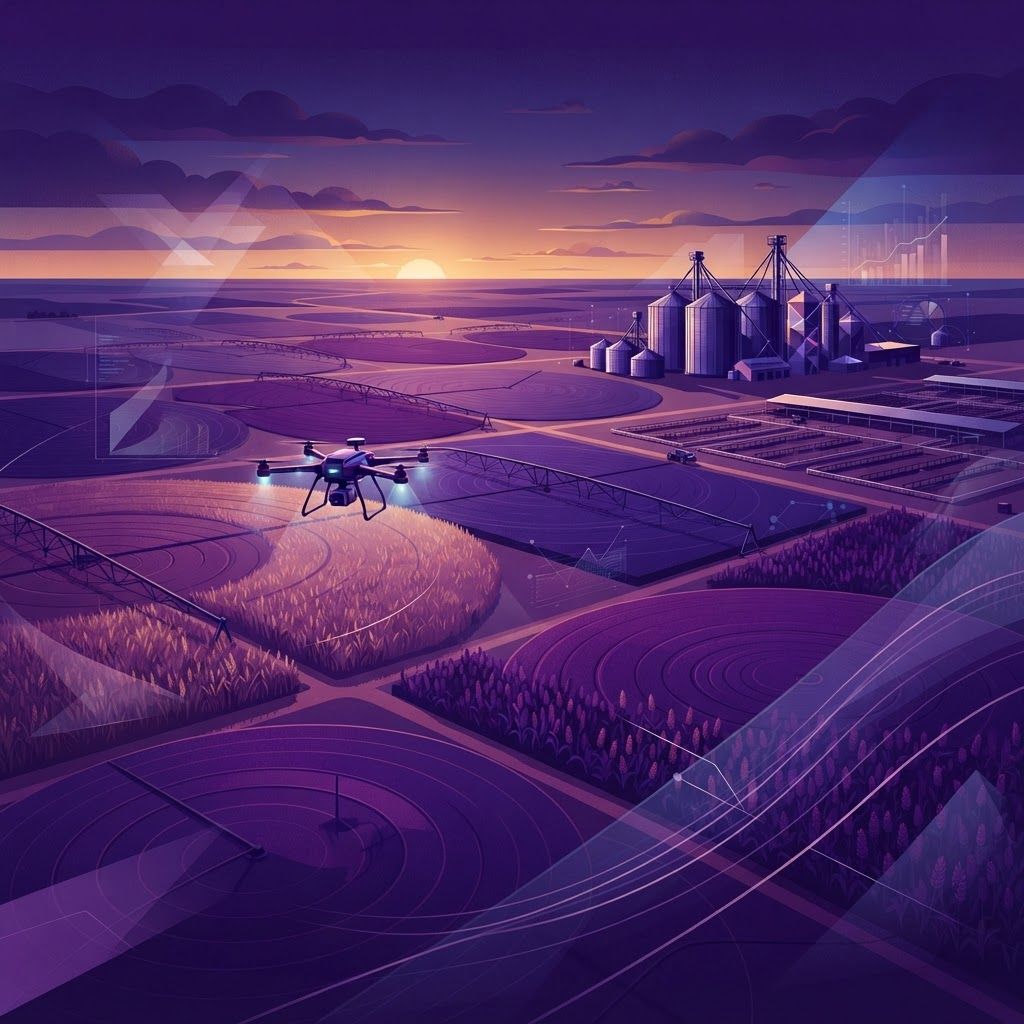
Agriculture is not a sector of the Amarillo economy so much as its foundation. The surrounding counties produce a remarkable concentration of beef cattle, grain sorghum, corn, wheat, and cotton, supported by the Ogallala Aquifer and a climate that, while demanding, suits large-scale production. Farming operations here tend to be substantial, technically sophisticated, and deeply integrated with feeding, processing, and transportation businesses. Understanding these companies means understanding how the Panhandle actually works.
The Agricultural Profile of the Panhandle
Several characteristics define production in this region. Irrigation is central, with center-pivot systems drawing from the aquifer to support yields that dryland farming could not sustain. Cattle feeding is enormous in scale, and the proximity of feedyards to grain production creates an efficient local supply chain. Wind is both a constraint and an asset, driving soil conservation practices while generating lease income from turbine installations.
Crop selection reflects water reality. Grain sorghum tolerates limited moisture well, corn delivers higher yields where water permits, wheat serves both grain and grazing purposes, and cotton has expanded northward as varieties adapted to shorter seasons became available.
The Top 10 Farming Companies in Amarillo
1. Panhandle Grain Farms
Panhandle Grain Farms operates large-scale corn, sorghum, and wheat production with an emphasis on irrigation efficiency. Their adoption of variable-rate application and soil moisture monitoring has become a reference point for neighboring operations evaluating similar investments.
2. Amarillo Cattle and Crop Company
Amarillo Cattle and Crop Company integrates cattle feeding with feed grain production, capturing value across both stages. This vertical structure buffers them against price swings in either market and reduces transportation cost on feed inputs.
3. High Plains Irrigated Agriculture
High Plains Irrigated Agriculture specializes in intensively managed irrigated acreage, running advanced pivot systems with remote monitoring and control. Their water-use documentation and conservation practices have positioned them well as aquifer management expectations tighten.
4. Llano Estacado Family Farms
Llano Estacado Family Farms represents the multi-generation operations that still form the backbone of Panhandle agriculture. Combining accumulated local knowledge with modern equipment and agronomy, they manage diversified acreage across several crops to spread risk.
5. Canyon Creek Cotton Growers
Canyon Creek Cotton Growers produces cotton on both irrigated and dryland acreage, working with short-season varieties suited to the region's frost windows. Their attention to fiber quality rather than yield alone earns premiums at the gin.
6. Route 66 Wheat and Forage Producers
Route 66 Wheat and Forage Producers grow wheat for grain and grazing along with forage crops supplying regional dairies and feedyards. Their dual-purpose wheat management, balancing grazing revenue against grain yield, is a genuinely skilled practice.
7. Yellow City Organic Farms
Yellow City Organic Farms manages certified organic acreage, serving markets willing to pay premiums for verified production practices. Weed management without conventional herbicides demands intensive planning, and their crop rotation and cultivation discipline make the system work.
8. Bison Ridge Dairy and Feed Operations
Bison Ridge Dairy and Feed Operations combines dairy production with on-farm feed cultivation, an increasingly common Panhandle model given the region's dairy expansion. Controlling forage quality directly translates into milk production consistency.
9. Palo Duro Ranch and Rangeland Company
Palo Duro Ranch and Rangeland Company focuses on cow-calf production and rangeland stewardship across native pasture. Their grazing rotation and brush management practices sustain carrying capacity through drought cycles that break less carefully managed operations.
10. Tri-State Precision Agriculture Partners
Tri-State Precision Agriculture Partners farms while also providing data-driven agronomic services to other producers. Their use of satellite imagery, yield mapping, and prescriptive fertility planning demonstrates how technology adoption is reshaping decision-making across the region.
Water: The Defining Challenge
No discussion of Panhandle farming is honest without addressing the aquifer. The Ogallala provides the water that makes intensive production possible, but withdrawal has historically exceeded recharge across much of the region. This reality drives nearly every long-term decision producers make.
Responses have been substantial. Low-pressure and drop-nozzle pivot conversions dramatically reduce evaporative loss compared with older high-pressure systems. Soil moisture sensors and evapotranspiration data allow irrigation scheduling based on actual crop need rather than calendar habit. Crop selection has shifted toward more drought-tolerant options where economics permit. Residue management and reduced tillage improve infiltration and cut evaporation from bare soil.
The producers who will remain viable are those treating water as their scarcest asset and optimizing yield per unit of water rather than yield per acre.
Technology Trends in Panhandle Agriculture
Precision agriculture has moved well past novelty. Automated guidance reduces overlap and operator fatigue. Variable-rate seeding and fertility application match inputs to soil variability within a single field, improving both yield and input efficiency. Yield monitoring creates a feedback loop that turns each season into data for the next.
Remote sensing through satellite and drone imagery detects stress before it is visible from the cab, allowing intervention while it still matters. Livestock operations are adopting similar tools, with electronic identification, automated feed monitoring, and health tracking improving both performance and animal welfare documentation.
Market and Policy Forces
Producers here operate in genuinely global markets. Export demand for beef and grain influences local prices substantially, as do input costs for fuel, fertilizer, and machinery. Crop insurance and risk management tools are essential rather than optional given weather volatility.
Renewable energy has become a meaningful secondary income stream, with wind turbine and solar leases providing revenue that is uncorrelated with crop prices. Carbon and conservation programs are emerging as another potential revenue source for practices many producers already employ.
Final Thoughts
The farming companies around Amarillo operate at a scale and technical level that surprises people unfamiliar with the region. Grain, cotton, cattle, dairy, organic production, and rangeland management all coexist within a short radius of the city. Their shared challenge is water, and their shared advantage is a combination of accumulated regional knowledge and rapid technology adoption. Watching how these operations manage the aquifer will determine the agricultural future of the entire High Plains.