
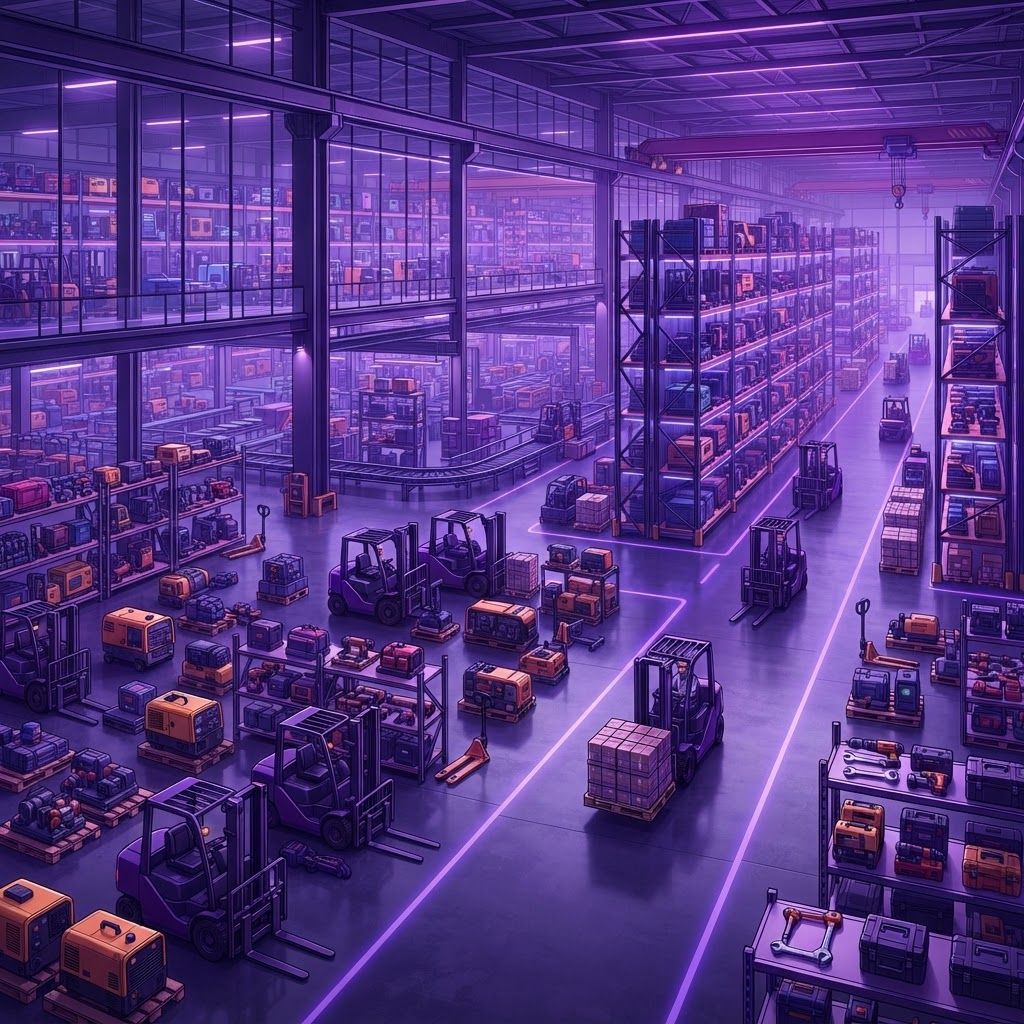
Equipment Distribution in an Industrial Region
Equipment wholesaling differs from most distribution because the sale is only the beginning of the relationship. A forklift, air compressor, or generator will require parts, scheduled service, and eventually rebuilding or replacement. Buyers who evaluate equipment distributors purely on purchase price frequently discover that a lower acquisition cost was offset by poor parts availability and slow service response.
Toledo's concentration of manufacturing, warehousing, food processing, and construction activity supports a substantial equipment distribution base. The region's material handling demand alone is significant, given the volume of freight moving through the I-75 and I-80/90 corridors and the number of distribution facilities serving the Great Lakes market.
Ten Equipment Wholesalers and Distribution Categories
1. Material Handling Equipment Dealers
Forklifts, reach trucks, pallet jacks, order pickers, and attachments, sold alongside fleet management, operator training, and preventive maintenance contracts. Fleet telematics now allows dealers to report utilization and impact events, which improves both safety and right-sizing decisions.
2. Air Compressor and Compressed Air System Suppliers
Rotary screw and reciprocating compressors, dryers, filtration, and piping. Compressed air is often a plant's most expensive utility, so distributors who perform air audits and identify leaks deliver measurable savings.
3. Power Generation and Backup Power Distributors
Standby generators, transfer switches, and load bank testing serve hospitals, data facilities, food processors, and municipalities where outages are unacceptable. Emergency service availability is the decisive factor.
4. Construction Equipment Dealers
Excavators, loaders, skid steers, compaction equipment, and attachments serve contractors and municipalities. Machine control technology and telematics have become standard expectations rather than premium options.
5. Warehouse Storage and Racking Suppliers
Pallet racking, mezzanines, conveyors, and shelving systems, ideally supplied with layout design and permitted engineering. Rack safety inspection programs are an increasingly requested service after damage-related collapses raised industry attention.
6. Industrial Tool and Power Tool Distributors
Pneumatic and cordless tools, fastening systems, torque equipment, and abrasives. Calibration services for torque tools matter in any assembly operation with documented specifications.
7. Pumps, Motors, and Rotating Equipment Suppliers
Process pumps, electric motors, gearboxes, and drives, along with repair and rebuild services. Vibration analysis and alignment services extend equipment life significantly.
8. Welding Equipment and Gas Distributors
Welding machines, consumables, fume extraction, and industrial gases delivered in cylinders or bulk. Combining equipment supply with gas delivery simplifies procurement for fabrication shops.
9. Cleaning and Facility Equipment Wholesalers
Floor scrubbers, sweepers, pressure washers, and industrial vacuums support large facilities where manual cleaning is impractical. Service coverage and battery support drive total cost.
10. Equipment Rental and Fleet Providers
Short and long-term rental fills peak demand, covers equipment down for repair, and allows contractors to access specialized machines without capital commitment.
Buy, Rent, or Lease
The right acquisition method depends on utilization and cash flow rather than preference. High utilization equipment used continuously generally favors purchase, since rental rates recover capital cost quickly. Equipment needed intermittently or for specific projects favors rental, which also transfers maintenance obligation and avoids storage cost.
Leasing sits between the two, preserving capital while providing consistent monthly cost and often bundling maintenance. For material handling fleets in particular, full maintenance leases give operations teams predictable expense and dealers an incentive to keep equipment running well.
Calculate total cost of ownership honestly. Include acquisition, financing, fuel or energy, maintenance, parts, operator training, downtime cost, and residual value. Equipment decisions made on purchase price alone routinely cost more over a five year horizon than the alternative that appeared expensive at signing.
Service and Parts: The Real Differentiator
Ask specific questions about service capability. How many field technicians serve the territory? What is the average response time for a down machine? Is there a guaranteed response commitment? What percentage of common parts are stocked locally versus ordered from a national warehouse? Is remote diagnostics available to shorten troubleshooting?
Preventive maintenance programs deserve particular attention. Scheduled service based on hours or condition monitoring prevents the catastrophic failures that stop production. Dealers who track service history and proactively schedule intervals deliver higher uptime than those responding only to breakdown calls.
Operator training is frequently overlooked and consistently valuable. Powered industrial truck operator certification is required by regulation, and properly trained operators cause dramatically less equipment damage, which reduces both repair cost and injury risk.
Trends in Industrial Equipment
Electrification is progressing steadily. Lithium-ion powered forklifts have largely displaced lead-acid in multi-shift operations because opportunity charging eliminates battery changes. Electric construction equipment is emerging for indoor and urban work where emissions and noise are constrained.
Automation continues to expand, with automated guided vehicles and autonomous mobile robots handling repetitive transport in warehouses. Distributors are adding integration capability, since these systems require software configuration and warehouse process changes rather than simple delivery.
Telematics and predictive maintenance are becoming standard. Machine data on utilization, fault codes, and operating conditions allows both better fleet sizing and earlier intervention before failure. Energy efficiency is also under scrutiny, with variable speed drives, efficient motors, and compressed air optimization commonly justified by documented utility savings.
Conclusion
Equipment wholesalers serving Toledo support the machinery that keeps regional industry productive. The suppliers worth committing to are those with genuine local service depth, stocked parts, credible response times, and the analytical support to help you size and maintain a fleet correctly, because uptime is ultimately the only equipment metric that matters.