
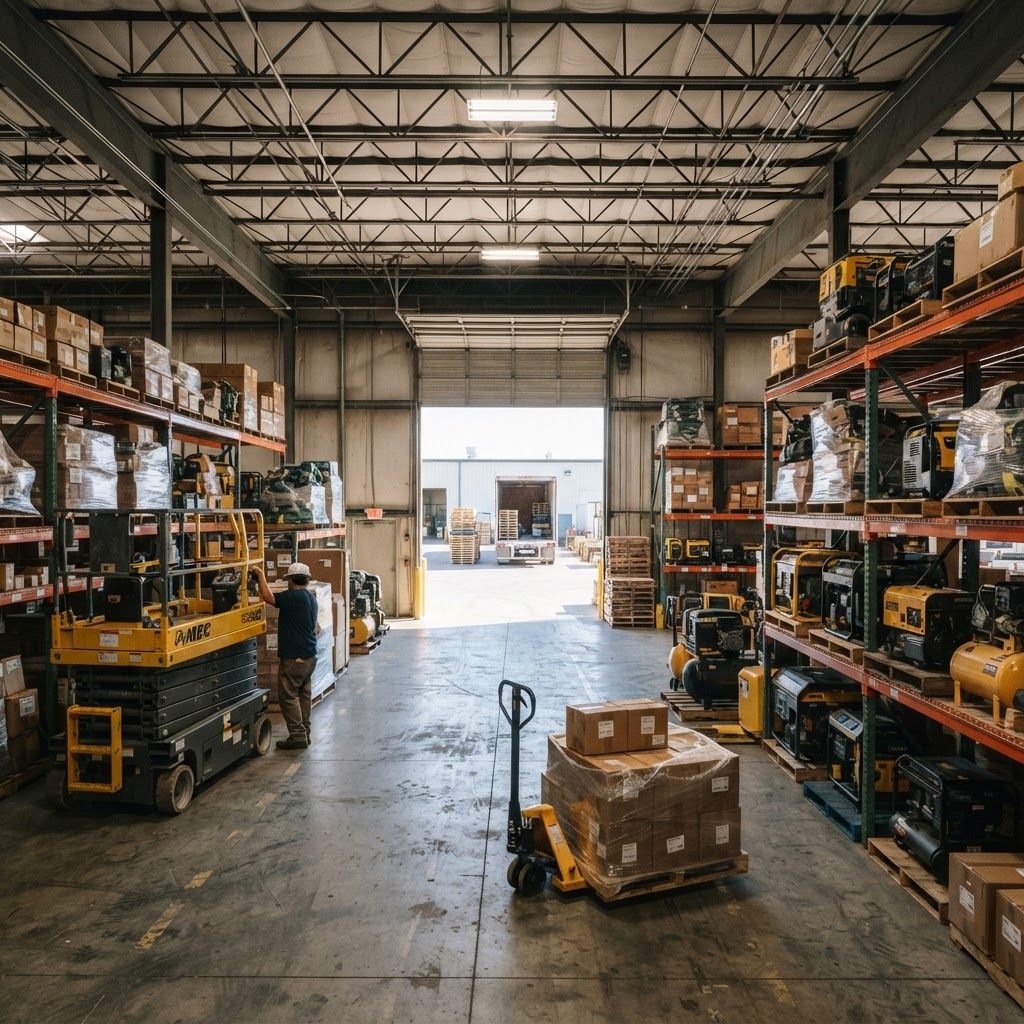
Equipment Distribution in a Manufacturing and Logistics Region
St. Louis has a working economy. Manufacturing plants, food processing facilities, distribution centers, construction firms, breweries and chemical operations all run here, and every one of them consumes equipment — machinery, material handling, tooling, compressed air, power generation, safety systems and the endless stream of consumables that keep operations moving.
That demand supports an equipment wholesale sector that is unusually capable for a metropolitan area of this size. Buyers can source new machinery, rebuilt equipment, rentals and replacement parts locally, often with service technicians available in hours rather than days. In equipment, that service proximity is frequently worth more than the purchase discount, because unplanned downtime costs far more than any negotiated savings.
How These Suppliers Were Evaluated
Criteria included product range and brand representation, parts availability, field service capability, technician expertise, rental and financing flexibility, safety and compliance support, and demonstrated reliability across both large industrial accounts and smaller contractors.
1. Gateway Industrial Equipment Company
Gateway Industrial Equipment Company is a broad industrial distributor covering power transmission components, bearings, pneumatics, hydraulics, motors, drives and maintenance consumables. Its value comes from inventory breadth combined with application engineering — helping a plant select the right bearing or gearbox rather than simply shipping what was ordered. Maintenance departments rely on it for the unglamorous parts that stop production lines when they fail.
2. Midwest Material Handling Solutions
Midwest Material Handling Solutions supplies forklifts, pallet jacks, conveyors, racking, mezzanines, dock equipment and warehouse automation. As distribution operations in the region have expanded, this category has grown accordingly. The company's strength is systems thinking: designing throughput improvements rather than selling individual units, then supporting the installed base with parts and certified technicians. Fleet management programs for lift trucks help operators control total cost of ownership.
3. Arch City Construction Equipment
Arch City Construction Equipment covers earthmoving, compaction, lifting and site equipment through sales, rentals and service. Contractors value the rental fleet as much as the sales catalog, since project-based demand rarely justifies ownership of specialized machines. Field service trucks and strong parts availability keep equipment productive, and operator training support helps contractors meet safety requirements.
4. Riverfront Compressed Air Systems
Riverfront Compressed Air Systems specializes in air compressors, dryers, filtration, piping and vacuum systems. Compressed air is one of the largest hidden energy costs in manufacturing, and the company approaches it as an efficiency problem rather than an equipment sale — conducting leak audits, right-sizing systems and recommending variable-speed technology. Preventive maintenance contracts and rapid emergency response protect facilities where an air system failure halts everything.
5. Show Me Machine Tools Wholesale
Show Me Machine Tools Wholesale serves machine shops and fabricators with CNC machining centers, lathes, presses, saws, welding equipment and precision tooling. Applications engineering, tooling selection and programming support distinguish it from catalog resellers. Both new and quality used machinery are available, which matters for shops scaling capacity without full capital commitment, and service technicians maintain the installed base locally.
6. Heartland Restaurant Equipment Distributors
Heartland Restaurant Equipment Distributors supplies commercial kitchen equipment: ranges, ovens, fryers, refrigeration, dishwashing systems, ventilation hoods and stainless fabrication. Kitchen design services and code guidance on ventilation, gas and health requirements prevent costly build-out errors. Refrigeration service capability is particularly valued, since a failed walk-in cooler is an emergency measured in perishable inventory.
7. Missouri Power Systems and Generators
Missouri Power Systems and Generators handles standby and prime power generation, transfer switches, uninterruptible power supplies and load bank testing. Healthcare facilities, data centers, food processors and municipal operations depend on backup power that works on the first attempt, and the company's emphasis on commissioning, scheduled load testing and documented maintenance reflects that. Rental power for planned outages and emergencies rounds out the offering.
8. Delmar Safety and Industrial Supply
Delmar Safety and Industrial Supply provides personal protective equipment, fall protection, gas detection, confined space gear, lockout systems, spill containment and safety training resources. Regulatory knowledge is central to the value here, as compliance requirements change and misapplied equipment creates real liability. Site assessments and hazard-specific recommendations help employers build defensible safety programs rather than assembling equipment ad hoc.
9. Soulard Landscape and Turf Equipment
Soulard Landscape and Turf Equipment serves commercial landscapers, golf courses, municipalities and grounds crews with mowers, utility vehicles, irrigation components, aeration equipment and small engine service. Seasonality drives the business, so the company maintains strong service throughput in spring and parts availability through peak mowing season. Commercial-grade durability and quick turnaround on repairs are the recurring themes in customer feedback.
10. Cardinal Medical Equipment Supply
Cardinal Medical Equipment Supply distributes clinical and facility equipment to hospitals, clinics, long-term care operations and home health providers, including examination equipment, patient handling systems, sterilization units and durable medical goods. Regulatory documentation, biomedical service support and calibration tracking are essential in this segment, and the company's compliance infrastructure is why healthcare buyers stay with it long term.
Trends in the Equipment Wholesale Sector
Connected equipment with remote monitoring is shifting maintenance from scheduled to predictive, reducing downtime and changing how service contracts are structured. Electrification is expanding rapidly in material handling and light construction equipment, driven by indoor air quality and total cost of ownership rather than regulation alone. Skilled technician shortages have made service capability a stronger differentiator than product line. Equipment-as-a-service and flexible rental structures continue to grow as buyers preserve capital. Finally, energy efficiency is now a primary specification driver in compressed air, refrigeration and motor-driven systems.
How to Choose an Equipment Wholesaler
Evaluate service before product. Ask about technician headcount, average response time, parts stocking depth for your specific equipment and whether service is in-house or subcontracted. Confirm training and commissioning support, since improperly installed equipment underperforms regardless of quality. Compare total cost of ownership including energy, consumables and expected service intervals rather than purchase price. Where demand is uncertain, rental or short-term lease arrangements reduce risk considerably.
Final Thoughts
St. Louis equipment buyers benefit from suppliers who genuinely understand industrial operations, not just catalogs. The ten wholesalers above cover construction, manufacturing, warehousing, hospitality, healthcare and grounds maintenance. Prioritize service capability, insist on proper commissioning, and treat your distributor as part of your maintenance strategy rather than a transactional vendor.