
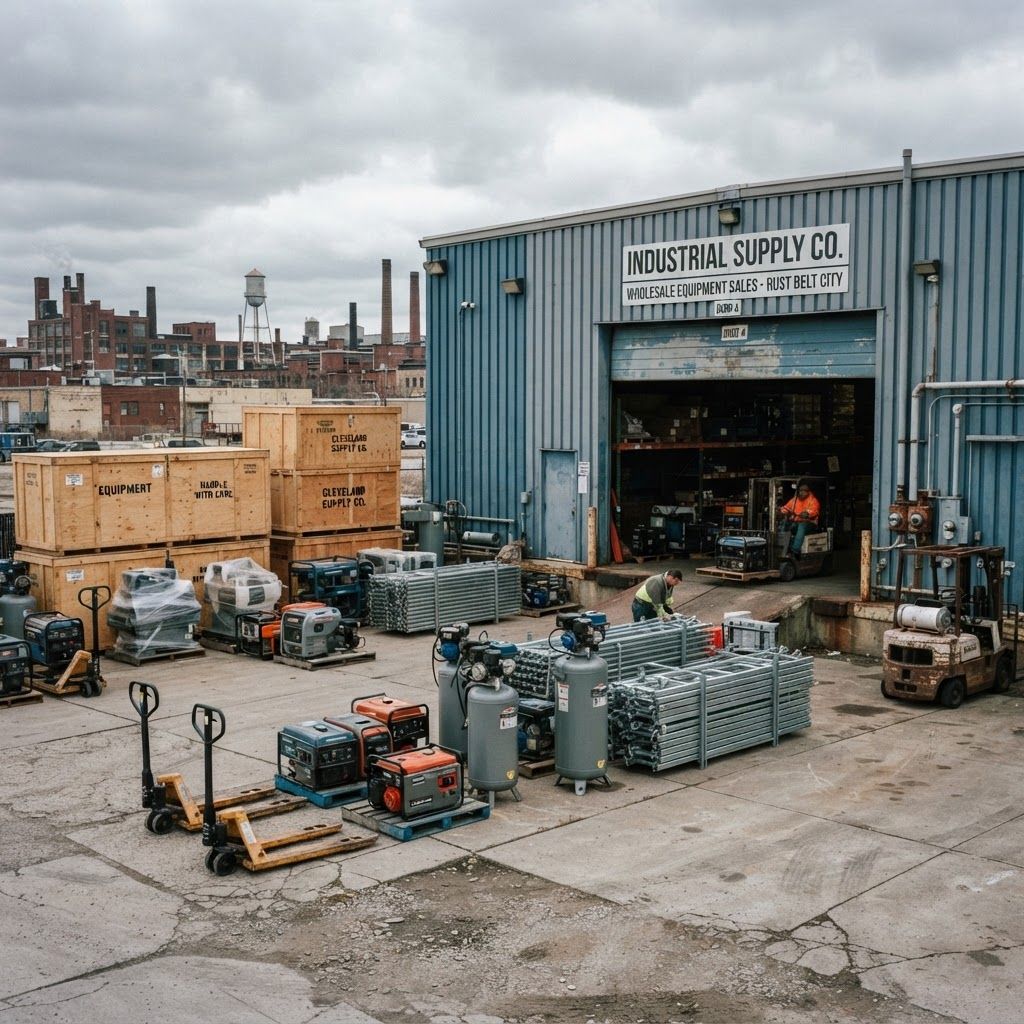
Equipment purchasing sits in an awkward middle ground. It is too expensive to treat casually and too operationally critical to delay. In Buffalo, where construction seasons are compressed, manufacturing remains a meaningful employer and the hospitality sector runs on tight margins, choosing the wrong equipment wholesaler can idle a crew or close a kitchen. The city's supplier base has developed accordingly, with distributors that compete on service response as much as on acquisition price.
Buffalo's Equipment Market in Context
Western New York's economy blends legacy industry with newer growth. Advanced manufacturing, food processing, healthcare construction, logistics warehousing and a busy restaurant scene all generate steady equipment demand. Layer on aggressive weather and a short outdoor building window, and the priority becomes uptime. A distributor's ability to deliver a replacement pump, motor or compressor within hours frequently matters more than a modest discount.
Buffalo also benefits from being a border market. Cross-border trade with Ontario supports a larger inventory base than population alone would sustain, and several distributors serve customers on both sides of the Niagara River, which deepens the parts pool available locally.
The Top 10 Equipment Wholesalers in Buffalo
1. Queen City Industrial Equipment Supply
A broad industrial distributor covering pumps, motors, gearboxes, bearings, compressors and power transmission components. Their advantage is engineering support: application review before purchase reduces the mismatched-specification failures that plague general online buying.
2. Niagara Construction Equipment Distributors
Serves contractors with excavators, skid steers, compactors, generators, light towers and attachments, offered for both purchase and rental. Flexible rent-to-own structures help smaller contractors scale equipment fleets without overleveraging during slow winter months.
3. Lakeshore Restaurant Equipment Wholesale
Focused on commercial kitchens: ranges, fryers, combi ovens, refrigeration, dishwashers, ventilation and stainless fabrication. Kitchen layout consulting and health-code-aware specification help operators pass inspection the first time rather than retrofitting after the fact.
4. Erie County Material Handling Systems
Specializes in forklifts, pallet jacks, conveyors, racking, dock levelers and warehouse automation. With regional distribution expanding, their capacity planning and racking engineering services are increasingly in demand from third-party logistics operators.
5. Buffalo Welding and Fabrication Supply
Provides welders, plasma cutters, gases, consumables, positioners and personal protective equipment. On-site gas delivery schedules and machine repair capability keep fabrication shops productive without maintaining redundant equipment.
6. Great Lakes HVAC and Refrigeration Equipment
Distributes rooftop units, boilers, heat pumps, chillers, controls and refrigeration components. Given Buffalo's heating loads and increasing interest in electrification, their technical guidance on sizing and efficiency incentives has real financial value.
7. Southtowns Landscape and Turf Equipment
Supplies commercial mowers, blowers, trimmers, aerators and, critically for the region, snow removal equipment including plows, spreaders and blowers. The dual-season inventory model matches how local landscape contractors actually operate.
8. Allentown Medical and Laboratory Equipment
Serves clinics, dental practices, veterinary offices and research labs with examination equipment, autoclaves, imaging accessories, centrifuges and cold storage. Compliance documentation, calibration records and preventive maintenance contracts are core to the offer.
9. Cheektowaga Power Tools and Jobsite Supply
Focused on professional-grade hand and power tools, battery platforms, fasteners, ladders, lighting and jobsite storage. Standardized battery ecosystems and warranty processing on the counter save contractors meaningful downtime.
10. Buffalo Used and Refurbished Machinery Exchange
Deals in inspected pre-owned industrial machinery — lathes, mills, presses, packaging lines — with documentation on hours and condition. For manufacturers expanding capacity cautiously, refurbished equipment with a service warranty is often the smartest capital decision available.
How to Evaluate an Equipment Wholesaler
Purchase price is only the opening figure. Total cost of ownership includes installation, energy consumption, consumables, preventive maintenance, expected repair frequency and eventual resale value. A machine costing fifteen percent more but consuming twenty percent less energy and lasting years longer is straightforwardly the cheaper option.
Parts availability deserves specific interrogation. Ask how long the distributor commits to stocking wear parts, whether the manufacturer has a documented parts program, and what the typical turnaround is on a critical component. Equipment with a two-week parts lead time is a liability regardless of specification.
Assess service capability honestly. Does the distributor employ its own technicians or subcontract? What are the response time commitments, and are they contractual or aspirational? Confirm training availability for your operators, because most premature equipment failures trace back to misuse rather than defect. Finally, review financing and warranty structure, including whether labor is covered and what voids coverage.
Trends Shaping Equipment Distribution
Electrification is progressing across construction and landscape categories, driven by emissions rules, noise ordinances and lower operating costs. Telematics and connected diagnostics now allow distributors to monitor machine health remotely and schedule service before failure, converting emergency downtime into planned maintenance. Equipment-as-a-service and subscription models are gaining traction for businesses that prefer operating expense to capital expense. Supply chain diversification has also pushed distributors to broaden manufacturer relationships, improving availability but requiring buyers to compare specifications more carefully across brands.
Final Thoughts
The right equipment wholesaler in Buffalo behaves like a partner rather than a vendor. They specify accurately, stock the parts that will actually fail, respond quickly when they do, and train your team to operate the machine properly. Evaluate suppliers on those dimensions before comparing quotes, and for any purchase you depend on daily, insist on written response-time and parts-availability commitments. That discipline pays for itself the first time a critical machine goes down mid-season.