
An Electronics Base Built on Demanding Customers
Electronics manufacturing tends to develop where demanding customers concentrate, and St. Louis has an unusual concentration of them. The region's aerospace and defense presence, anchored by Boeing's large defense operations in north St. Louis County, has cultivated decades of expertise in high-reliability electronics: wire harnesses, ruggedized assemblies, avionics components, test equipment, and systems that must function under vibration, temperature extremes, and electromagnetic stress.
Alongside that sit medical device manufacturing, industrial controls and automation, agricultural technology sensors and telemetry, transportation electronics, and instrumentation for laboratory and analytical use. Each of these markets demands documentation, traceability, and quality systems that go far beyond consumer electronics, and the local supplier base has organized itself accordingly.
The Structure of the Industry
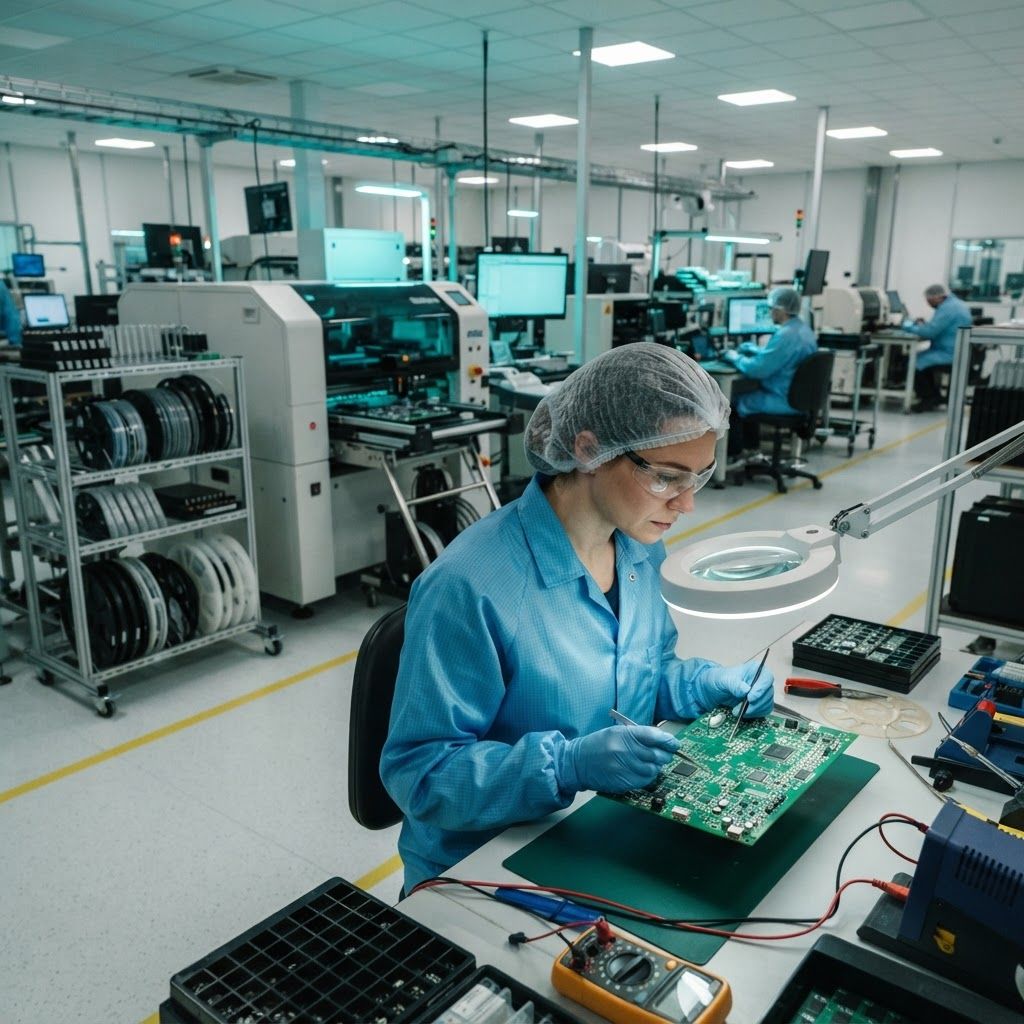
Electronics manufacturing services, commonly called contract manufacturing, form the backbone. These firms provide printed circuit board assembly using surface mount and through-hole processes, cable and harness assembly, box build and system integration, conformal coating and potting, functional and in-circuit testing, and often design for manufacturability support. They range from small prototype shops that turn boards in days to larger operations running multiple automated lines.
Printed circuit board fabrication is a separate discipline involving lamination, drilling, plating, imaging, and finishing. Fewer domestic fabricators remain than assemblers, and those that survive typically specialize in quick-turn prototypes, high-layer-count boards, or specialty materials for radio frequency and thermal applications.
Original equipment manufacturers design and sell their own products, from industrial sensors and control panels to medical instruments and communications gear. Component distributors, test and measurement providers, calibration laboratories, environmental and reliability testing labs, and repair and refurbishment operations complete the ecosystem. Machine shops and sheet metal fabricators supply enclosures, brackets, and heat sinks, and their proximity meaningfully shortens development cycles.
What Separates Excellent Electronics Manufacturers
Certification tells much of the story. Look for ISO 9001 quality management as a baseline, AS9100 for aerospace work, ISO 13485 for medical devices, and IPC workmanship class compliance appropriate to the application. IPC-A-610 Class 3 workmanship, required for high-reliability products, demands substantially more process control than Class 2 commercial standards, and shops that genuinely operate at Class 3 invest heavily in training and inspection.
Process capability follows. Strong assemblers maintain controlled solder paste handling with documented storage and stencil management, calibrated reflow profiles verified by thermal profiling, automated optical inspection, X-ray inspection for ball grid array and bottom-terminated components, and electrostatic discharge control throughout the facility. Traceability systems should link every assembly to component lot codes, operator, equipment, and process parameters.
Engineering collaboration is where good partners create real value. Design for manufacturability review that catches insufficient pad spacing, thermal relief problems, testability gaps, or component obsolescence before the first build saves far more than any per-unit price difference. The best partners also manage component lifecycle proactively, flagging end-of-life parts and proposing qualified alternates.
Trends Driving the Sector
Supply chain resilience has become the dominant strategic theme. Component shortages taught the industry hard lessons about single sourcing, and buyers now expect suppliers to hold safety stock on critical parts, qualify second sources, and provide visibility into lead times. Domestic assembly has gained ground precisely because it reduces exposure to distant disruption.
Defense and aerospace demand has strengthened, driving investment in secure facilities, cybersecurity compliance for controlled information, and expanded capacity for high-reliability builds. Medical device production continues to grow, with associated regulatory documentation burdens. Industrial automation and the broader industrial internet of things have increased demand for connected sensor assemblies and edge computing hardware.
On the technology side, miniaturization continues to push placement accuracy requirements, high-density interconnect and flexible circuits are becoming routine rather than exotic, and power electronics using silicon carbide and gallium nitride are creating new thermal management challenges. Automation of inspection through machine vision has improved yield while reducing dependence on scarce skilled inspectors.
How to Select a Partner
Match the shop to your stage. Prototype and low-volume, high-mix work requires flexibility, fast changeovers, and engineering access. High-volume production rewards automation, purchasing leverage, and process stability. Few facilities excel at both, and a shop that claims to may be optimizing for neither.
Audit before committing. Walk the floor, review calibration records, examine the corrective action system, and ask to see recent first article inspection reports. Discuss capacity honestly: what portion of their lines is currently loaded, and what happens to your schedule if a larger customer expands. Clarify who owns test fixtures, programming files, and excess inventory.
Quote comparison requires normalization. Confirm whether pricing is turnkey or consigned, what non-recurring engineering charges apply, whether test development is included, and how material price changes are handled. Understand the terms around component substitution, since an unauthorized substitution in a regulated product can be extremely costly.
Managing the Relationship
Provide complete documentation packages: bills of material with approved manufacturer part numbers, Gerber and assembly drawings, test specifications, and acceptance criteria. Ambiguity in these documents is the leading cause of build disputes. Establish a regular cadence for reviewing quality metrics, on-time delivery, and open corrective actions. Share forecasts so that long-lead components can be secured in advance.
Looking Ahead
St. Louis is positioned to expand its electronics manufacturing base. Aerospace and defense investment, a growing medical device and life science cluster, strong engineering programs at local universities, central logistics, and reasonable operating costs all support growth. For product companies, the practical advantage of a capable local assembler, where an engineer can stand at the line during a first build, remains one of the most reliable accelerators of a successful product launch.