
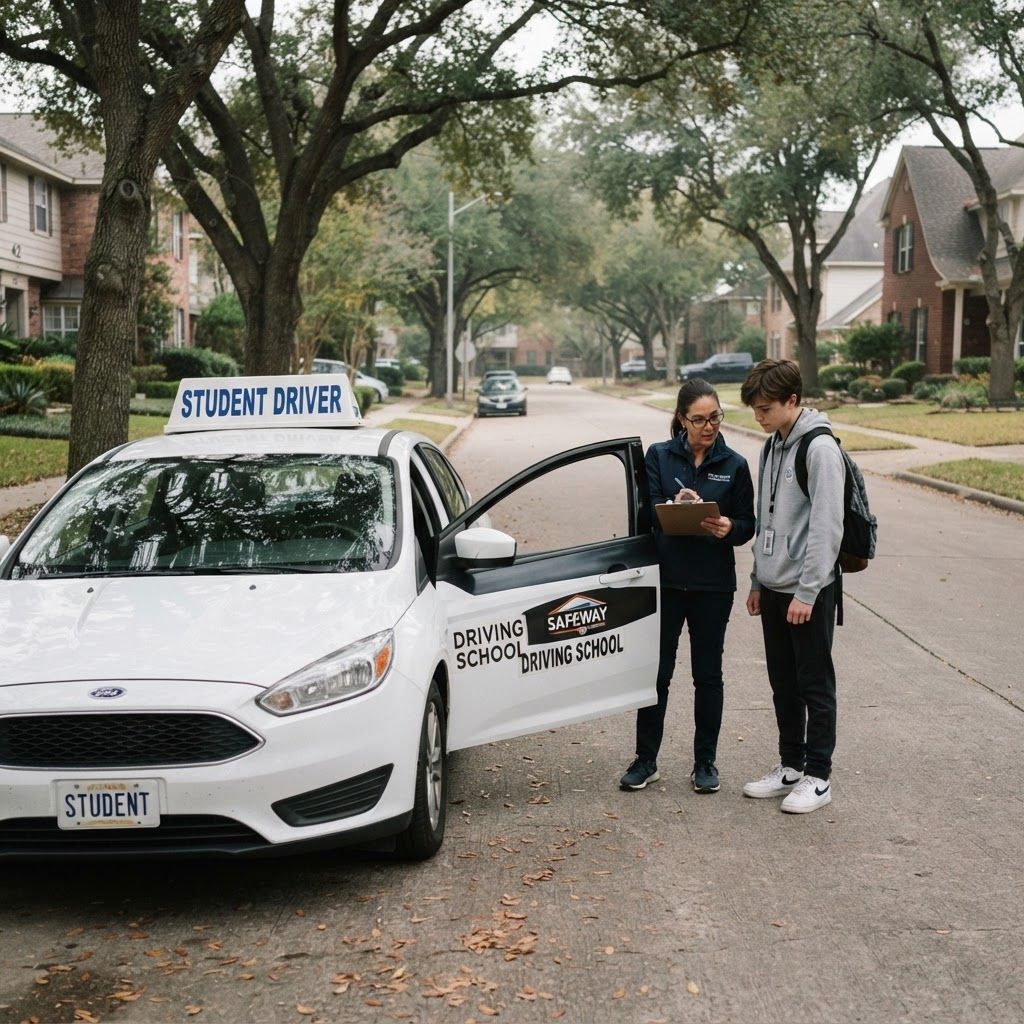
Learning to Drive in a Demanding Environment
New drivers in North Hempstead face conditions that would challenge many experienced motorists. The town sits at the intersection of suburban village streets, dense commercial corridors along Northern Boulevard, and high-speed limited-access parkways with short merge lanes and low overpasses. Add heavy commuter volume, aggressive lane changing, frequent double-parked delivery vehicles, and winter weather, and the learning curve is genuinely steep.
That environment argues strongly for professional instruction rather than relying solely on parent-supervised practice. Not because parents cannot teach, but because the specific skills that matter most here, particularly high-speed merging, gap judgment, and hazard scanning in dense traffic, are difficult to teach without a dual-control vehicle and a structured curriculum.
New York Licensing Requirements Explained
The process begins with a learner permit, obtained after passing a written knowledge test. Applicants under eighteen require parental consent. Permit holders face supervision requirements and, in Nassau County, restrictions on passengers and on operation without a supervising licensed driver aged twenty-one or older.
Before the road test, applicants must complete either a five-hour pre-licensing course or an approved high school or college driver education program. This course covers alcohol and drug awareness, defensive driving principles, and highway safety, and the completion certificate must be presented at the road test.
New York also requires a minimum of fifty hours of supervised practice driving for applicants under eighteen, including at least fifteen hours after sunset, documented on a certification form signed by a parent or guardian. This requirement is substantive rather than a formality, and drivers who genuinely complete varied practice perform noticeably better on the test and afterward.
After passing the road test, drivers under eighteen receive a junior license with restrictions that vary by region, and Long Island has specific limitations. Restrictions lift at age eighteen, or at seventeen with completion of an approved driver education course.
The Ten Best Driving Schools Serving North Hempstead
1. Established local driving academies serving Great Neck and Manhasset are the most commonly used option for good reason. Instructors know the specific road test routes used at regional testing sites, the sequence of maneuvers examiners request, and the local intersections that cause the most failures. That route familiarity is difficult to overstate as a practical advantage.
2. Ferrari Driving School is a long-established regional operation with a strong presence across Queens and Nassau. It offers permit test preparation, lesson packages, the five-hour pre-licensing course, and road test vehicle rental, which simplifies logistics for families without an appropriate vehicle.
3. Pierre Paul Driving School is another well-known regional provider offering structured lesson packages, defensive driving courses, and road test scheduling assistance. Its scale means broad availability and consistent curriculum.
4. Sears Driving School and comparable national-brand programs provide standardized instruction with documented lesson plans. Predictability appeals to families who want a known curriculum rather than instructor-dependent variability.
5. High school driver education programs offered through local districts remain among the best values available. These programs combine classroom instruction with behind-the-wheel training, satisfy the pre-licensing requirement, and often qualify students for insurance discounts and earlier restriction removal.
6. AAA Northeast driver training programs bring the organization's safety research into instruction, with emphasis on hazard perception and defensive technique rather than only test passing. Its defensive driving course for experienced drivers also delivers insurance reductions and point reduction.
7. New Hyde Park and Williston Park area independent driving schools serve the eastern portion of the town with flexible scheduling, home pickup, and instructors who often work with the same families across multiple children. Continuity and reputation drive this segment.
8. Port Washington and Roslyn area schools specialize in the particular challenges of the northern peninsula, including narrow waterfront roads, steep grades near the harbors, and limited-visibility intersections. Local practice on these roads builds skills that a generic curriculum does not address.
9. Adult and refresher instruction providers serve a substantial and growing segment: new residents transferring licenses from other countries, adults who never learned to drive, and older drivers seeking evaluation and refresher training. Patient, judgment-free instruction is the distinguishing feature of the best providers in this category.
10. Advanced and defensive driving course providers complete the list. These programs teach skid recovery, emergency braking, and evasive maneuvering in controlled conditions. For a newly licensed driver about to begin commuting on the parkways, a single day of advanced training is among the highest-value safety investments available.
What Separates a Good School From an Adequate One
Instructor certification and turnover are the first indicators. Ask how long instructors have been with the school and whether the same instructor will handle all lessons, since continuity substantially improves progress. Ask whether vehicles have dual controls and how recently they were serviced.
Curriculum structure is the second. A school that follows a documented progression, from empty parking lots through residential streets to commercial corridors and finally highway merging, produces more confident drivers than one that simply drives around for an hour.
Communication with parents is the third. The best schools provide written progress notes after each lesson identifying what was covered and what needs practice, which makes supervised practice sessions far more productive.
Practical Advice for Families
Start the fifty hours of practice early and vary the conditions deliberately: rain, dusk, night, highway, and heavy traffic. Drivers who only practice on quiet streets in daylight are unprepared for the environment they will actually encounter.
Schedule the road test only when the student is genuinely ready. Failed tests create scheduling delays and, more importantly, damage confidence. Most instructors can predict readiness accurately and will say so honestly if asked directly.
Finally, model good driving. Research consistently shows that new drivers replicate the habits they observed for years from the passenger seat. In a driving environment as demanding as North Hempstead, that inherited habit set matters as much as any formal instruction.