
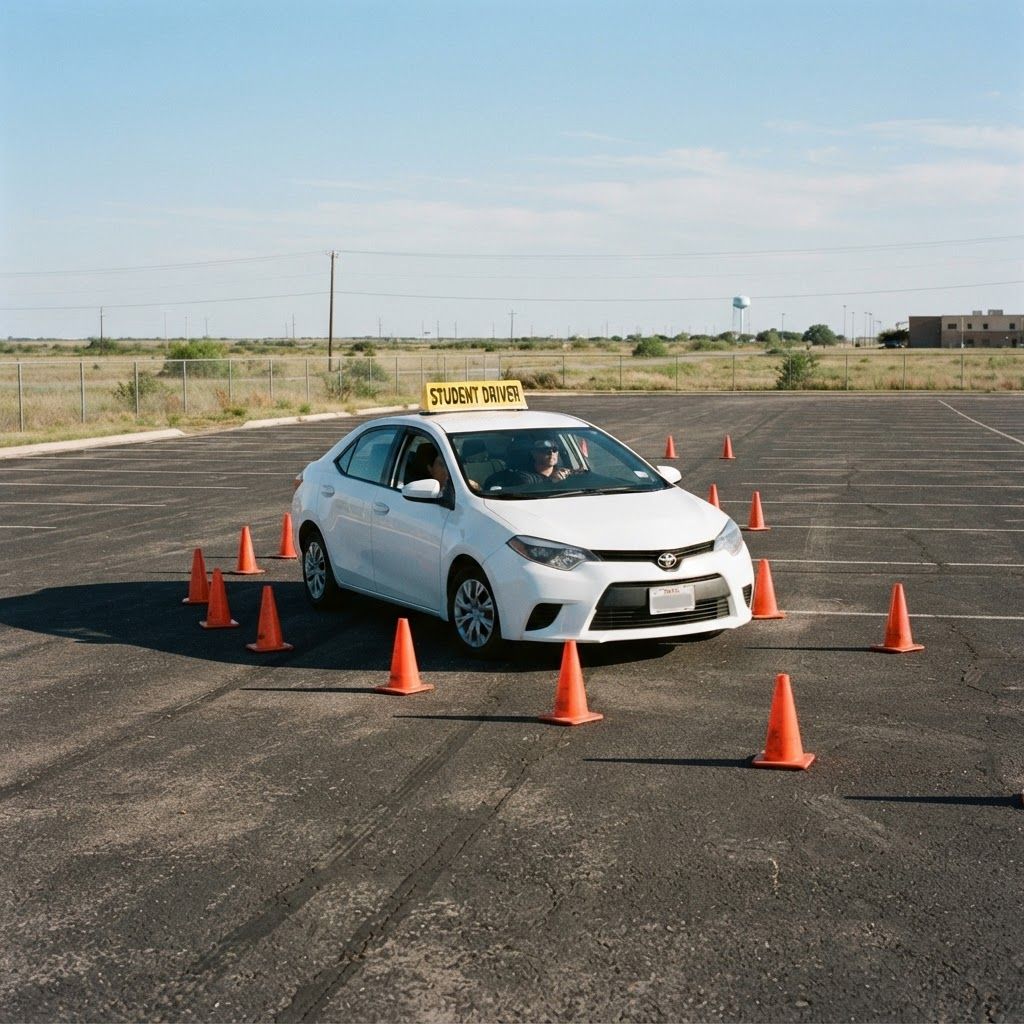
Learning to Drive in a West Texas City
Lubbock is, in many ways, a forgiving place to learn to drive. The street grid is generous, most arterial roads are wide and well marked, and traffic volumes are modest compared with Dallas or Houston. But the city also presents specific challenges that a good driving school addresses directly: high-speed merging on Loop 289 and the interstate, dense pedestrian and cyclist activity around the Texas Tech campus, frequent crosswind on open stretches, blowing dust that can reduce visibility to almost nothing within minutes, and the occasional winter ice event that catches inexperienced drivers badly.
Those conditions make instruction quality genuinely important. A programme that only teaches a student to pass a test produces a licensed driver; a programme that teaches hazard perception, space management and recovery from mistakes produces a safe one.
How Driver Education Is Structured
Texas offers several recognised routes to a licence, and understanding them is the first step in choosing a school.
Teen driver education for students aged fourteen to seventeen combines classroom or online instruction with supervised behind-the-wheel training and a substantial period of parent-supervised practice. Students complete a first phase of theory before they can obtain a learner permit, then continue instruction while accumulating logged practice hours.
Parent-taught driver education allows a qualifying parent or guardian to deliver the programme using an approved curriculum. It is popular with families who want flexible scheduling and lower cost, and many Lubbock schools support these families by selling supplemental behind-the-wheel lessons for skills a parent may not feel confident teaching, such as highway merging or night driving.
Adult driver education serves new drivers aged eighteen and over with a shorter mandated course. Lubbock's schools see steady demand from university students, new residents and adults who simply never learned to drive earlier in life.
Defensive driving and ticket dismissal courses operate separately. These are aimed at drivers seeking insurance discounts or the dismissal of a moving violation, and are typically delivered online or in compressed classroom sessions.
Specialised instruction rounds out the market. This includes commercial driver licence training for the trucking and agricultural sectors, refresher lessons for older drivers or those returning after a long gap, anxiety-focused coaching for nervous drivers, and adaptive instruction for students with disabilities.
What Makes a Driving School Genuinely Good
Licensing and instructor credentials come first. A legitimate school holds the appropriate state approval and employs instructors who have passed background checks and completed formal instructor training. Ask directly about credentials; established schools answer without hesitation.
Curriculum depth is the next consideration. Strong programmes go well beyond vehicle controls and road signs. They teach visual scanning habits, following distance judgement, right-of-way reasoning at complex intersections, roundabout navigation, highway merging and lane discipline, parallel and reverse parking, skid awareness, and the practical realities of driving in rain, dust and low sun glare. Distracted driving and impairment are covered seriously rather than as a checkbox.
Vehicle condition and equipment matter for both safety and learning. Dual-control brakes on training cars are essential, and modern vehicles with backup cameras and driver assistance features let students learn how those systems help and where they cannot be trusted.
Instructor manner is what parents and students remember most. The best instructors stay calm, explain the reasoning behind a rule rather than just stating it, give feedback immediately but without alarming the student, and progressively increase difficulty as confidence grows. Nervous students in particular improve far faster with a patient instructor than with a strict one.
Scheduling flexibility and logistics deserve attention too. Schools that offer evening and weekend lessons, pick up students from home or school, and provide the vehicle for the road test remove a great deal of family friction. Availability of road test appointments is a common bottleneck, and schools authorised to conduct testing themselves can shorten the wait considerably.
Trends in Driver Training
Blended learning is now standard. Theory is increasingly delivered online through interactive modules that students complete at their own pace, while behind-the-wheel time is reserved for skills that can only be learned in a vehicle. This has improved access for rural families across the South Plains who previously drove long distances for classroom sessions.
Simulator use is expanding at the higher end of the market. Simulators allow safe exposure to genuinely dangerous scenarios, such as a tyre blowout, a sudden pedestrian entering the roadway or loss of traction on ice, which cannot responsibly be practised on public roads.
Curricula have also adapted to modern vehicle technology. Students now need to understand adaptive cruise control, lane keeping assistance, automatic emergency braking and blind spot monitoring, including the important lesson that these systems assist a driver but do not replace attention.
Finally, there is growing emphasis on parent involvement. Research consistently shows that the volume and variety of supervised practice is the strongest predictor of a new driver's safety, so good schools now coach parents on how to structure practice sessions rather than leaving them to improvise.
Practical Advice for Students and Parents
Book early. Demand for lessons and road tests peaks during summer and around school holidays, and waiting until the week a permit becomes valid usually means a long delay.
Confirm exactly what a package includes before paying. Compare the number of behind-the-wheel hours, whether observation time counts toward those hours, whether the road test and vehicle use are included, and what a cancellation or reschedule costs.
Spread practice across conditions rather than concentrating it in easy daytime driving. Deliberately practise at night, in rain, in strong crosswind, during rush hour near the university, and on the loop at highway speed. Each of these builds a distinct skill.
Keep a genuine log of supervised hours as required, and treat it as a training plan rather than paperwork. Reviewing what went well and what felt uncomfortable after each session accelerates progress dramatically.
Final Thoughts
Driving schools in Lubbock range from large established operations with multiple instructors and fleets of training vehicles to small independent instructors offering highly personalised lessons. Both models work. The decision should rest on instructor credentials, curriculum depth, vehicle safety, scheduling fit and how comfortable the student feels in the car. Learning to drive is one of the few skills where the quality of early instruction shapes behaviour for decades, and it is worth choosing carefully.