
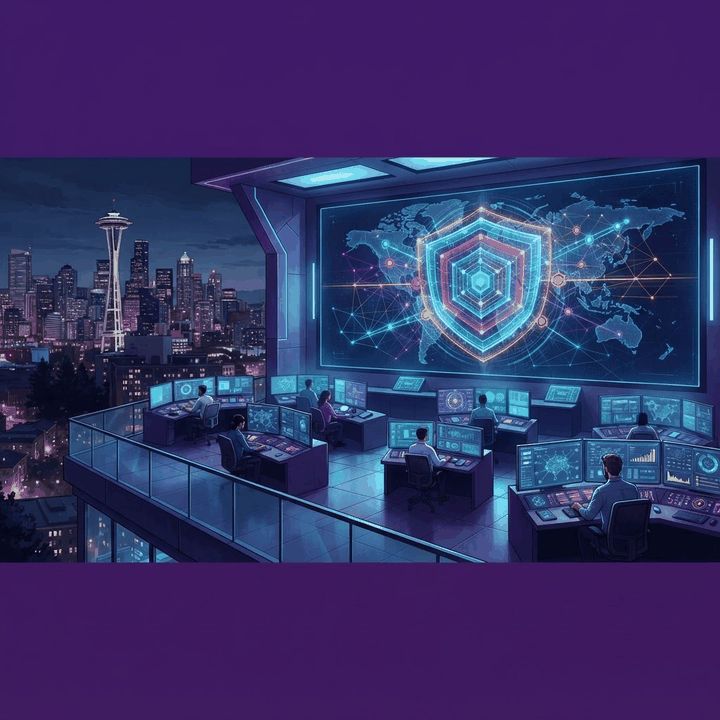
Cybersecurity in a High-Value Technology Market
Washington’s concentration of cloud infrastructure, software companies, healthcare organizations, research institutions, government agencies, and global commerce makes it both a center of cybersecurity expertise and an attractive target. Ransomware, credential theft, software supply-chain weaknesses, and cloud misconfiguration affect organizations of every size. Effective defense requires more than purchasing tools; it requires clear ownership, secure operations, tested recovery, and informed employees.
The best cybersecurity companies in Washington include global product leaders, specialized innovators, and local service providers. Each addresses a different part of the risk landscape. Organizations should build a layered program and select partners according to their most important assets, obligations, and realistic threat scenarios.
1. Microsoft Security
Redmond-based Microsoft provides security across identity, endpoints, cloud workloads, email, data, applications, and threat intelligence. Its advantage is visibility across products used by a vast number of organizations. Businesses invested in the Microsoft ecosystem can consolidate signals and automate responses across familiar tools. Successful implementation still requires thoughtful configuration, skilled analysts, and continuous tuning.
2. Amazon Web Services Security
Amazon Web Services develops extensive cloud security capabilities from its Seattle base. Services cover identity, encryption, network protection, logging, compliance, secrets, vulnerability management, and threat detection. AWS follows a shared responsibility model, meaning customers remain accountable for how applications and resources are configured. Its broad controls are powerful when organizations establish strong cloud governance and automate secure defaults.
3. ExtraHop
Seattle-based ExtraHop specializes in network detection and response. Its technology analyzes network activity to identify suspicious behavior, investigate incidents, and reveal risks that may bypass other controls. This visibility can be important in complex environments where organizations need to understand movement between systems. ExtraHop’s regional roots and enterprise focus make it a notable part of Washington’s security sector.
4. WatchGuard Technologies
Headquartered in Seattle, WatchGuard provides network security, secure Wi-Fi, multifactor authentication, and endpoint protection, with a strong channel-partner model. Its products are widely used by small and midsize businesses that need capable protection without an extensive internal security team. Integration and centralized management are key advantages for managed service providers supporting many customer environments.
5. F5
Seattle-based F5 protects and delivers applications across data centers, clouds, and edge environments. Its portfolio includes application security, traffic management, API protection, and defenses against automated abuse. As businesses expose more services online, application and API risks become central. F5’s long experience with high-volume enterprise traffic distinguishes it in environments where availability and security must operate together.
6. Protect AI
Protect AI is a Seattle company focused on security for machine learning and artificial intelligence systems. It addresses model files, open-source dependencies, pipelines, and other elements of the AI supply chain. This specialization is increasingly important because AI development introduces assets and workflows that traditional security tools may not fully understand. The company combines product development with research that helps the broader industry recognize emerging risks.
7. Rubica
Washington-founded Rubica has focused on digital security and privacy for individuals, executives, and smaller organizations. Its approach emphasizes monitoring and protecting users whose personal and professional risks overlap. Executive protection is a growing concern because attackers may target family members, personal accounts, or home networks to reach a business. Providers in this category should be evaluated for privacy, response processes, and transparency.
8. Critical Insight
Critical Insight, based in the Seattle area, provides managed detection and response, security assessments, incident response, and advisory services. The company has experience with healthcare, public-sector, and other regulated organizations. Its managed model can help teams that need continuous monitoring but cannot staff a full security operations center. Local expertise and strategic guidance complement its operational services.
9. CI Security
CI Security has delivered managed cybersecurity, consulting, and incident response services from Washington. Its work has included organizations responsible for critical services and sensitive data. A provider with both monitoring and incident experience can help clients improve practical readiness because it understands how failures unfold. Businesses should confirm current service capabilities, staffing, and escalation procedures during evaluation.
10. Intrinium
Spokane-based Intrinium offers cybersecurity and managed IT services to organizations in the Inland Northwest and beyond. Its capabilities include assessments, testing, compliance support, monitoring, and security program development. Regional presence is valuable for Eastern Washington businesses seeking direct relationships and an understanding of local industries. Intrinium can support organizations moving from informal controls toward a more structured risk program.
How to Select a Cybersecurity Company
Start with a risk assessment and asset inventory. Ask providers to explain what they monitor, how quickly they investigate, who responds after hours, and which actions require client approval. Verify certifications and relevant experience, but do not rely on badges alone. Request sample reports and escalation scenarios. Contracts should define data handling, notification, service levels, subcontractors, and responsibilities during an incident.
Security tools cannot compensate for missing basics. Washington organizations should prioritize multifactor authentication, rapid patching, tested offline recovery, least-privilege access, secure vendor management, and employee awareness. The right cybersecurity company will be candid about limitations and help leadership prioritize improvements. Strong security is a continuing operational discipline that protects customer trust and allows innovation to proceed with greater confidence.