
Why Equipment Rental Strategy Matters
Equipment rental is one of the few construction decisions where a small amount of planning produces a large financial return. The obvious calculation is rental cost versus purchase cost, but the decisions that actually determine outcomes are different: whether the machine arrives on the day the crew is ready, whether it is the right size for the access constraints of the site, whether it breaks down mid-job and how fast a replacement appears, and whether the rental agreement exposes you to damage and fuel charges you did not anticipate.
Chula Vista projects add specific practical constraints. Infill lots in the western neighborhoods often have narrow driveways, tight side yards and overhead utility lines, which means compact and mini equipment frequently outperforms larger machines that cannot physically reach the work. Hillside sites in the eastern communities involve slopes that demand tracked rather than wheeled equipment. Work near the bayfront and in dense residential areas involves noise considerations and limited staging space for both the machine and the material it moves. Delivery access is often the binding constraint, not machine capability.
How to Evaluate an Equipment Rental Provider
Ask about fleet age and maintenance records
A breakdown costs far more than the rental rate, because it idles a crew. Ask the average age of the specific machine class you need, how maintenance is documented, and what the replacement policy is if a unit fails on site. Providers who answer these questions precisely are the ones who maintain their fleet.
Understand the full rate structure before signing
Rates are quoted daily, weekly and monthly, and the weekly rate is often barely more than three days. Beyond the base rate, ask about delivery and pickup charges, environmental and fuel surcharges, damage waiver cost and whether it is optional, minimum rental periods, hour limits on the rate, and overtime hourly charges beyond the included allowance. These items commonly add a substantial percentage to the quoted rate.
Confirm insurance requirements early
Most providers require proof of liability coverage naming them as additional insured, or sale of a damage waiver. Sort this out before delivery day, since insurance paperwork is a frequent cause of last-minute delays.
Verify delivery access with the provider
Describe your access honestly, including gate widths, driveway slope, overhead clearance and turning space. Good providers will tell you when a machine will not fit and recommend an alternative, which is far cheaper than a failed delivery attempt.
Ask about operator training and certification requirements
Some equipment legally requires certified operators. Ask what training the provider offers, what documentation you need, and whether an operated rental with a qualified operator makes more sense than a bare rental for your scope.
The Ten Types of Equipment Rental Provider Serving Chula Vista
1. Full-line general rental yards
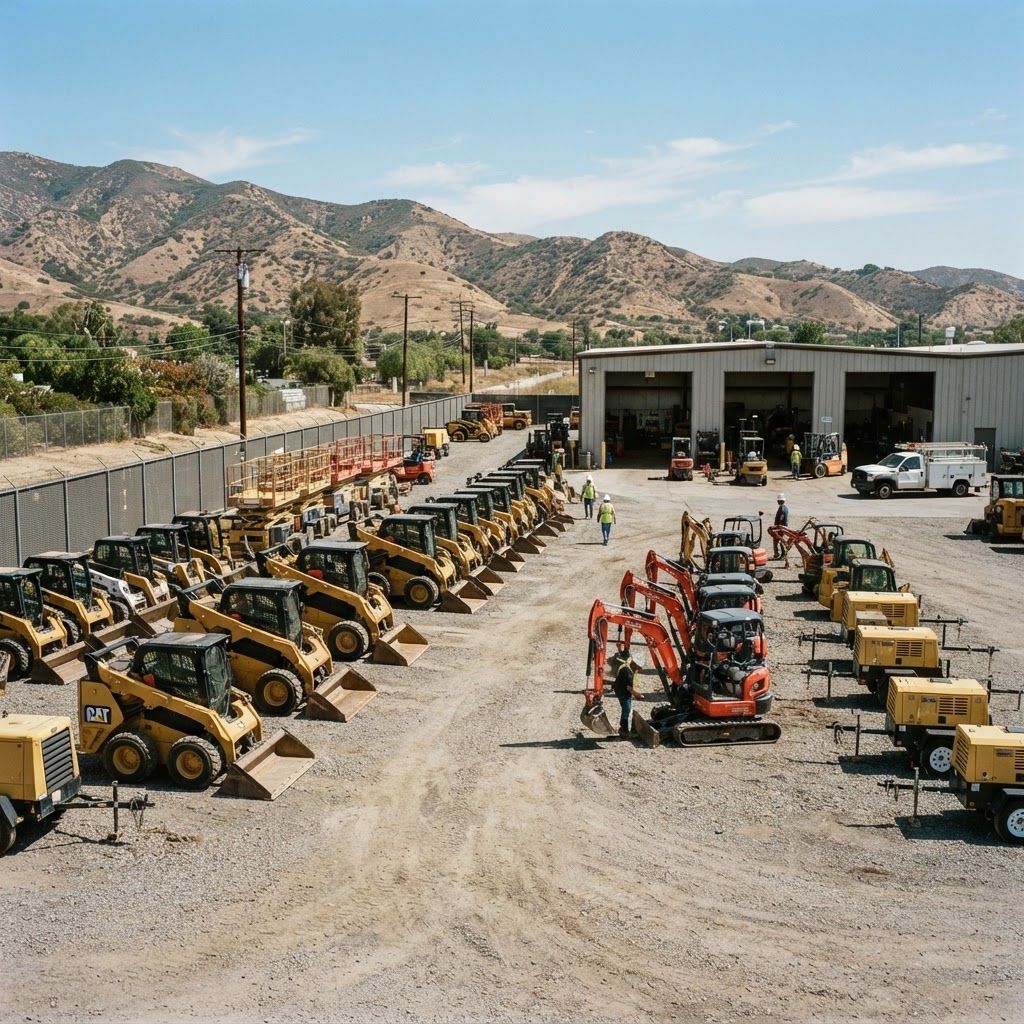
These providers stock earthmoving, aerial, compaction, concrete and support equipment in one place. The advantage is consolidated billing, one delivery relationship and the ability to swap machine classes as a project evolves.
2. Compact and mini equipment specialists
Mini excavators, compact track loaders, skid steers and walk-behind equipment are the workhorses of infill and residential work. Specialists in this category stock a range of sizes and attachments, which is exactly what tight Chula Vista lots require.
3. Earthmoving and heavy equipment providers
Excavators, dozers, loaders, scrapers and articulated trucks serve grading, mass excavation and site development. These providers handle the transport logistics that heavy machines require and typically offer operated rental options.
4. Aerial lift and access equipment rentals
Scissor lifts, boom lifts, telehandlers and scaffolding serve exterior work, high ceilings and installation at height. Selection depends on reach, platform capacity, terrain and whether indoor electric or outdoor rough-terrain units are appropriate.
5. Concrete and masonry equipment specialists
Mixers, power screeds, trowels, saws, core drills, vibrators and grinders support concrete work. Specialists here also carry the diamond blades and consumables that generalists run out of.
6. Compaction and paving equipment providers
Plate compactors, rammers, walk-behind and ride-on rollers, and paving support equipment serve site work and hardscape. Correct compaction equipment selection depends on soil type and lift thickness, and knowledgeable providers advise on this.
7. Trench safety and shoring rental firms
Trench boxes, shoring, plating and confined space equipment are safety-critical rentals. Providers in this niche understand the engineering and regulatory requirements and often supply the tabulated data that inspections require.
8. Pump, dewatering and water management rentals
Trash pumps, submersible pumps, hose and filtration serve excavation dewatering and winter storm response. Availability during rain events is the key differentiator here.
9. Tool and small equipment rental shops
Saws, drills, breakers, generators, air compressors, sanders and specialty hand tools serve homeowners and small contractors. These shops are the practical choice for short jobs where a machine rental is unnecessary.
10. Temporary site services and support providers
Portable toilets, temporary fencing, storage containers, light towers, temporary power and dumpsters make a site functional. Coordinating these with equipment rental from a single relationship simplifies logistics considerably.
Practical Advice for Renters
Reserve equipment well ahead of peak demand periods, since spring and early summer strain regional fleets. Inspect and photograph machines at delivery and at pickup, documenting existing damage and fuel level, because this is the most common source of billing disputes. Return equipment fueled and clean when the agreement requires it, as refueling and cleaning charges are typically well above market rates. Match rental duration to realistic schedules rather than optimistic ones, and consider whether the weekly rate is cheaper than three or four separate daily rentals.
Finally, evaluate operated rental honestly. For a small amount of specialized work, hiring a machine with an experienced operator often costs less overall than a bare rental plus an inexperienced operator's slower pace and higher damage risk.
Conclusion
Equipment rental in Chula Vista rewards providers with well-maintained fleets, transparent rate structures and honest advice about site access. Verify fleet condition and replacement policy, understand every charge in the agreement, sort out insurance in advance, and select the machine size that fits your access rather than the largest one available. Handle those details and equipment becomes a reliable accelerator rather than a source of delay.