
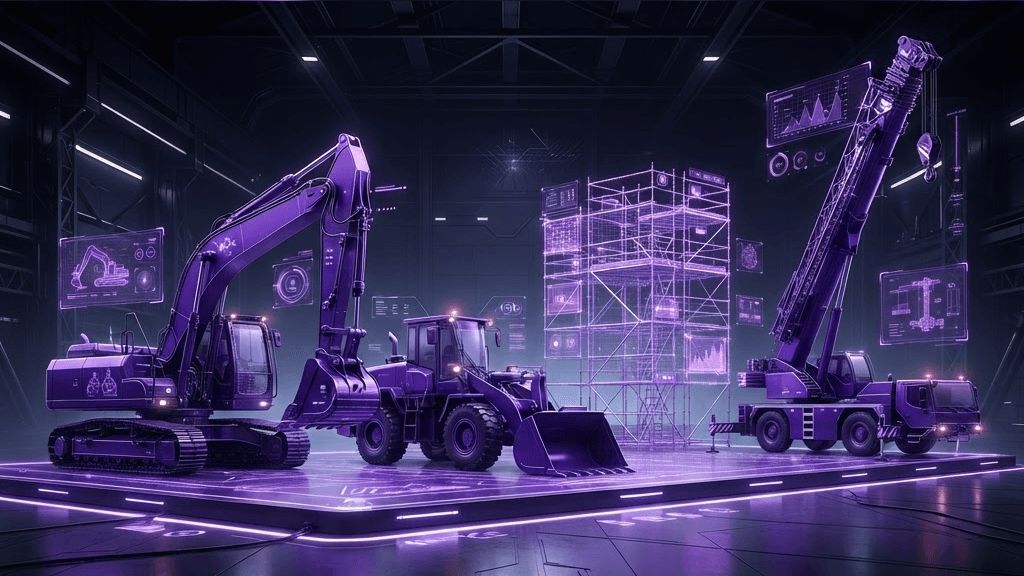
Why Equipment Rental Dominates Modern Construction
Few contractors can justify owning the full range of machinery a project demands. An excavator may be needed for three weeks, a concrete pump for two days and a mobile crane for a single lift. Ownership brings capital cost, storage, insurance, maintenance, operator employment and depreciation — all of which continue whether the machine works or sits idle. Rental converts these fixed costs into variable ones tied directly to project needs.
In Alexandria, rental demand is driven by a steady pipeline of residential development, port and industrial projects, infrastructure work and a large renovation market. The city's dense older districts also create specific demand for compact machinery capable of working in restricted access conditions where full-size equipment simply cannot operate.
Evaluation Criteria
These companies were assessed on fleet condition and age, breadth of equipment available, maintenance standards and breakdown response, availability of trained operators, delivery logistics, transparency of rental terms, and reliability of availability against booked dates.
The Top 10 Construction Equipment Rental Companies in Alexandria
1. Alexandria Equipment Rentals — A broad-fleet supplier covering excavators, loaders, compactors and generators, with documented servicing records and prompt replacement when a machine fails.
2. Pharos Heavy Machinery — Specialises in large earthmoving equipment for major civil and infrastructure projects, supplying operators alongside machines.
3. Mediterranean Crane Services — Focused on lifting: mobile cranes, tower cranes and telehandlers, with lift planning support that many rental firms do not provide.
4. Delta Concrete Equipment — Supplies concrete pumps, mixers, vibrators and power floats, critical for pour days where equipment failure has immediate structural consequences.
5. Corniche Scaffolding and Access — Provides scaffolding, mobile towers, boom lifts and scissor lifts, including erection and dismantling by trained crews.
6. Smouha Compact Equipment — Focuses on mini excavators, skid steers and small compactors suited to narrow streets and confined urban sites in the older districts.
7. Nile Coast Power Solutions — Rents generators, lighting towers, welding sets and temporary power distribution, essential on sites without established supply.
8. Royal Formwork Systems — Supplies system formwork, shoring and props on a rental basis, allowing contractors to use modern systems without purchasing them.
9. Horizon Demolition Equipment — Provides breakers, crushers and demolition attachments, along with dust suppression equipment increasingly required in populated areas.
10. Alexandria Tool Hire Centre — Serves smaller contractors and renovation trades with hand tools, power tools and light equipment on short-term hire.
The Economics of Renting Versus Buying
The decision hinges on utilisation. As a general principle, equipment used consistently across the majority of a year may justify purchase, while equipment needed intermittently almost never does. Rental also transfers maintenance risk, avoids depreciation on machines that are technologically superseded, and provides access to newer, more efficient equipment than most contractors would otherwise own. For smaller contractors, rental additionally preserves working capital that is better deployed into project cash flow.
Operated Versus Bare Rental
Bare rental supplies the machine only, requiring the contractor to provide a competent operator. Operated rental includes a trained operator, typically at a higher daily rate but with significantly lower risk of misuse, damage and unsafe operation. For specialised equipment — cranes, concrete pumps, large excavators — operated rental is usually the correct choice regardless of cost, because operator skill has a direct effect on both productivity and safety.
Avoiding Downtime
Downtime, not rental rate, is the real cost driver. Book equipment well in advance of critical dates, particularly cranes and concrete pumps whose unavailability halts everything. Inspect machines on delivery and record their condition photographically to avoid disputes at return. Confirm the supplier's breakdown response commitment and whether a replacement machine is guaranteed within a defined period. Ensure site access, ground bearing and working space are prepared before delivery, since a machine that cannot be positioned still accrues charges.
Trends in the Rental Market
Fleet telematics are spreading, allowing suppliers to monitor machine hours, location and fault codes remotely, which improves preventive maintenance and reduces unexpected failures. Demand for lower-emission and quieter equipment is growing for work in residential areas. Compact and remote-controlled machinery is expanding as urban infill and renovation projects increase. And short-term, flexible hire arrangements are becoming more common as contractors optimise equipment use day by day rather than booking for whole project phases.
Contractual Points to Clarify
Establish exactly what the rate includes: delivery and collection, fuel, operator, maintenance and insurance are all variables. Confirm liability for damage and whether the machine is insured during hire or whether the contractor must arrange cover. Clarify minimum hire periods and how partial days are charged. Agree the return condition standard, particularly regarding cleaning and fuel level. And check whether idle standing time — when work is suspended by weather or delay — is charged at full rate.
Final Thoughts
The best construction equipment rental companies in Alexandria compete on fleet reliability and responsiveness, not just daily rates. A supplier who delivers a well-maintained machine on the promised date and replaces it quickly when it fails will save far more than a cheaper competitor whose equipment strands your crew for a day.