
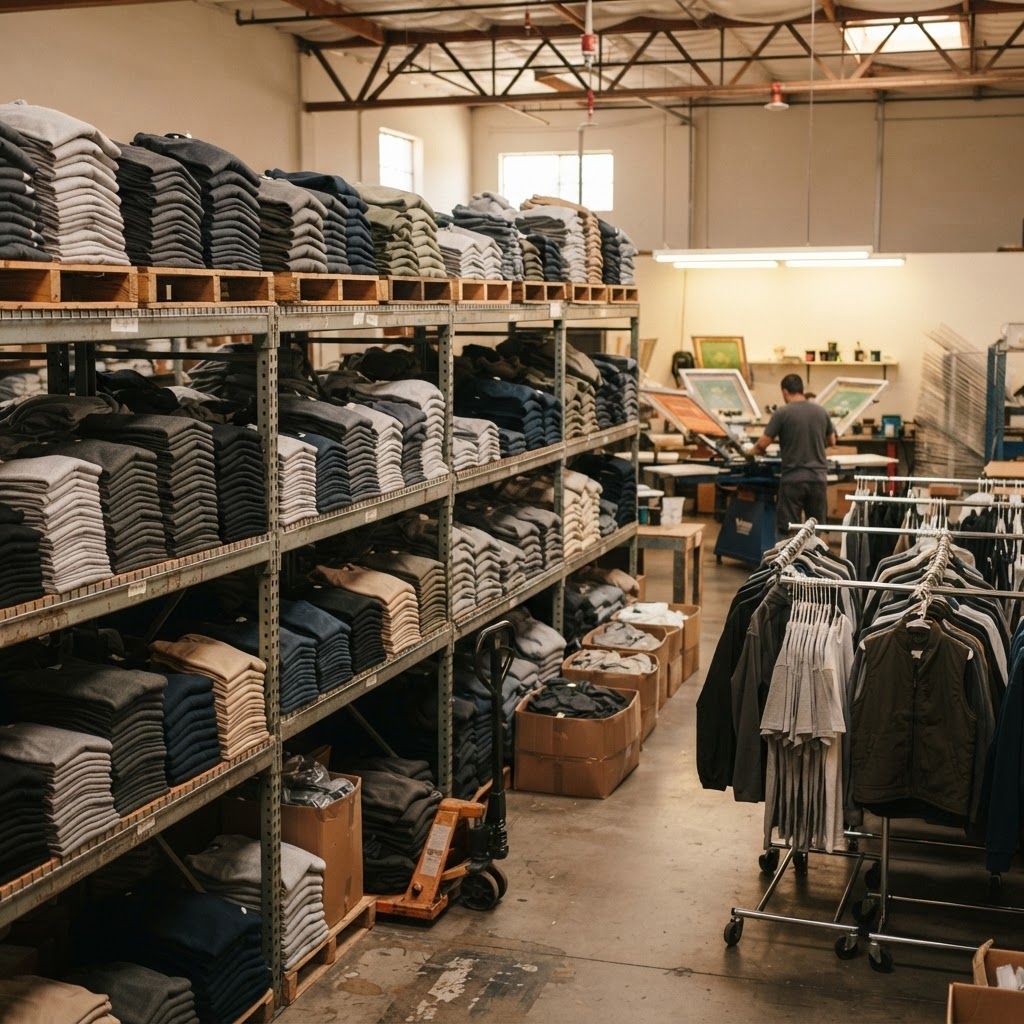
Buffalo's apparel wholesale trade serves a more varied customer base than most people would guess. Independent boutiques along Elmwood and Hertel avenues need fashion lines in small quantities. Screen printers and embroiderers need blanks by the case. Hospitals, restaurants and industrial employers need uniform programs with consistent sizing and reorder availability. Meanwhile the region's intense sports culture sustains a steady market for team and fan apparel. Local wholesalers have organized themselves around these distinct needs.
How Apparel Wholesale Works
Buyers generally choose among several supplier types. Blank apparel distributors stock undecorated garments in volume for decorators. Fashion wholesalers and showrooms carry branded collections, typically sold by season with advance ordering. Uniform suppliers combine garments with decoration, sizing management and reorder programs. Off-price and closeout wholesalers move overstock at reduced cost with limited size availability. Understanding minimum order quantities, reorder reliability and decoration capability matters more to profitability than headline unit price.
Ten Clothing Wholesalers to Know
Queen City Apparel Wholesale stocks blank garments including tees, fleece, polos and outerwear across a wide range of brands and sizes. Same-day will-call pickup and deep inventory make it a mainstay for decorators working against tight deadlines.
Niagara Uniform Supply provides complete uniform programs for healthcare, hospitality and industrial employers. The value is administrative as much as material, with size management, employee ordering and consistent reorder availability across multi-year programs.
Elmwood Fashion Distributors serves independent boutiques with contemporary women's and men's collections. Lower minimums than most showrooms let small retailers carry a curated assortment without overcommitting inventory capital.
Buffalo Team Apparel Group supplies decorated and blank athletic wear for schools, leagues and retailers. Performance fabrics, sublimation printing and roster-based ordering support programs that must outfit entire teams before a season begins.
Frontier Workwear Wholesale distributes durable work clothing, high-visibility garments and flame-resistant apparel. Compliance is central here, and the company helps employers match garments to the specific safety standards their operations require.
Lakeshore Outerwear Company concentrates on cold-weather apparel, an unsurprising specialty given the regional climate. Insulated jackets, shells and layering pieces are stocked for both retail and corporate outfitting, with an emphasis on garments that genuinely perform in lake-effect conditions.
Cataract Closeout Clothing moves overstock, past-season and canceled-order inventory at significant discounts. Buyers accept incomplete size runs in exchange for margin opportunity, and the assortment turns over constantly.
Harbor Point Accessories Wholesale supplies hats, bags, socks and accessories that complement apparel programs. Headwear in particular has become a decoration staple, and the company stocks styles suited to both embroidery and patch application.
Allentown Vintage Wholesale sources and grades secondhand and vintage clothing in bulk for resellers. The resale market has grown substantially, and reliable grading standards let buyers purchase confidently by lot rather than inspecting individual pieces.
Lackawanna Textile and Trim supplies fabric, thread, interfacing and trim to small manufacturers and independent designers. As local small-batch apparel production has grown, access to materials in modest quantities has become genuinely valuable.
Trends Affecting Apparel Wholesale
Sustainability and transparency now influence buying decisions meaningfully. Retailers ask about organic and recycled fibers, and about labor conditions in the supply chain, and wholesalers who can supply verified information gain preference. The resale and circular market has also matured from niche to mainstream, creating legitimate wholesale channels for secondhand goods.
On-demand and small-batch decoration continues to expand, driven by direct-to-garment printing and improved digital methods that make single-unit customization viable. That has shifted blank distributors toward broader size and color availability rather than deep stock of fewer options. Nearshoring is a third trend, with brands reducing lead times by moving production closer to North American markets, which benefits wholesalers able to restock quickly.
Choosing an Apparel Wholesale Partner
Prioritize reorder reliability above all for programs that repeat. A garment that cannot be replenished in the same color and fit creates real problems for uniform customers and disappoints retail buyers who built displays around it. Ask how long the supplier commits to carrying a given style.
Understand minimums, price breaks and return policies clearly, since apparel carries significant inventory risk and unsold stock erodes margin quickly. Evaluate sizing consistency by ordering samples across the full range, because size variation generates returns and complaints. Finally, consider decoration capability and turnaround, as a wholesaler who can also print or embroider consolidates the supply chain and shortens delivery for time-sensitive orders.
Managing Inventory Risk in Apparel
Apparel punishes overbuying more than most retail categories, because unsold stock loses value with each passing season rather than simply sitting on a shelf. Disciplined buyers plan assortments around a core of continuity items that sell year-round, layering seasonal and fashion pieces on top in smaller quantities where the markdown risk is contained.
Size curve accuracy matters enormously as well. Ordering an even spread across sizes almost always leaves the extremes unsold while the middle sells out, so tracking actual sales by size and weighting future orders accordingly protects margin meaningfully. For decorators, holding blanks rather than finished decorated goods preserves flexibility, since undecorated inventory can serve any customer while a printed run serves only one.
Final Thoughts
Buffalo's clothing wholesalers span blanks, fashion, workwear, team apparel and resale, giving regional retailers and decorators genuine choice. Selecting a supplier whose model matches the business, whether that means deep blank inventory or curated seasonal collections, is what turns apparel from an inventory risk into a reliable revenue stream.