
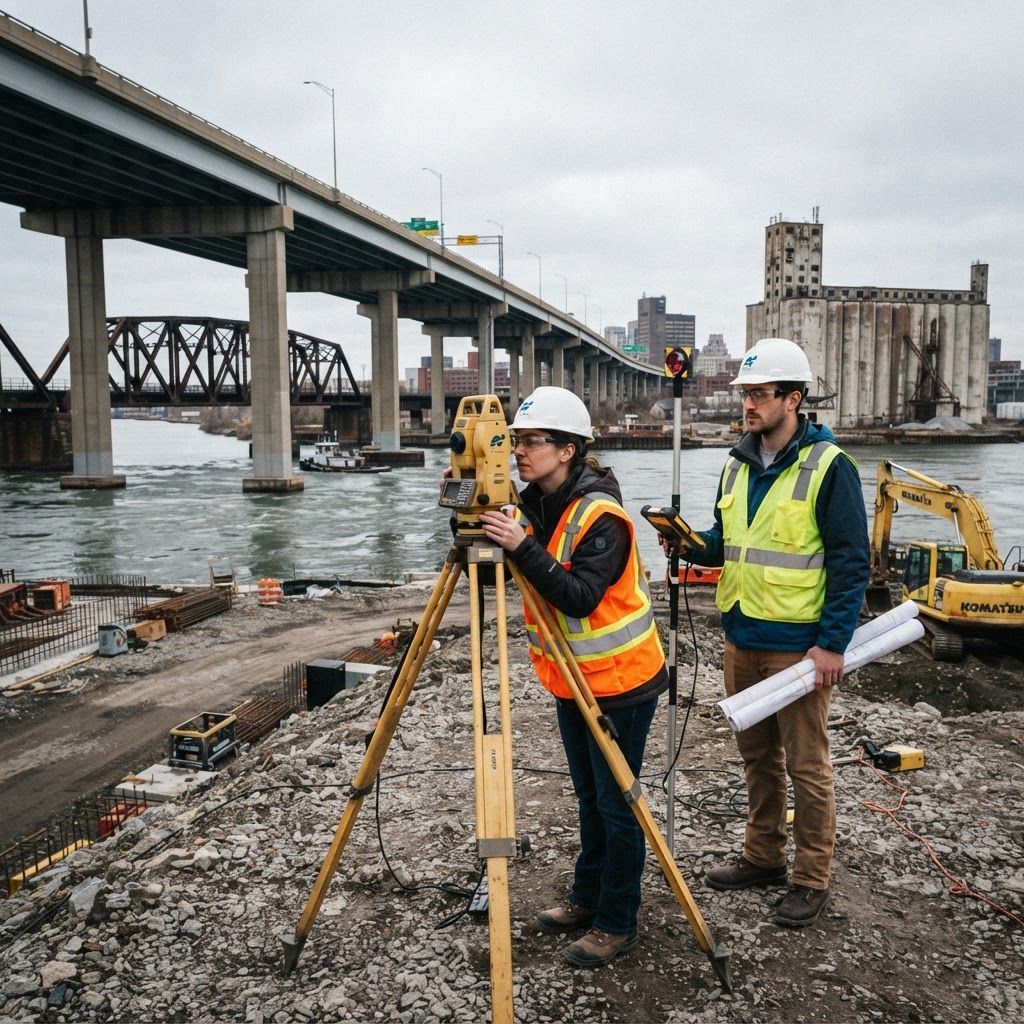
Engineering for the Great Lakes Region
Civil engineering in Western New York contends with conditions that would challenge any practice. Heavy annual precipitation and snowmelt drive demanding stormwater design. Aging combined sewer infrastructure requires careful capacity planning. Lakeshore and riverfront sites raise shoreline stabilisation and flood considerations. Decades of industrial history left brownfield parcels requiring environmental engineering before redevelopment. And a dense inventory of bridges and roadways built mid-century needs continuous assessment and rehabilitation.
Firms that thrive here combine technical rigour with regulatory fluency, because a technically elegant design that cannot secure approvals from state environmental agencies, municipal engineering departments and conservation authorities delivers nothing.
What Distinguishes a Strong Civil Firm
Professional engineering licensure is the baseline. Beyond that, look for demonstrated local permitting success, in-house capability across the disciplines a project needs, and modern tooling including hydraulic and hydrologic modelling, survey-grade positioning and drone-based topographic capture. Firms that provide construction phase services rather than disappearing after design deliver considerably more value, because field conditions always differ from drawings.
The Top 10 Civil Engineering Firms in Buffalo
1. Queen City Civil Engineering Associates
A full-service practice covering site development, grading, utilities, stormwater and municipal approvals. Their strength is entitlement work, guiding developers through planning board review, environmental assessment and permitting with realistic timelines rather than optimistic ones.
2. Lakeshore Water Resources Engineering
Specialists in hydrology and hydraulics, including stormwater management design, floodplain analysis, shoreline stabilisation and green infrastructure. Their work on combined sewer overflow reduction addresses one of the region most persistent infrastructure challenges.
3. Elmwood Structural and Bridge Engineers
Bridge inspection, rehabilitation design and load rating for municipal and state assets, alongside structural engineering for buildings. Deep familiarity with freeze-thaw deterioration and salt-induced concrete damage informs their repair recommendations.
4. Niagara Geotechnical Consultants
Subsurface investigation, foundation recommendations, slope stability and retaining wall design. Buffalo variable glacial soils and high water tables make competent geotechnical work essential rather than optional, and their reporting is notably clear for non-engineers.
5. Southtowns Transportation Engineering
Roadway design, traffic impact studies, signal design, intersection improvement and complete streets planning. Their multimodal work supporting bicycle and pedestrian infrastructure has shaped several successful corridor redesigns.
6. Amherst Environmental Engineering Group
Brownfield assessment and remediation design, environmental site investigation, and regulatory compliance support. Given Buffalo industrial legacy, their expertise unlocks parcels that would otherwise remain undevelopable.
7. Cheektowaga Land Surveying and Civil Design
Combining licensed land surveying with civil design, this firm handles boundary surveys, topographic mapping, subdivision platting and construction staking. Integrated survey and design reduces coordination errors on complex sites.
8. Delaware Park Municipal Engineering Services
Serving towns and villages as contract engineers, they manage water and sewer system design, capital planning, grant applications and construction inspection. Long-term municipal relationships give them unusual institutional knowledge of local systems.
9. Buffalo Waterfront Infrastructure Engineers
Marine and waterfront engineering including seawalls, docks, breakwaters and shoreline resilience design. As lake level variability increases, demand for this specialisation has grown considerably along the Erie and Niagara shorelines.
10. Kenmore Construction Engineering and Inspection
Focused on the construction phase, this firm provides resident engineering, materials testing, quality assurance inspection and documentation for public infrastructure projects. Their independence protects owners on projects where quality disputes are costly.
Trends in Regional Civil Engineering
Green infrastructure has moved from pilot to standard practice for stormwater management, with bioretention and permeable paving now routine. Federal infrastructure funding has increased bridge and water system project volume substantially. Climate resilience analysis, including updated precipitation intensity assumptions, is being written into design criteria. Digital delivery using civil modelling and reality capture is shortening design cycles and improving construction coordination.
Working Effectively With Engineers
Engage a civil firm before purchasing a site, because due diligence on drainage, soils and utility capacity can change a project economics entirely. Provide clear programme requirements and budget constraints early. Budget realistically for permitting duration, which frequently exceeds design duration in Western New York. And retain the design engineer through construction so that field decisions preserve design intent.
Final Thoughts
Buffalo civil engineering community offers genuine depth in water resources, geotechnical, structural, environmental and transportation disciplines. Matching firm specialisation to project challenge, and involving engineers at the earliest stage, is what keeps complex projects viable.