
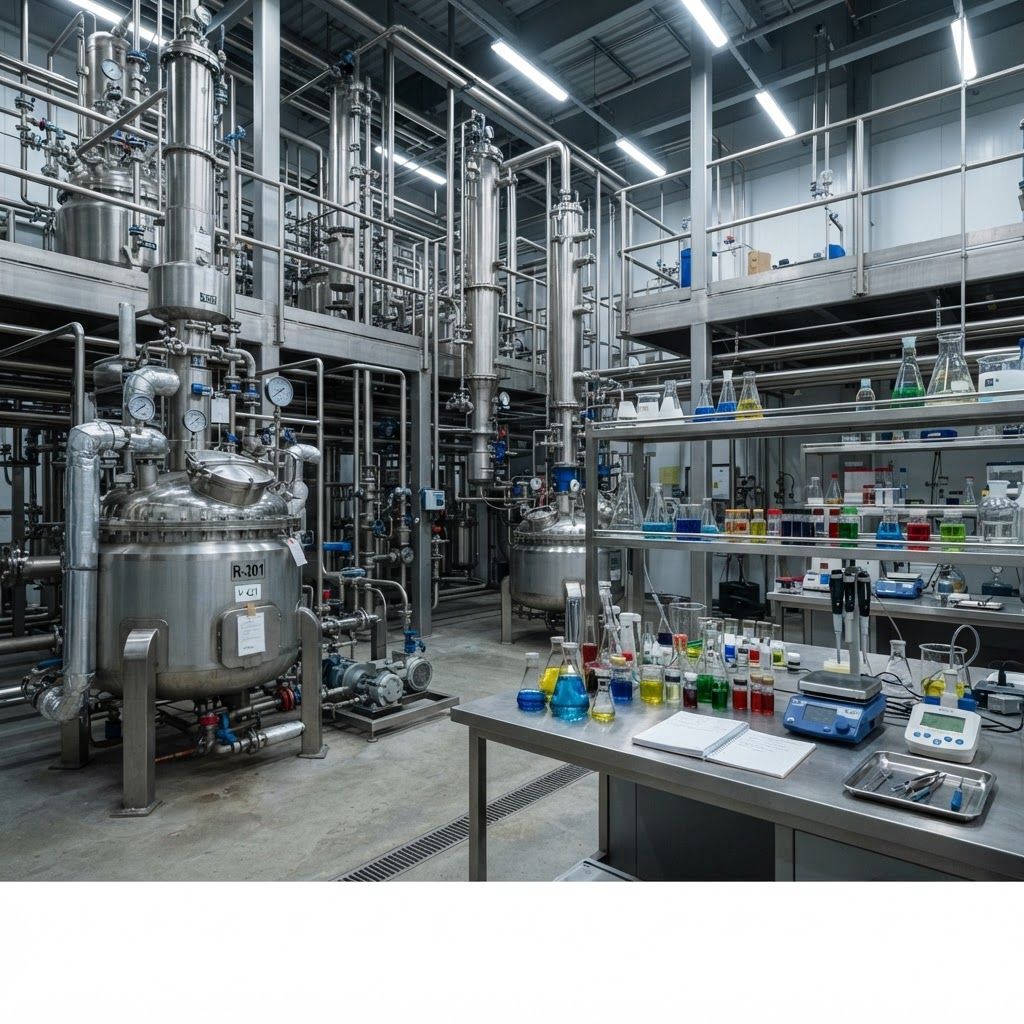
Buffalo's chemical industry rarely makes headlines, yet it touches an enormous share of everyday products. The same combination that attracted heavy manufacturing to Western New York, namely abundant power, deep water access and rail connectivity, also made the region attractive to chemical producers. What remains today is a more specialized sector than the mid-century era of bulk commodity plants, focused instead on formulated products, coatings, polymers and process chemicals where technical knowledge matters more than sheer volume.
The Shape of Buffalo's Chemical Sector
Regional chemical companies have largely moved up the value chain. Rather than competing on commodity tonnage against Gulf Coast megaplants, local firms concentrate on custom formulation, small-batch specialty production and application engineering. That means smaller reactors, more frequent product changeovers and laboratory staff who work directly with customers on performance problems. The result is an industry that supports advanced manufacturing, construction, municipal utilities and food processing throughout the Northeast and Ontario.
Ten Chemical Companies Worth Knowing
Niagara Chemical Technologies operates as a custom synthesis and toll processing partner. Customers bring a formulation or a reaction that has outgrown their own capacity, and the company scales it from bench to production with the documentation regulated industries require. Its strength lies in process safety review and analytical support rather than any single product line.
Queen City Specialty Chemicals formulates additives for coatings, lubricants and industrial cleaners. The technical service group is the differentiator, spending as much time in customer plants diagnosing performance issues as it does developing new blends, which builds unusually durable relationships.
Erie Basin Coatings manufactures industrial paints and protective coatings engineered for harsh conditions. Products designed for freeze-thaw cycling, road salt exposure and marine humidity reflect genuine local knowledge, and the company supplies bridge, tank and structural steel projects across the Great Lakes.
Lakeview Polymer Sciences develops resins and polymer compounds for molders and extruders. Custom color matching, additive packages and recycled content formulations have become growth areas as brand owners commit to sustainability targets that their material suppliers must actually deliver.
Buffalo Industrial Solvents distributes and blends solvents while operating a recovery service that reclaims used material for reuse. That closed-loop model reduces both disposal cost and environmental exposure for metal finishing, printing and coating customers, and it has become a compelling selling point as waste regulations tighten.
Cataract Water Treatment Chemicals supplies municipal utilities and industrial facilities with coagulants, corrosion inhibitors and boiler treatment programs. Field technicians handle testing and dosing optimization, an service-heavy model that suits plant operators who lack in-house water chemistry expertise.
Frontier Adhesives Group produces industrial adhesives and sealants for packaging, woodworking and assembly applications. The company invests in application trials, bringing samples and equipment to customer lines so that bond performance is proven under real production speeds before a specification changes.
Harbor Point Laboratories provides analytical testing and formulation development rather than large-scale manufacturing. Independent laboratories play an essential quality role in the chemical supply chain, and this one supports environmental compliance, raw material verification and competitive product analysis.
Lackawanna Process Chemicals serves metal producers and finishers with pickling acids, fluxes and surface treatment chemistry. Deep familiarity with metallurgical processes lets the company troubleshoot surface defects that a general supplier would struggle to diagnose.
Elmwood Fine Chemicals focuses on high-purity intermediates for pharmaceutical and electronics customers. Small volumes, exacting specifications and rigorous documentation define the work, and the company competes on consistency and confidentiality rather than price.
Trends Reshaping Chemical Manufacturing
Sustainability has moved from marketing to specification. Customers now request bio-based feedstocks, lower volatile organic compound content and verifiable recycled input, and suppliers who cannot document these attributes lose bids. Regulatory pressure reinforces the shift, with reporting requirements expanding steadily at both state and federal levels.
Supply chain resilience is a second priority. After years of disrupted imports, buyers increasingly qualify regional suppliers as primary sources rather than backups, which has benefited Buffalo producers able to deliver reliably within a day's drive. Digital process control is the third trend, as even modest plants adopt sensors and data historians to improve batch consistency and demonstrate compliance.
Selecting a Chemical Supplier
Technical support should weigh as heavily as product specifications. A supplier whose chemists will visit a facility and work through a problem provides value that no data sheet captures. Verify regulatory competence as well, including safety data sheet quality, transportation compliance and relevant certifications, because a supplier's compliance failures quickly become the customer's problem.
Consider batch consistency and lead time reliability over spot pricing. In formulated products, variation between lots causes downstream defects that cost far more than a modest price premium. Ask directly how the company handles a nonconforming batch, since the answer reveals more about a partnership than any sales presentation.
Final Thoughts
Buffalo's chemical companies have adapted intelligently, trading commodity scale for specialized knowledge and responsive service. For manufacturers, utilities and product developers across the Northeast, that combination of technical depth and regional proximity makes the local sector a genuinely valuable resource.