
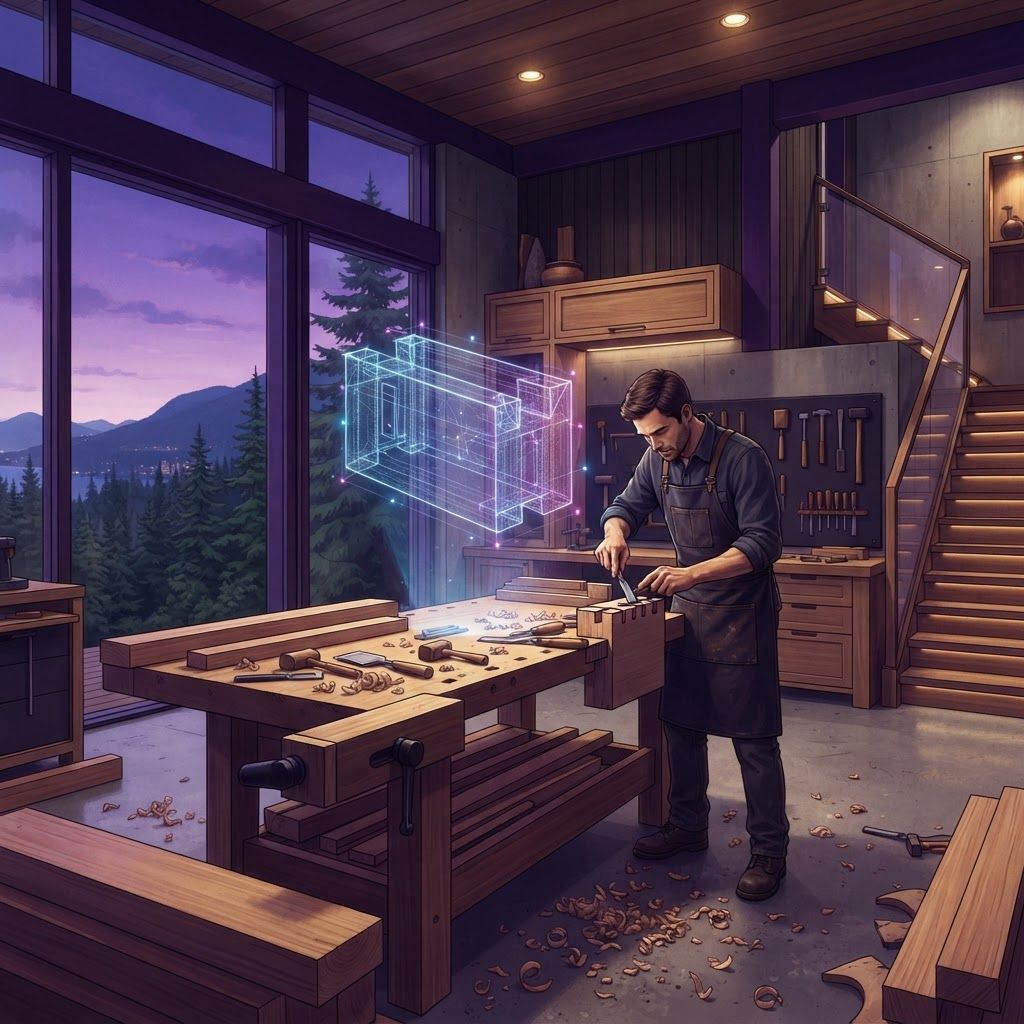
A City Built on Wood
British Columbia's forestry heritage runs through Vancouver's built environment. Almost all of the region's housing is wood-framed, its heritage homes are finished in old-growth fir, and its most celebrated new architecture increasingly features exposed mass timber. Carpentry is therefore not one service but a family of related trades, spanning rough framing, formwork, finish carpentry, cabinetmaking, timber framing and restoration joinery.
The local climate raises the technical bar. Wood moves with moisture, and in a city with high humidity for much of the year, understanding species behaviour, acclimatisation and moisture-tolerant detailing separates work that stays tight from work that gaps, cups and fails.
How to Judge a Carpenter
The most reliable indicator is portfolio depth in the exact type of work you need, since framing skill does not transfer automatically to fine joinery. Beyond that, look for red seal certification or equivalent experience, WorkSafeBC coverage, liability insurance, and clear written scope. On finish work, examine previous projects up close: consistent reveals, tight mitres, flush transitions and clean scribes to out-of-square walls are the marks of a skilled hand. On structural work, ask about engineering coordination and inspection experience.
1. Framing and Structural Carpentry Crews
Framing crews build the skeleton of Vancouver's homes and low-rise buildings: floor systems, walls, roof structures, engineered beams and joists, shear walls and seismic hold-downs. Their work is measured in accuracy and speed, because everything installed afterward depends on square, plumb and level structure. Experienced local crews also understand weather protection during framing, which matters enormously when a deck is exposed to rain mid-build.
2. Finish Carpentry and Trim Specialists
Finish carpenters install baseboards, casings, crown mouldings, wainscoting, coffered ceilings, stair components, interior doors and hardware. This is the work homeowners see and touch daily, and in Vancouver's mix of character and contemporary homes it ranges from replicating historic profiles to executing minimalist shadow-gap details that leave no room for error. Precision here defines how expensive a home feels.
3. Custom Cabinetmakers and Millwork Shops
Cabinet shops design, fabricate and install kitchens, bathroom vanities, built-in storage, wall units, closets and office casework. Vancouver has a strong local manufacturing base using computer-controlled machinery for accuracy alongside hand skills for fitting. Custom cabinetry is particularly valuable in the city because so many homes and condos have irregular dimensions, sloped ceilings or awkward mechanical chases that stock cabinets cannot accommodate.
4. Staircase Builders and Railing Specialists
Stairs are the most geometrically demanding element in residential carpentry, combining code compliance on rise, run, headroom and guard height with visual prominence. Specialists build open-riser feature stairs, floating treads with concealed structure, curved and winder configurations, and glass or cable railing systems. Because a stair is both a structure and a sculpture, this trade attracts the most technically capable carpenters.
5. Deck, Patio and Outdoor Structure Builders
Outdoor living matters in Vancouver despite the rain, and deck builders construct cedar and hardwood decks, composite systems, covered patios, pergolas and privacy screens. The critical local skill is water management: proper ledger flashing, waterproof membranes over living space, drainage between joists and detailing that keeps water away from the house. Poorly flashed decks are one of the most common sources of hidden structural rot in the region.
6. Timber Frame and Mass Timber Carpenters
Heavy timber carpentry is a signature West Coast craft, producing exposed post-and-beam structures, timber entryways, pavilions and increasingly commercial mass timber assemblies using glulam and cross-laminated panels. The work demands precise joinery, steel connection detailing and careful crane logistics. Its appeal is structural honesty, since the frame becomes the architecture rather than being hidden in walls.
7. Heritage Restoration Joiners
Restoration joiners repair and replicate the elements that give Vancouver's older neighbourhoods their character: double-hung fir windows, panelled doors, porch columns, bracket detailing, wainscot and built-in buffets. The skill set includes matching old-growth grain with available material, epoxy consolidation of sound but weathered wood, and traditional joinery techniques. This work preserves value that replacement destroys.
8. Basement, Suite and Interior Renovation Carpenters
Carpenters specialising in suite conversions and interior renovation handle framing new partitions, fire and sound separation assemblies between dwelling units, soffits around mechanical runs, egress window openings and complete finishing. Their advantage is problem-solving inside existing buildings, where nothing is square and every dimension must be verified rather than assumed.
9. Commercial Carpentry and Store Fixture Installers
Commercial carpenters build retail fixtures, reception desks, display millwork, restaurant banquettes and office casework, frequently working overnight in occupied buildings. Speed, protection of surrounding finishes and the ability to work from shop drawings distinguish this segment. Multi-location clients value installers who can replicate a brand standard consistently.
10. Handyman and Small-Project Carpentry Services
Not every job needs a full crew. Skilled handyman carpenters handle door adjustments, shelving, closet organisers, trim repairs, fence sections, dry rot patching and small structural fixes. For condo owners and busy households, a reliable tradesperson for small work is genuinely valuable, and the best of them are honest about when a job exceeds their scope and needs a specialist.
Materials and Sustainability
Local carpenters work extensively with Douglas fir, western red cedar, hemlock and spruce, plus engineered products including laminated veneer lumber, glulam and I-joists that offer dimensional stability. Cedar remains the default for exterior work because of its natural decay resistance. Sustainability considerations are increasingly part of specification, from certified lumber sourcing to reclaimed timber, and mass timber's lower embodied carbon has made it a policy favourite in the province.
Getting the Best Result
Define scope precisely, since carpentry pricing depends heavily on detail level and material selection. Allow lead time for custom millwork fabrication, which frequently exceeds the duration of the installation. Let interior wood acclimatise on site before installation to avoid movement after finishing. And engage the right specialist for the work rather than assuming any carpenter covers the full range. In a city where wood is both structure and finish, choosing the appropriate craftsperson is what turns a project from adequate into something worth showing off.