
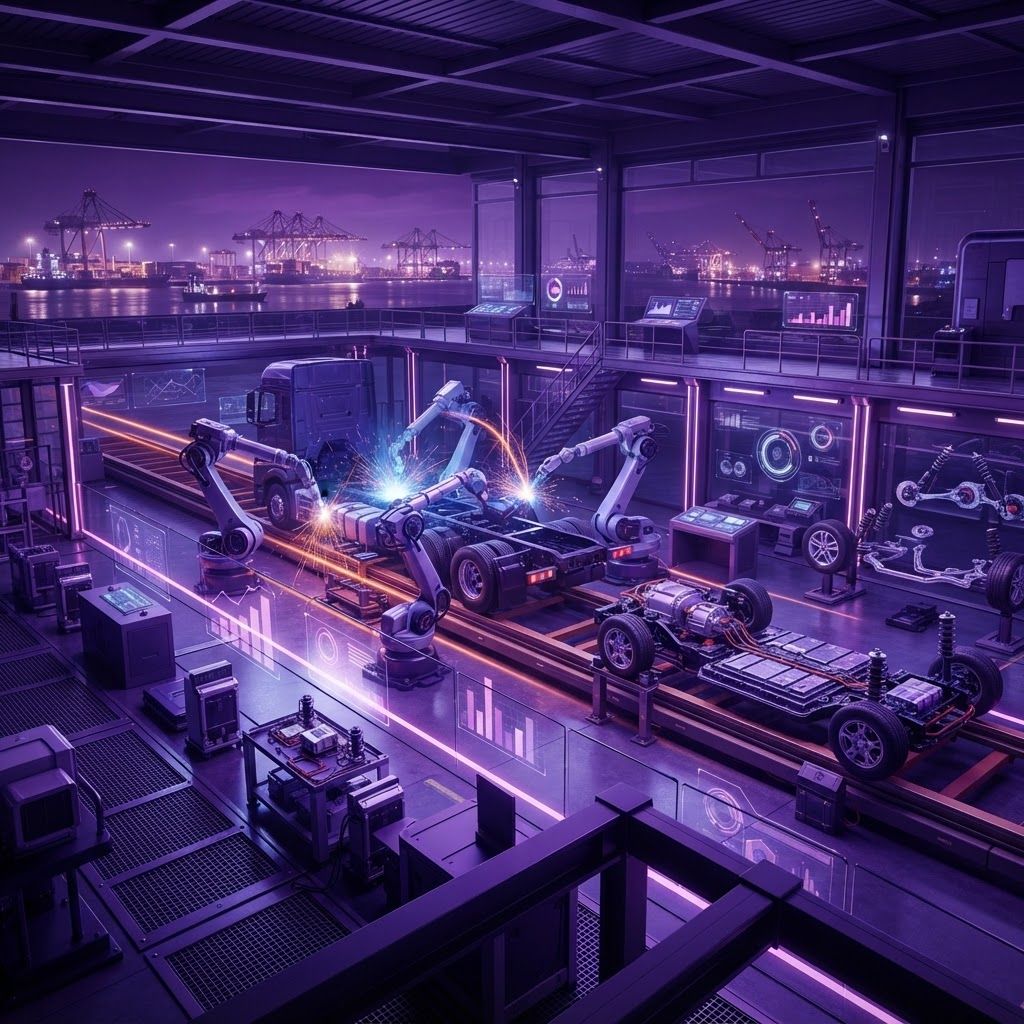
Automotive Manufacturing Beyond the Assembly Line
Tacoma does not host a large passenger vehicle assembly plant, and the city's name is more widely associated with a pickup truck model than with local production. Yet automotive manufacturing is genuinely active here, concentrated in segments that suit a port city with heavy industry, extensive logistics traffic, and a strong trades workforce. The work centers on specialty vehicle building, commercial truck upfitting, trailer and body fabrication, component machining, and increasingly electric drivetrain conversion.
Demand is local and practical. Utilities, municipalities, construction contractors, delivery operators, emergency services, marine businesses, and forestry companies all require vehicles configured for specific tasks. A service body with custom compartments, a crane-equipped flatbed, a refrigerated van, a command vehicle, or a port yard tractor cannot be bought off a dealership lot. Companies that build and modify these vehicles form the backbone of the regional automotive manufacturing sector.
The Major Segments
Understanding the categories clarifies where to look for capability. Truck upfitting and body installation mounts service bodies, dump beds, cranes, liftgates, and utility equipment onto chassis. Specialty and emergency vehicle building produces fire apparatus support units, command centers, mobile clinics, and food service vehicles. Trailer manufacturing and repair covers utility, equipment, and marine trailers. Component manufacturing includes machined parts, brackets, suspension components, and aftermarket accessories. Electrification and alternative fuel conversion retrofits fleet vehicles with battery drivetrains or alternative fuel systems. Prototype and low-volume production serves engineering firms and startups needing small runs of vehicles or subsystems.
Ten Automotive Manufacturing Profiles in Tacoma
1. Commencement Truck Body Works. Builds and installs service bodies, flatbeds, and utility equipment on commercial chassis, with in-house paint and electrical integration.
2. Rainier Specialty Vehicles. Produces custom mobile units including command vehicles, mobile clinics, and inspection trucks with integrated power and climate systems.
3. Tideflats Trailer Manufacturing. Fabricates and repairs equipment, utility, and marine trailers, including custom axle configurations and load-specific decking.
4. Puget Fleet Electrification. Converts delivery vans, yard tractors, and light trucks to battery electric drivetrains and installs supporting charging infrastructure.
5. Harborline Precision Machining. Machines automotive and heavy equipment components to tight tolerances, supporting both production and replacement part needs.
6. Northwest Off-Road Fabrication. Manufactures bumpers, racks, skid plates, and overland accessories, popular with the region's outdoor recreation market.
7. South Sound Suspension Engineering. Designs and builds suspension and chassis components for heavy-duty and specialty applications.
8. Foss Waterway Marine Hauling Equipment. Builds boat hauling trailers, launch equipment, and yard handling vehicles for marinas and boatyards.
9. Stadium Auto Interiors and Upholstery. Produces custom seating, headliners, and interior panels for commercial, transit, and restoration vehicles.
10. Pierce Prototype Automotive. Supports engineering clients with low-volume builds, test vehicle preparation, and instrumentation installation.
How Fleets Should Evaluate a Builder
Vehicle modification touches safety, liability, and regulatory compliance, so evaluation deserves more rigor than a typical purchase. Begin with certification and compliance. Ask how the builder handles federal motor vehicle safety requirements, weight distribution and axle load calculations, and chassis manufacturer body builder guidelines. Improper weight distribution is one of the most common defects in poorly executed upfits and creates genuine handling and braking risk.
Examine electrical practice closely. Aftermarket wiring is where cheap builds fail, causing intermittent faults, parasitic drain, and fire risk. Look for proper circuit protection, labeled harnesses, sealed connectors, strain relief, and documentation. Ask to see wiring diagrams from a completed project.
Confirm warranty interaction. A poorly executed modification can jeopardize chassis warranty coverage, and reputable builders know which practices manufacturers accept. Ask whether the shop is a recognized body builder or installer for the chassis brands you operate.
Then assess project management. Fleet vehicles generate revenue, so downtime matters. Discuss realistic lead times, chassis availability, staged delivery for multi-unit orders, and how the shop communicates schedule changes. Request references from fleets of similar size and application.
The Electrification Question
Fleet electrification has moved from pilot projects to genuine procurement in the region, aided by low-carbon local electricity and port-driven emissions goals. For manufacturers, this creates work in three areas: purpose-built electric vehicle assembly, retrofit conversion of existing chassis, and installation of depot charging infrastructure.
Retrofits deserve careful evaluation. A well-executed conversion can extend the life of a serviceable chassis at lower cost than a new electric vehicle, particularly for yard tractors, shuttle buses, and short-route delivery vans where duty cycles are predictable. A poorly executed conversion creates safety hazards around high-voltage systems and battery thermal management. Ask specifically about high-voltage training and certification, battery enclosure design, thermal management, isolation monitoring, service disconnect provisions, and first responder documentation.
Cost, Quality, and Total Ownership
The cheapest upfit rarely proves cheapest over a vehicle's life. Corrosion protection matters enormously in the Pacific Northwest, where road treatments and constant moisture attack unprotected steel and poorly sealed penetrations. Ask about materials, coatings, and drainage design. Serviceability also affects cost: bodies that allow easy access to chassis components reduce maintenance labor for a decade. Finally, consider resale and redeployment. Modular equipment that can be transferred to a new chassis preserves value when the original vehicle retires.
Final Thoughts
Automotive manufacturing in Tacoma is a craft-and-engineering business serving fleets that need vehicles built for real work. The strongest builders combine metal fabrication skill, disciplined electrical practice, regulatory fluency, and honest scheduling. For fleet managers, the best protection against expensive disappointment is asking to see documentation and finished work in person before signing, and choosing a shop that treats weight distribution and wiring integrity as non-negotiable rather than optional refinements.