
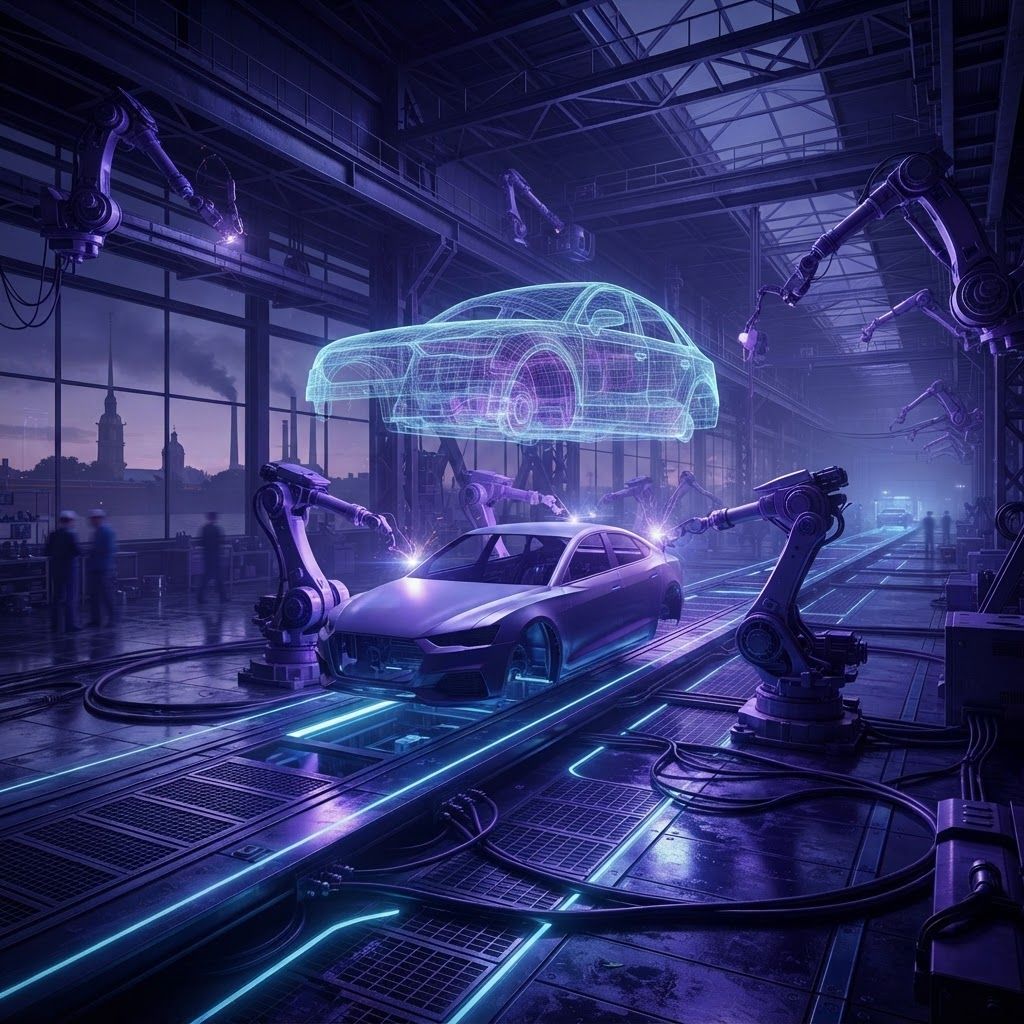
How St. Petersburg Became an Automotive Hub
St. Petersburg's rise as an automotive centre was deliberate rather than accidental. The city offered a rare combination of deep-water port access, established heavy engineering skills, available industrial land on its southern and northern fringes, and a labour market accustomed to precision manufacturing. Vehicle assembly plants clustered there, and once the anchor plants existed, the supplier network followed.
That sequence matters, because automotive manufacturing is only as strong as its tier-two and tier-three base. Stamping, injection moulding, seat assembly, wiring harnesses, glass and paint all need to be nearby for just-in-time delivery to function. Today the city supports a genuine ecosystem rather than isolated factories, which is why it continues to attract investment in components even as vehicle platforms change.
The Structure of the Cluster
Automotive production in the city breaks into three layers. At the top sit final assembly operations, where bodies are welded, painted and married to powertrains. Below them, tier-one suppliers deliver complete systems — seats, dashboards, exhaust assemblies, braking modules — often sequenced to the assembly line hour by hour. Beneath that, a broad base of specialist workshops supplies individual components, tooling and machining services.
For buyers and job seekers alike, understanding these layers clarifies expectations. Assembly plants operate on rigid takt times with heavy automation. Tier-one suppliers combine engineering with logistics discipline. Smaller component makers offer flexibility and are often the best route for low-volume, specialist or aftermarket work.
Ten Automotive Manufacturers Worth Knowing
Neva Motor Works is among the city's larger vehicle assembly operations, running body-in-white, paint and final assembly under one roof. Its scale and automation make it the reference point for production standards locally.
Baltic Automotive Components is a tier-one supplier producing interior systems and trim, sequencing deliveries directly to assembly lines. Logistics precision is its defining strength.
Petrograd Powertrain focuses on engine and transmission components, with machining tolerances and metallurgy expertise built up over decades of heavy engineering work in the city.
Northern Chassis Systems manufactures suspension assemblies, subframes and structural stampings. Its press shop capacity makes it a significant regional supplier of large sheet-metal parts.
Admiralty Commercial Vehicles builds specialised commercial bodies — refrigerated units, service vehicles and municipal equipment — on purchased chassis. Customisation rather than volume defines its business.
Fontanka Electric Mobility operates at the newer edge of the sector, developing battery packs, electric drive units and light electric vehicles. It has become a magnet for engineers moving from combustion to electrified platforms.
Vyborg Precision Machining supplies machined components to multiple tier-one customers, specialising in tight-tolerance turned and milled parts with full dimensional reporting.
Ladoga Plastics and Injection produces moulded interior and exterior components, including painted and textured parts. Its tooling capability allows relatively fast changeovers between programmes.
Kolpino Assembly Group handles sub-assembly and kitting for larger manufacturers, taking on labour-intensive operations that assembly plants prefer to outsource.
Aurora Vehicle Engineering concentrates on design, prototyping and validation testing rather than volume production, supporting manufacturers through development phases and homologation work.
Trends Reshaping Automotive Production
Electrification is the dominant force. Battery pack assembly, thermal management and power electronics have created entirely new supplier categories while reducing demand for exhaust systems and complex transmissions. St. Petersburg's cluster is adapting unevenly — firms with strong electrical and thermal engineering capability are growing, while purely mechanical specialists face harder transitions.
Software content is the second shift. Modern vehicles carry substantial embedded software, and manufacturers increasingly need suppliers who can deliver validated firmware alongside hardware. This has drawn the city's software talent pool into automotive work in ways that would have seemed unlikely a decade ago.
Third, supply chain resilience has replaced pure cost optimisation as a strategic priority. Manufacturers now hold more buffer inventory, dual-source critical components and favour regional suppliers over distant ones. That change directly benefits established local component makers.
What Buyers and Partners Should Evaluate
Quality system certification is the entry ticket in automotive work, but it is a floor rather than a differentiator. Look instead at process capability data, first-time-right rates and how a supplier handles a containment situation when defective parts reach a customer. The best suppliers can describe a past failure clearly and explain what changed as a result.
Capacity headroom is equally important. A supplier running at ninety-eight percent utilisation has no ability to absorb your volume increase or recover from a breakdown. Ask about shift patterns, planned maintenance windows and what a genuine surge scenario looks like.
Finally, assess engineering depth rather than just manufacturing capability. Suppliers who contribute design-for-manufacture input during development prevent costly late changes, and that collaborative capacity is what separates a strategic partner from a vendor.
Final Thoughts
St. Petersburg's automotive sector combines assembly scale with a mature supplier base and a growing electrification specialism. For anyone sourcing components or building a vehicle programme, the city's density of capability is its greatest asset — provided you evaluate process discipline, capacity headroom and engineering depth rather than unit price alone.