
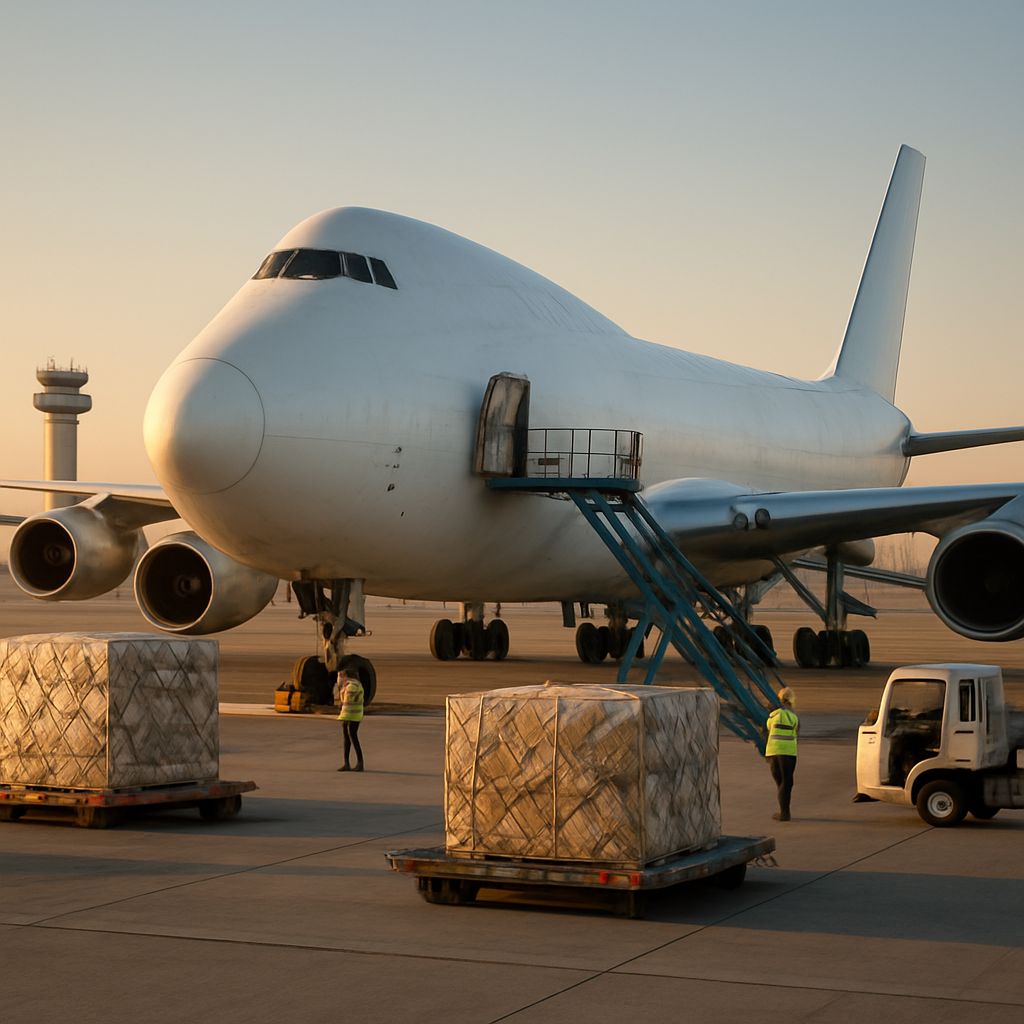
Air Cargo in a Historic Aviation Region
St. Louis has aviation history few cities can match. It funded Charles Lindbergh's transatlantic flight, hosted major aircraft manufacturing for decades, and remains home to substantial aerospace and defense engineering. That heritage matters commercially because it produced an industrial base, workforce and supplier network that generate real air cargo demand.
Today the region's air freight capability rests on two airports with different roles. St. Louis Lambert International handles the bulk of belly cargo in passenger aircraft plus dedicated freighter operations by integrated carriers. MidAmerica St. Louis Airport, across the river in Illinois, has developed as a dedicated cargo facility with foreign trade zone designation, long runways, minimal congestion and room to grow, and it has attracted international freighter service including perishables imports.
When Air Cargo Makes Sense
Air freight costs substantially more per pound than ocean, rail or truck, so it needs justification. The cases where it clearly wins are time-critical shipments where delay costs exceed freight premium, high-value goods where inventory carrying cost and capital tied up in transit are significant, perishables with limited shelf life, pharmaceuticals and biologics requiring controlled conditions and short transit, aerospace and industrial spare parts where equipment downtime is expensive, and emergency or expedited situations.
Given the region's concentration in plant science, biotechnology, medical devices, aerospace and geospatial technology, all of those cases occur regularly here.
The Ten Best Air Cargo Companies Serving St. Louis
1. FedEx Express
FedEx Express operates the world's largest air cargo fleet and maintains substantial capability at Lambert. Its time-definite delivery reliability is the industry standard, and its portfolio spans overnight envelopes through heavy air freight and charter. Specialized services for healthcare shipments, including temperature-controlled packaging and monitoring, matter significantly to the region's life sciences employers. Late pickup cutoffs and next-morning delivery reach across most of the country make it the default for genuine urgency.
2. UPS Air Cargo
UPS combines an extensive freighter network with the advantage of integrated ground, freight forwarding and customs brokerage under a single relationship. For shippers who want one provider handling an international air shipment door to door including clearance, that integration removes real friction. Its healthcare logistics capability, including validated cold chain and clinical trial material handling, is well developed and relevant to regional biotech shippers.
3. DHL Global Forwarding and DHL Express
DHL is the strongest international air freight option in the market. Its network depth into Europe, Asia and emerging markets, combined with genuine customs expertise, makes it the preferred choice for exporters and for importers of high-value components. Its life sciences and specialized industry verticals bring dedicated handling protocols rather than generic service, and its charter brokerage handles oversized and urgent project cargo.
4. Amerijet International
Amerijet operates freighter service focused on Latin America, the Caribbean and select global markets, with particular strength in perishables, pharmaceuticals and general cargo. Its service into MidAmerica St. Louis Airport has been notable in the region's cargo development, supporting perishables imports that benefit from the facility's low congestion and quick turn times. For shippers with Latin American trade lanes, its network is directly relevant.
5. Atlas Air
Atlas Air operates large freighter aircraft on charter, ACMI and scheduled service worldwide, and it is the carrier of choice for oversized cargo, full-planeload movements and time-critical charter requirements. When a manufacturer needs to move production tooling, aerospace components, or an entire shipment that will not fit conventional capacity, charter through an operator of this scale is the solution. Its heavy-lift capability handles cargo that no integrated carrier can accommodate.
6. Kalitta Air
Kalitta specializes in freighter charter and scheduled cargo operations, including automotive, aerospace, humanitarian and government logistics. Its ability to mobilize aircraft quickly for urgent requirements makes it valuable in supply chain disruption scenarios, and its experience with unusual and difficult cargo, including hazardous materials and outsized equipment, is extensive.
7. Passenger Airline Cargo Divisions
The cargo divisions of major passenger carriers serving Lambert, including the large domestic network airlines, move substantial volume in aircraft bellies. Belly capacity is generally the lowest-cost air option for shipments that fit standard dimensions, and same-day and next-flight-out products offer speed that even integrated carriers sometimes cannot match on specific city pairs. For urgent parts shipments to a city with direct service from St. Louis, next-flight-out is often the fastest option available.
8. Regional Air Freight Forwarders
Independent forwarders in the metro book capacity across multiple airlines, consolidate shipments to achieve better rates, handle export documentation and coordinate pickup and delivery. Their advantage over dealing with airlines directly is neutrality and consolidation economics: a forwarder shipping thousands of pounds weekly across multiple carriers gets rates a single shipper cannot, and can select the best routing rather than defending one network. For companies shipping air freight regularly but not enormously, this is usually the most cost-effective channel.
9. Customs Brokerage and Foreign Trade Zone Operators
Air cargo crossing borders requires clearance, and licensed customs brokers in the region handle classification, valuation, duty payment, partner government agency filings and compliance programs. The foreign trade zone designation at MidAmerica adds real capability, allowing duty deferral, inverted tariff benefits and manufacturing within the zone. For importers of components assembled locally, FTZ utilization can produce meaningful duty savings that most companies never explore.
10. Specialized Medical and Life Sciences Couriers
Given the region's concentration of hospital systems, research universities, plant science institutions and biotech companies, specialized couriers handling diagnostic specimens, clinical trial materials, organs for transplant, cell and gene therapies and controlled-temperature pharmaceuticals form a distinct and critical segment. These operators provide validated packaging, continuous temperature monitoring, chain-of-custody documentation and hand-carry service where necessary. The requirements here are regulatory as much as logistical, and general carriers are not equipped for them.
Trends in Regional Air Cargo
MidAmerica's development as a cargo gateway is the most significant regional story, with foreign trade zone status, uncongested runways and quick truck access creating a genuine alternative to congested coastal gateways for certain traffic. E-commerce has permanently increased air cargo demand while shifting it toward smaller, more frequent shipments. Pharmaceutical and life sciences cargo continues growing faster than general freight, driving investment in cold chain infrastructure. Sustainable aviation fuel adoption is beginning to appear in carrier commitments and shipper reporting. And capacity volatility remains elevated, making forwarder relationships more valuable than spot booking.
How to Ship Air Freight Well
Book earlier than the deadline requires, since capacity constraints appear without warning. Provide accurate dimensions and weights, because reweighing and remeasuring generates billing corrections and delays. Classify goods correctly and complete documentation fully, as paperwork errors cause more air freight delays than capacity does. Understand dangerous goods requirements before shipping anything with batteries, aerosols or chemicals. Use a forwarder to access multi-carrier options rather than defaulting to one integrator. Evaluate whether MidAmerica offers advantages for your international lanes. And for anything temperature-sensitive, validate the packaging and monitoring solution rather than assuming.
Final Thoughts
Air cargo capability in St. Louis is stronger and more varied than the region's profile suggests, spanning integrated express giants, international forwarders, charter operators for outsized needs, belly capacity for cost efficiency, and specialized life sciences couriers. With two airports playing complementary roles and foreign trade zone benefits available, shippers who plan deliberately can move urgent freight globally from here on competitive terms.