
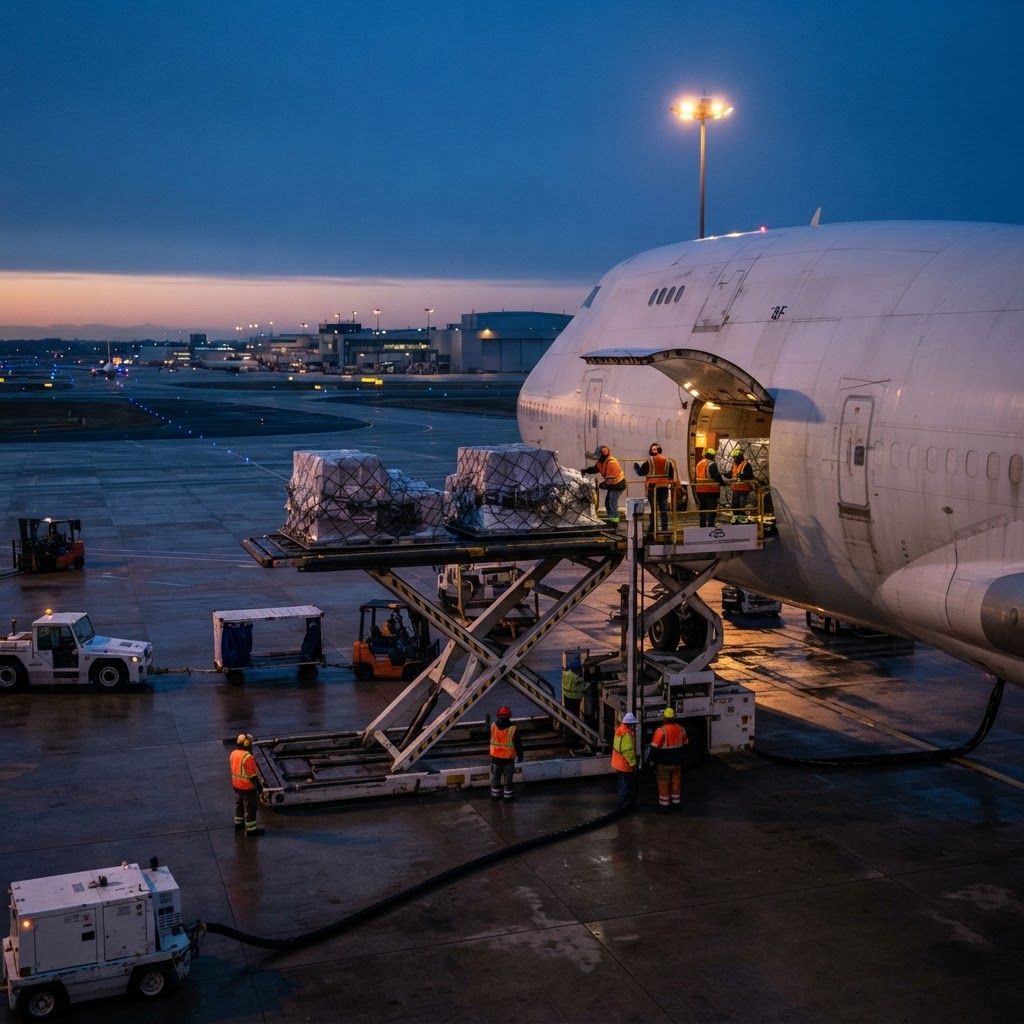
Buffalo's Air Cargo Role
Buffalo Niagara International Airport is not a mega freight hub, and understanding that is the starting point for shipping air cargo from the region. What Buffalo offers instead is a well-connected regional gateway with excellent trucking access to larger hubs, meaningful integrator presence, and a location that lets Canadian shippers use American air networks while American shippers reach Canadian markets quickly.
A large share of air freight labeled as originating in Buffalo actually flies from Chicago, Newark, New York, or Toronto after moving by road, a practice known as trucking to a gateway. That is not a weakness; it is how regional air cargo works everywhere, and it gives Buffalo shippers access to global capacity without paying hub-city handling costs.
Carriers and Service Providers in the Market
The integrators dominate volume. FedEx Express and UPS Airlines both operate substantial Buffalo facilities with overnight and deferred air products, and their networks handle everything from documents to heavy freight. DHL Express is particularly strong on international express and cross-border express traffic. Amazon Air has expanded regional air linehaul across the Northeast, indirectly affecting available capacity.
On the traditional air freight side, Kalitta Air, Atlas Air, and other freighter operators serve the broader Great Lakes region on charter and scheduled ad hoc bases, which matters for oversized aerospace and industrial shipments. Forwarders control most of the commercial relationships: Expeditors, Kuehne + Nagel, DSV, Geodis, and C.H. Robinson all arrange air freight for Western New York shippers, booking space with passenger and freighter airlines and handling documentation. Local ground handling, screening, and warehousing services support these operations at and around the airport, while customs brokers including Livingston International and A.N. Deringer clear air shipments crossing the border.
When Air Cargo Is the Right Choice
Air freight makes economic sense in four situations. When inventory is stranded and a production line is at risk, the cost of downtime dwarfs the freight premium. When goods are perishable, whether biological samples, pharmaceuticals, or fresh food, air is often the only viable mode. When products have high value density, such as semiconductors, medical devices, or aerospace components, freight cost becomes a small percentage of goods value. And when demand spikes unexpectedly, air provides the responsiveness that ocean and rail cannot.
Buffalo's industrial base generates all four patterns. The region's aerospace suppliers, medical campus and life sciences employers, automotive component makers, and specialty manufacturers all ship by air routinely, and several maintain standing arrangements with forwarders for expedited handling.
Understanding Air Freight Pricing
Air freight is priced on chargeable weight, which is the greater of actual weight and volumetric weight calculated from dimensions. Bulky, light cargo therefore costs far more than its scale weight suggests, and shippers who reduce packaging dimensions see immediate savings. On top of the base rate sit fuel surcharges, security surcharges, screening fees, terminal handling, and documentation charges, plus customs brokerage and duties on international moves.
Service levels matter too. Express integrator products bundle pickup, linehaul, customs clearance, and delivery into a single door-to-door price with a firm commitment. Traditional air freight is typically quoted airport to airport, with pickup and delivery arranged separately, and offers better economics on heavier shipments at the cost of more coordination.
Trends in the Sector
Capacity dynamics have grown more volatile since a large share of global air cargo travels in passenger aircraft bellies. Changes in passenger schedules therefore move freight rates, which makes forwarder relationships and booking lead times more valuable than they once were. Ecommerce continues to push cross-border express volumes upward, and the treatment of low-value shipments under simplified customs procedures remains a live commercial issue for anyone shipping direct to consumers.
Pharmaceutical and life sciences logistics has become a specialty in its own right, with temperature-controlled containers, validated packaging, and continuous monitoring now routine requirements. Digital booking platforms have compressed quoting cycles, and sustainability reporting has arrived here as well, with shippers requesting emissions data per shipment and weighing whether truly urgent status justifies air's carbon intensity.
Practical Guidance for Shippers
Book earlier than you think you need to, particularly during the peak season from September through December. Provide accurate dimensions and weights, since corrections discovered at the terminal cause both delays and rebilling. Prepare documentation before tender, including commercial invoice, packing list, and any certificates the destination requires. Confirm whether your cargo is classified as dangerous goods, because lithium batteries, aerosols, and certain chemicals require specialized handling and paperwork.
Evaluate providers on more than price. Ask how they communicate when a flight is offloaded, who manages customs clearance, and whether they have handled your commodity and destination before. For recurring shipments, negotiate a rate agreement rather than quoting each move, and consider whether trucking to a larger gateway or using a nearby Canadian airport produces better total cost and transit time.
Final Thoughts
Air cargo from Buffalo works best when shippers treat the region as a well-connected gateway rather than expecting hub-scale freighter service on site. Between the major integrators, an experienced forwarder community, and strong customs brokerage, the region handles urgent and high-value freight efficiently. Control your dimensions, prepare your paperwork, build relationships with providers who know your commodity, and air freight becomes a precise tool rather than an expensive emergency.