
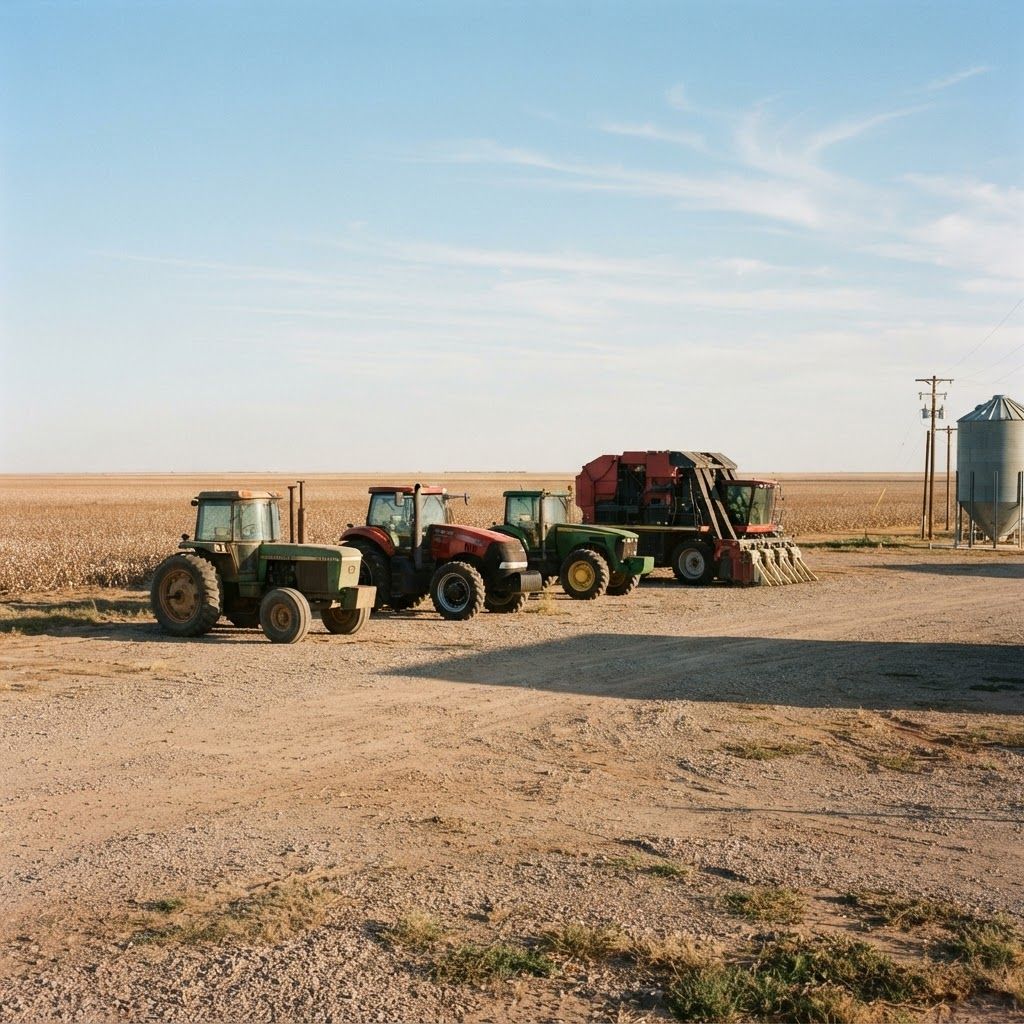
Why Lubbock Is a Serious Machinery Market
Cotton is the most equipment-intensive major row crop in the United States, and the counties around Lubbock plant more of it than almost anywhere else on earth. That combination has made the city a genuine centre of agricultural machinery activity, with dealer networks, parts inventories, service shops and precision agriculture specialists concentrated within a short radius.
The stakes are unusually high here because harvest windows are narrow and weather risk is real. A cotton picker sitting idle during a two-week window can cost more than the repair itself many times over. As a result, growers in this region evaluate brands on parts availability and service response almost as heavily as on the machine's specifications.
How Growers Judge Equipment Brands
The criteria that come up repeatedly are uptime and serviceability, dealer parts depth within driving distance, resale value, compatibility with existing precision guidance and data platforms, and total cost of ownership across a realistic ownership period rather than sticker price. Increasingly, growers also ask about data portability, having learned how frustrating locked ecosystems can be.
The Top 10 Agricultural Equipment Brands and Dealers in Lubbock
1. Caprock Farm Machinery
A major full-line dealership serving the South Plains, Caprock Farm Machinery handles tractors, cotton harvesters, tillage and planting equipment along with a large parts operation. Its reputation is built on harvest-season service coverage, including extended hours and field service trucks, which growers consistently identify as the deciding factor in where they buy.
2. Llano Estacado Irrigation Systems
Centre pivots, subsurface drip, pumps, panels and control systems make irrigation equipment the largest capital category in this region after harvesters. Llano Estacado Irrigation Systems designs and installs complete systems and is well regarded for hydraulic design accuracy, which determines whether a field is watered uniformly or unevenly for the next twenty years.
3. South Plains Cotton Harvest Equipment
Specialising in cotton pickers, strippers, module builders and harvest support equipment, this dealer concentrates its inventory and expertise entirely on the region's defining crop. Rebuild programmes and refurbished machines give mid-sized growers access to capable harvest capacity without new-equipment capital, which is a significant service in a high-cost category.
4. Hub City Tractor Company
Serving both commercial row-crop growers and smaller acreage owners, Hub City Tractor Company covers utility and mid-range tractors, loaders, mowers and implements. Its breadth makes it a practical single stop for diversified operations, and its service department has a strong reputation for straightforward diagnostics and honest repair estimates.
5. West Texas Precision Ag Technologies
Focused on guidance systems, variable rate controllers, yield monitors, soil moisture sensing and data platforms, this company sells capability rather than iron. It integrates equipment from multiple manufacturers, which is valuable for growers running mixed fleets. Its agronomy-literate support staff help translate collected data into actual management decisions rather than unread reports.
6. Panhandle Tillage & Planting Implements
Supplying rippers, strip-till rigs, listers, planters and residue management tools, Panhandle Tillage & Planting Implements has adapted its lineup as growers move toward reduced tillage to conserve soil moisture. Its willingness to configure implements for specific soil types and row spacings is a meaningful differentiator on the High Plains.
7. Redland Grain Handling Equipment
Augers, grain carts, dryers, bins and conveyors are essential to sorghum, corn and wheat production around Lubbock. Redland Grain Handling Equipment supplies and installs this infrastructure, and its planning support on drying capacity and storage sizing helps growers avoid the bottlenecks that turn a good harvest into a logistics problem.
8. Texas Plains Sprayers & Application Equipment
Self-propelled sprayers, pull-type units, nozzle technology and section control systems are this dealer's focus. With increasing scrutiny on drift management and application accuracy, its expertise in nozzle selection and boom height control has practical regulatory and agronomic value, not just operational value.
9. Cotton Belt Equipment Rentals
Not every operation should own every machine, and Cotton Belt Equipment Rentals lets growers access harvest capacity, tillage equipment and specialty implements seasonally. For expanding farms and custom operators, rental and lease options preserve capital and reduce exposure to equipment depreciation during uncertain commodity price cycles.
10. Yellow House Equipment Repair & Fabrication
An independent service and fabrication shop rather than a brand dealer, this company repairs, modifies and custom-builds agricultural equipment. Its value shows up when a grower needs a component fabricated during harvest or an older machine kept productive beyond dealer support horizons, and that flexibility earns it deep loyalty among long-established farms.
Technology Trends Reshaping Farm Equipment
Autonomy and machine guidance have progressed from lane-keeping to genuinely automated field operations on some tasks, reducing the pressure of a tight regional labour market. Variable rate application tied to soil and yield mapping is now mainstream, delivering measurable input savings that shorten payback periods considerably.
Two other shifts deserve attention. Right-to-repair debates have made service access and diagnostic availability a purchasing criterion for many growers. And irrigation technology continues to advance toward sensor-driven scheduling, which in this aquifer-dependent region is the single most consequential efficiency gain available.
Making a Smart Equipment Decision
Calculate cost per acre over your realistic ownership window, including expected repairs, rather than comparing purchase prices. Verify parts availability for the specific model, not the brand generally. Confirm that data from a new machine will export in a format your existing platform accepts. And weigh dealer proximity heavily, because during harvest a two-hour service radius is a different business than a six-hour one.
Final Thoughts
Lubbock's agricultural equipment market reflects the seriousness of the farming it supports. From cotton harvest specialists and irrigation designers to precision technology integrators and independent fabricators, the ten businesses above cover every stage of a High Plains production cycle. In a region where timing determines profitability, that depth of local machinery support is a genuine competitive advantage for growers.