
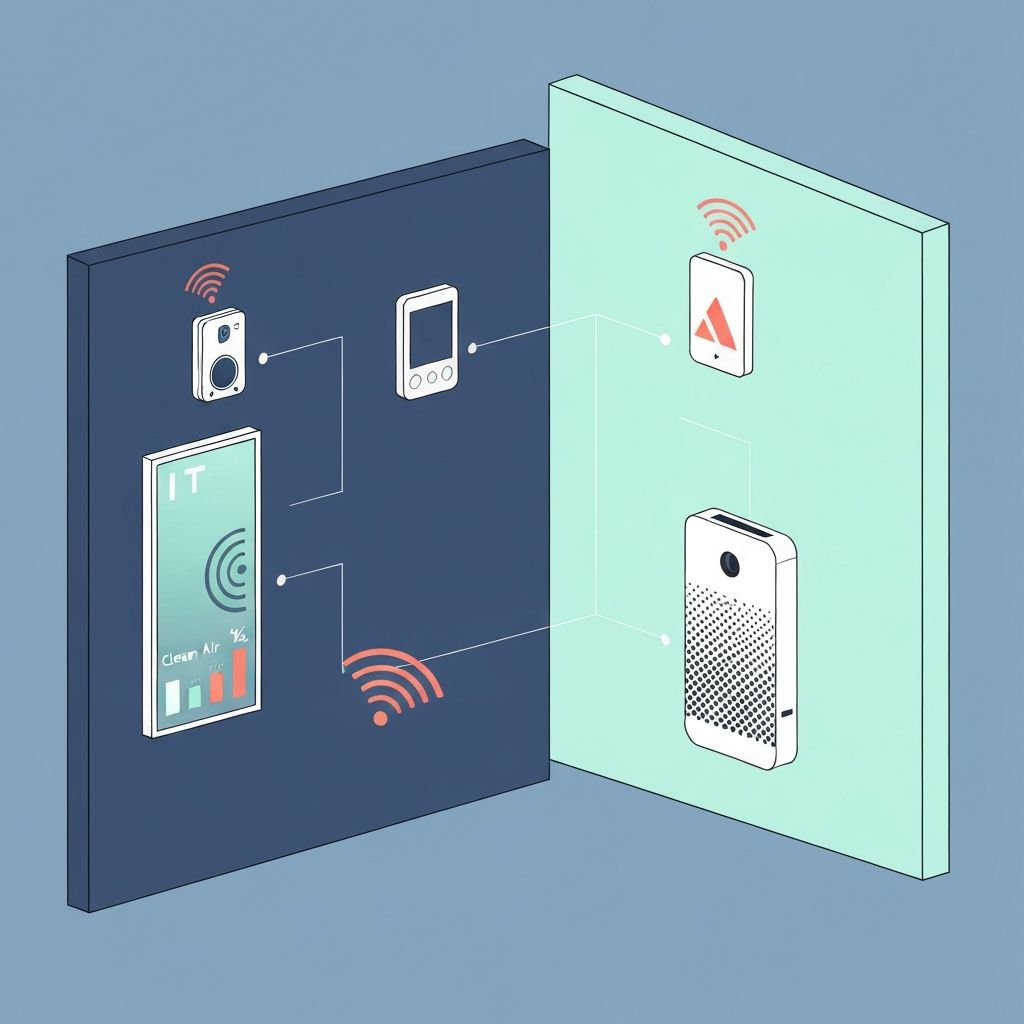
Indoor environments directly influence health, safety, and operational performance. Air quality, temperature stability, and behavioral monitoring all contribute to overall environmental control. Modern monitoring systems use sensors, data processing, and automation to detect changes in real time and trigger corrective actions.
Effective monitoring requires integration of hardware, software, and response protocols.
Sensor-Based Air Quality Monitoring
Air quality is one of the most critical factors in indoor environments. Pollutants such as particulate matter, volatile organic compounds (VOCs), and carbon dioxide affect both health and cognitive performance.
Sensor systems continuously measure these variables. Data is transmitted to centralized platforms where thresholds are applied to identify unsafe conditions.
Advanced air monitoring includes:
- Detection of fine particulate concentrations (PM2.5 and PM10)
- Measurement of CO2 levels to assess ventilation efficiency
- Monitoring of VOCs to identify chemical exposure
Continuous tracking allows immediate response to deteriorating conditions.
Behavioral Detection and Compliance Monitoring
Beyond environmental factors, monitoring systems increasingly track behavior that may affect safety or policy compliance. This is particularly relevant in controlled environments such as schools, offices, and public facilities.
Technologies related to vape detector use demonstrate how sensors can identify airborne chemical signatures associated with prohibited activities. These systems operate by analyzing particulate and gas patterns in real time.
Behavioral monitoring systems provide:
- Immediate alerts when policy violations occur
- Data logs for incident tracking and review
- Integration with administrative response protocols
This layer of monitoring enhances both safety and compliance.
Temperature and Humidity Control Systems
Thermal conditions affect both comfort and equipment performance. Temperature and humidity must be maintained within defined ranges to prevent health issues and material degradation.
Smart HVAC systems use distributed sensors to adjust airflow, heating, and cooling dynamically. Humidity control prevents mold growth and preserves structural materials.
Environmental control systems operate by:
- Collecting real-time data from multiple zones
- Adjusting output based on predefined thresholds
- Maintaining consistent conditions across spaces
Automated control improves efficiency and reduces manual intervention.
Real-Time Data Processing and Alerts
Monitoring systems rely on continuous data streams. Raw data must be processed quickly to identify anomalies and trigger alerts.
Cloud-based platforms and edge computing systems analyze incoming data and apply rule-based logic. Alerts are generated when values exceed acceptable limits.
Real-time processing enables:
- Immediate detection of environmental changes
- Automated notifications to administrators
- Rapid response to potential hazards
Speed of response is critical for preventing escalation.
Integration with Building Management Systems
Indoor monitoring systems are most effective when integrated with building management systems (BMS). Integration allows different subsystems to communicate and respond collectively.
For example, air quality sensors can trigger HVAC adjustments, while occupancy sensors can modify lighting and ventilation.
Integrated systems provide:
- Centralized control of environmental variables
- Coordinated responses across multiple systems
- Reduced operational complexity
System integration improves overall efficiency and control.
Data Analytics and Predictive Maintenance
Monitoring systems generate large volumes of data. Analyzing this data provides insights into trends and potential issues.
Predictive analytics can identify patterns that indicate future failures or inefficiencies. For example, gradual changes in air quality may signal ventilation issues.
Data analytics supports:
- Identification of recurring environmental problems
- Optimization of system performance
- Reduction of maintenance costs through early detection
Predictive capabilities improve long-term reliability.
Zoning and Spatial Monitoring Strategies
Large indoor environments require zoning to manage conditions effectively. Different areas may have varying requirements based on usage and occupancy.
Zoning systems divide spaces into monitored sections. Each zone operates independently while contributing to overall system performance.
Benefits of zoning include:
- Targeted control of environmental conditions
- Efficient allocation of resources
- Improved comfort and safety across diverse areas
Spatial segmentation enhances precision in monitoring.
Energy Efficiency and Resource Optimization
Monitoring systems contribute to energy efficiency by optimizing resource usage. Sensors ensure that systems operate only when needed and at appropriate levels.
For example, occupancy sensors can reduce lighting and HVAC usage in unoccupied areas. Air quality sensors prevent over-ventilation while maintaining safety.
Efficiency improvements include:
- Reduced energy consumption
- Lower operational costs
- Extended lifespan of equipment
Optimized resource use supports sustainability goals.
Compliance with Health and Safety Standards
Indoor monitoring systems help organizations meet regulatory requirements. Standards related to air quality, safety, and environmental conditions require consistent measurement and documentation.
Automated systems maintain records and generate reports that demonstrate compliance. This reduces administrative burden and improves audit readiness.
Compliance systems ensure that environments meet required standards consistently.
Future Developments in Indoor Monitoring
Advancements in sensor technology and data processing continue to expand monitoring capabilities. Emerging systems incorporate machine learning to improve detection accuracy and response strategies.
Future developments may include more granular detection of environmental changes and deeper integration with smart building ecosystems.
Continuous innovation will further enhance precision and adaptability.
Smart solutions for monitoring indoor environments rely on integrated systems that combine sensors, data processing, and automation. By tracking air quality, behavior, and environmental conditions in real time, these systems improve safety, efficiency, and compliance. As technology advances, monitoring capabilities will continue to evolve, enabling more precise control and proactive management of indoor spaces.