
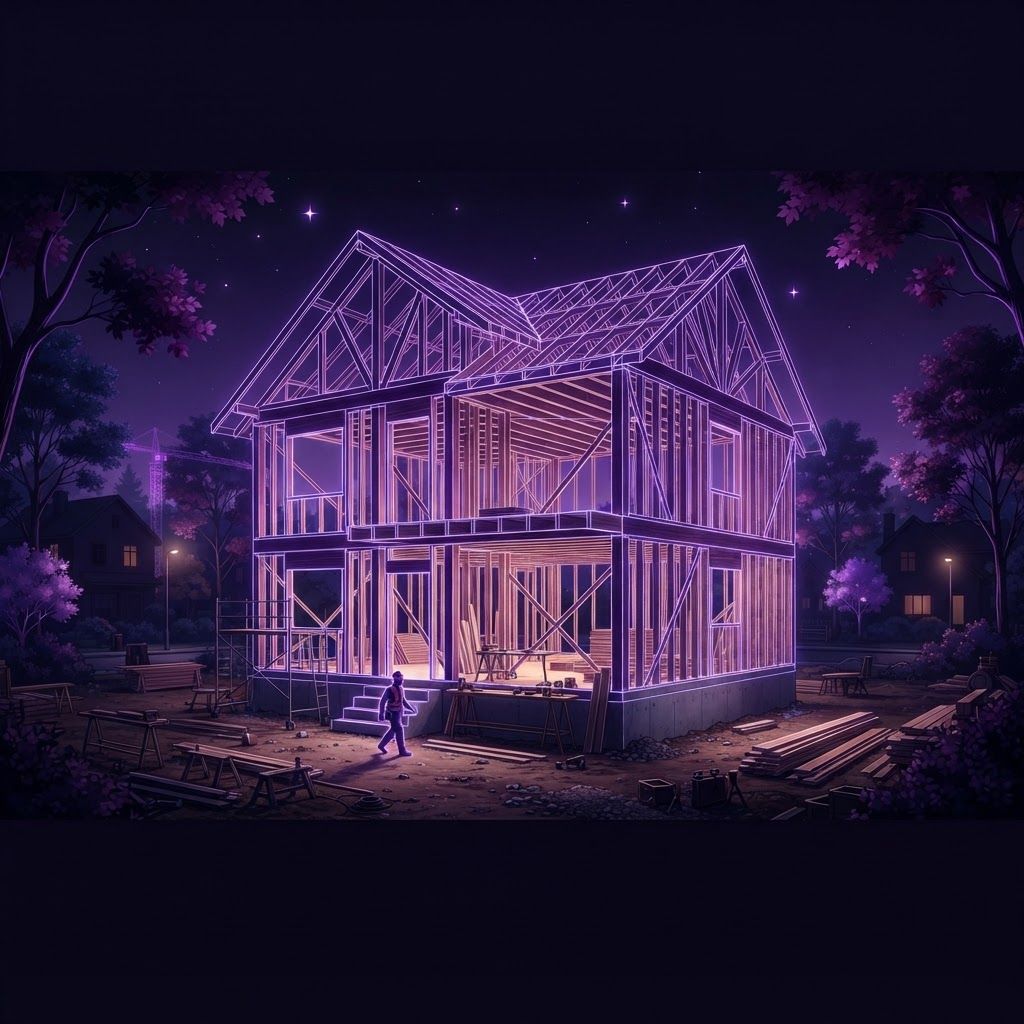
Residential Construction in Irving's Specific Conditions
Irving's housing stock tells the story of North Texas growth. Postwar neighborhoods near the Heritage District sit alongside 1980s and 1990s suburban development in Valley Ranch and North Irving, with newer infill and mixed-use residential in and around Las Colinas. Building well here means responding to conditions that are genuinely regional rather than generic.
The dominant factor is soil. Much of the area sits on expansive clay that swells with moisture and shrinks in drought, generating substantial movement. That single characteristic drives foundation design, drainage planning, landscaping decisions, and even plumbing strategy. The second factor is climate: extended periods above 100 degrees make envelope performance and mechanical sizing critical, while spring hail and high winds dictate roofing and cladding choices.
The Top 10 Residential Construction Companies in Irving
1. Irving Custom Home Builders — A custom builder handling ground-up single family construction with a genuinely consultative design process. Their engineering-forward approach to post-tensioned slabs and site drainage addresses Irving's soil conditions properly rather than treating them as boilerplate.
2. Las Colinas Residential Group — Builds and rebuilds higher-specification homes in the Las Colinas and Cottonwood Valley areas. Their strengths are architectural detailing, high-performance glazing, and integrated smart home and mechanical systems planned before framing rather than retrofitted after.
3. Trinity Valley Home Construction — Focused on major additions, second-story additions, and whole-house reconstruction on existing lots. Structural upgrades on older homes are their specialty, including reinforcing undersized framing and correcting decades of accumulated foundation movement.
4. Valley Ranch Builders — A production and semi-custom builder with efficient processes and predictable timelines. Owners who want a well-built home without an extended custom design process get good value here, and their material selections are chosen for durability in Texas conditions.
5. Metroplex Infill Development — Specialists in small-lot infill construction, including teardown and rebuild projects in established Irving neighborhoods. They handle setback constraints, tree preservation, utility coordination, and neighbor management with unusual competence.
6. Northgate Energy Efficient Homes — Concentrated on building envelope performance: continuous insulation, air sealing, spray foam applications, high-efficiency mechanical systems, and blower door verification. In a market where summer cooling dominates utility bills, their homes deliver measurably lower operating costs.
7. Cottonwood Multifamily Construction — Builds townhomes, duplexes, and small multifamily residential projects. Their understanding of fire separation, sound attenuation between units, and accessibility requirements makes them a reliable partner for small-scale residential developers.
8. Heritage Craft Homebuilders — Works in Irving's older neighborhoods, building new homes designed to sit comfortably alongside existing architecture. Their traditional detailing, real masonry work, and proportion discipline distinguish them from builders applying suburban templates to historic streets.
9. Grauwyler Residential Contractors — A practical, mid-market builder handling additions, garage conversions, accessory structures, and substantial renovations. Straightforward pricing and steady scheduling have built a solid reputation among Irving homeowners.
10. DFW Family Home Builders — Focused on families building their long-term residence, with attention to flexible floor plans, aging-in-place considerations, and outdoor living space suited to the Texas climate. Their post-completion service and warranty response are notably better than industry average.
Foundations and Soil: The Most Important Decision
On expansive clay, foundation design should never be an afterthought. A geotechnical investigation before design is money extremely well spent, because it establishes soil plasticity and moisture behavior specific to your lot. Post-tensioned slabs are common in North Texas and perform well when designed to actual soil conditions, while pier and beam systems and drilled pier foundations are appropriate in certain situations.
Equally important is moisture management around the finished home. Positive grading away from the structure, functional gutters and downspout extensions, root barriers where large trees sit close to the slab, and consistent irrigation practices all reduce differential movement. Many foundation failures in the area are drainage failures rather than structural design failures.
Energy Performance and Comfort
Cooling load dominates in Irving, so envelope decisions matter enormously. Radiant barriers, adequate attic insulation, meticulous air sealing, low solar heat gain glazing, and properly sized rather than oversized air conditioning equipment together produce a home that is comfortable and affordable to run. Oversized equipment short-cycles, fails to dehumidify, and wears out prematurely, which is a common and expensive mistake.
Duct design deserves specific attention. Ducts in unconditioned attics lose substantial capacity in a 140 degree attic environment, so builders who locate ducts within conditioned space, or who insulate and seal them rigorously, deliver noticeably better performance.
Budgeting Realistically
Construction budgets fail for predictable reasons: incomplete drawings, late selections, unforeseen site conditions, and owner-driven changes. Reduce that risk by completing design and material selections before construction begins, carrying a contingency of at least ten percent for new construction and more for renovation, and requiring written change orders with cost and schedule impact before work proceeds.
Also budget beyond the building itself. Site work, utility connections, driveways, landscaping, fencing, permits, engineering, and window coverings are frequently underestimated and can represent a significant share of total project cost.
Trends in Local Residential Construction
Several patterns are visible in Irving. Demand for dedicated home office space has persisted and is now designed in rather than improvised. Outdoor living structures with shade and cooling are increasingly standard given summer conditions. Accessory dwelling units and multigenerational layouts are growing as housing costs rise. Impact-resistant roofing has become a default choice because of insurance incentives in a hail-prone region.
Final Thoughts
The best residential construction outcomes in Irving come from addressing local realities directly: engineer the foundation for the actual soil, build an envelope that respects the heat, and select a builder with verifiable experience in your specific project type. Visit completed homes, speak with owners two or three years after completion, and read the contract carefully before signing.