
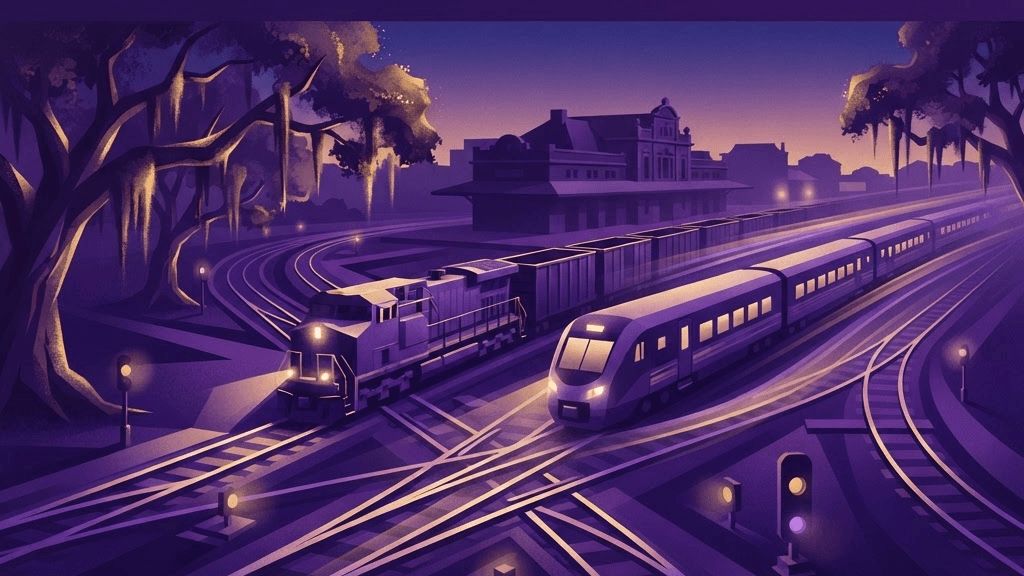
Charleston's Deep Railroad History
Few American cities have a stronger claim to railroad heritage than Charleston. The South Carolina Canal and Rail Road Company, chartered in the early nineteenth century, built what was at the time the longest railway in the world running out of Charleston toward Hamburg on the Savannah River. The locomotive known as the Best Friend of Charleston operated one of the first scheduled steam passenger services in the United States.
That history is not merely decorative. It established rail as central to the movement of goods between the Lowcountry and the interior, a role that has only intensified as the Port of Charleston has grown into one of the busiest container gateways on the East Coast.
The Top 10 Railway Operators and Rail Organizations in Charleston
1. CSX Transportation. One of the two Class I railroads serving Charleston, CSX provides intermodal and carload service connecting the port and regional industry to a network spanning the eastern United States. For shippers moving containers inland, CSX intermodal is a primary option.
2. Norfolk Southern. The other Class I serving the market, Norfolk Southern offers extensive eastern network coverage with strong intermodal capability. Competition between the two Class I carriers in Charleston benefits shippers in a way that single-railroad ports do not enjoy.
3. South Carolina Ports Authority rail operations. The port authority's on-dock and near-dock rail infrastructure, including intermodal facilities serving the container terminals, is critical to how efficiently containers transition from vessel to rail. Investment here has been central to Charleston's competitiveness.
4. Inland Port Greer. Operated by the ports authority, this upstate facility extends Charleston's reach via overnight rail service to the I-85 corridor, serving BMW and the broader upstate manufacturing base. It functions effectively as an extension of the seaport.
5. Inland Port Dillon. A second inland facility connecting Charleston to the I-95 corridor by rail, opening access to markets in eastern North Carolina and beyond while reducing highway truck miles.
6. Amtrak. Passenger rail service operates through the Charleston station in North Charleston on routes connecting the Northeast Corridor to Florida. Trains such as the Silver Meteor and Palmetto services link Charleston to New York, Washington, Savannah and Florida destinations.
7. Palmetto Railways. A division of the South Carolina Department of Commerce, this short-line operator provides switching and terminal railroad services in the Charleston area, connecting industrial customers and port facilities to the Class I networks. Short lines do the essential first-mile and last-mile work that makes the larger system function.
8. Carolina Piedmont Railroad and regional short lines. Several short-line railroads operate across South Carolina, serving industrial shippers in communities that Class I carriers no longer reach directly and feeding traffic into the mainline network.
9. Best Friend of Charleston Museum. A heritage organization preserving the story of the pioneering locomotive and Charleston's founding role in American railroading. It is a small but meaningful stop for anyone interested in the city's transportation history.
10. South Carolina Railroad Museum. Located in Winnsboro, this volunteer-operated museum offers heritage train excursions and rolling stock exhibits, providing the state's most accessible hands-on railroad experience for families and enthusiasts.
How Rail Supports the Port Economy
The relationship between the Port of Charleston and rail is straightforward but consequential. A container arriving by vessel can move inland either by truck or by rail. Truck offers flexibility and speed for regional destinations. Rail offers dramatically lower cost per container mile and far lower emissions for longer distances, at the expense of transit time and schedule rigidity.
Charleston's intermodal share has grown as terminal rail infrastructure improved and as the inland ports opened new markets. For a shipper moving containers to Atlanta, Charlotte, Memphis or the Midwest, rail intermodal frequently represents the best total cost outcome, particularly when highway driver capacity is constrained.
Passenger Rail Realities
Charleston's Amtrak service is useful but limited. The station is located in North Charleston rather than downtown, requiring onward ground transportation to reach the peninsula. Service frequency is low compared to European or Northeast Corridor standards, typically a small number of daily departures, and long-distance train punctuality is affected by freight traffic priority on shared track.
Where passenger rail works well is on longer journeys where the experience matters. The trip to Washington or New York is considerably more comfortable than flying for travelers who value legroom, scenery and the absence of airport security queues, and the overnight sleeper option appeals to those who would rather sleep than sit in a terminal.
Freight Rail Service Options
Shippers engage rail in several ways. Intermodal moves containers and trailers on flatcars, typically through a third-party intermodal marketing company or directly with the railroad for large volumes. Carload service moves bulk commodities, chemicals, lumber and machinery in dedicated rail cars, usually for customers with track access at their facility. Transloading converts between modes, moving product from rail car to truck at a facility near the shipper.
For businesses without rail access, transload facilities in the Charleston area make rail economics available without capital investment in a private siding.
Evaluating Rail as a Shipper
Rail makes sense when distance exceeds roughly five hundred miles, when volume is consistent, when transit time flexibility exists and when cost sensitivity outweighs speed. It makes less sense for short hauls, time-critical shipments and irregular volumes. Shippers should evaluate total landed cost including drayage at both ends, not simply the linehaul rate, because the first and last mile frequently determines whether rail actually saves money.
Sustainability reporting has made rail more attractive to companies tracking emissions, since rail produces substantially lower emissions per ton-mile than highway transport. For shippers with published reduction targets, mode shift to rail is one of the more straightforward levers available.
Looking Ahead
Continued investment in port terminal rail capacity, inland port expansion and intermodal service quality points toward a growing rail share of Charleston's freight movement. Highway congestion and driver availability constraints reinforce the trend. For passenger service, improvements depend largely on national infrastructure decisions rather than local ones.
Final Thoughts
Rail in Charleston operates on two levels: a historically significant heritage that the city genuinely originated, and a modern freight network that underpins the port's competitive position. CSX and Norfolk Southern provide Class I reach, Palmetto Railways and regional short lines handle the critical connecting work, the inland ports extend the seaport's market, and Amtrak offers a limited but worthwhile passenger option. For shippers, rail deserves evaluation on total landed cost and emissions rather than transit time alone.