
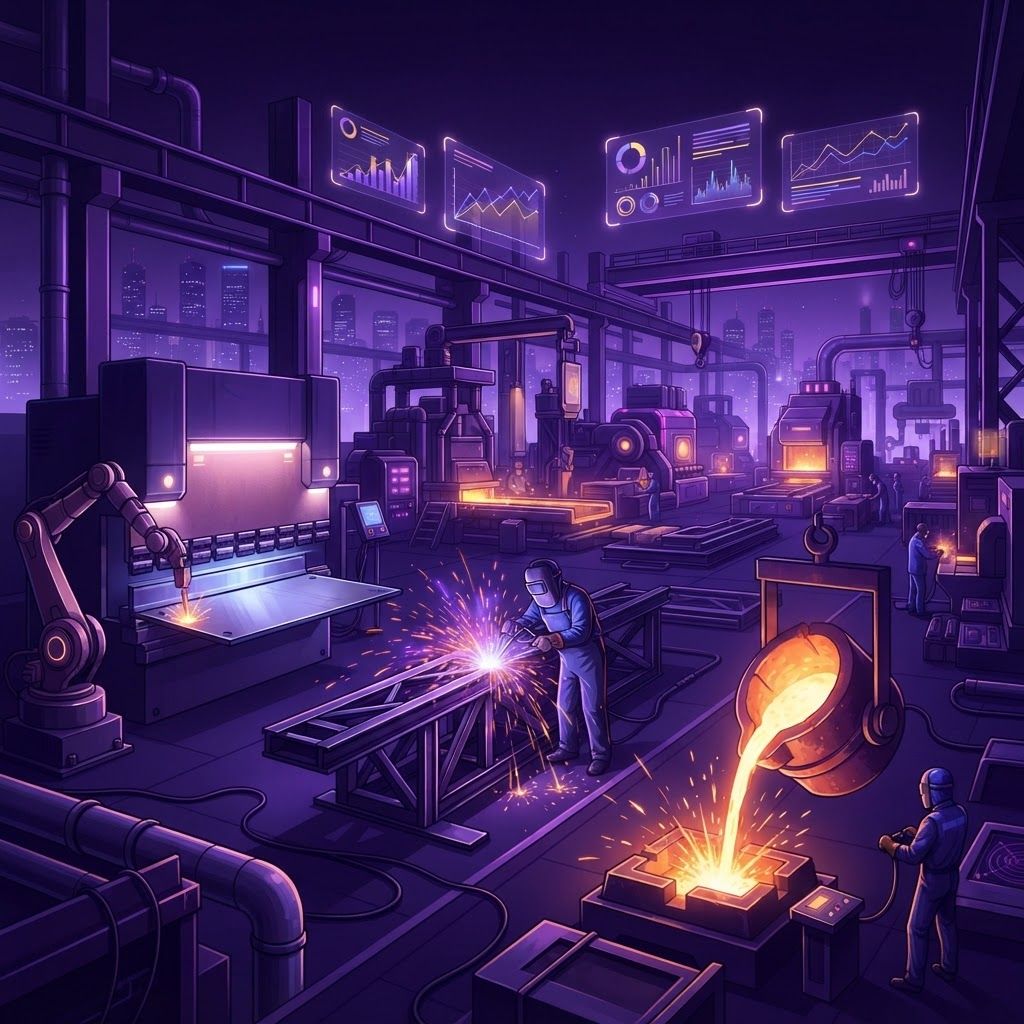
Metalworking as Fremont's Industrial Backbone
If Silicon Valley runs on software, it is assembled on metal. Every semiconductor tool, electric vehicle, laboratory instrument, and data centre rack depends on machined components, welded frames, and formed enclosures. Fremont's metalworking sector supplies these parts, and it has evolved into one of the most technically capable clusters on the West Coast. The city's shops range from two-person toolrooms to facilities running dozens of machining centres across multiple shifts.
The concentration produces real benefits for customers. A single project might require laser-cut brackets, precision-machined mounting plates, a welded structural frame, and anodised covers. In Fremont all of that can be sourced within a few miles, often with shops that already work together regularly and understand each other's tolerances and finishing sequences. Engineering support is close at hand, and design reviews can happen standing at the machine rather than over email across time zones.
Processes and Capability Levels
Sheet metal fabrication covers laser and turret punch cutting, press brake forming, welding, hardware insertion, and finishing. Precision machining spans three-axis milling through five-axis simultaneous work and multi-axis turning with live tooling, handling aluminium, stainless steel, titanium, copper alloys, and specialty materials. Welding capability includes tungsten inert gas work for critical joints, metal inert gas for structural volume, spot welding for sheet assemblies, and robotic cells for repeatable production.
Finishing determines both appearance and service life. Anodising, chemical conversion coating, powder coating, passivation, plating, bead blasting, and polishing are all available locally, and the better shops manage these operations as an integrated part of their process rather than an afterthought. Inspection capability matters equally. Coordinate measuring machines, optical comparators, surface finish gauges, and formal first-article reporting separate suppliers who can prove conformance from those who merely claim it.
Top 10 Best Metalworks Companies in Fremont
1. Warm Springs Precision Machining
A five-axis machining specialist producing complex components for semiconductor and aerospace customers. In-house metrology and disciplined process documentation support the tight tolerances its clients require.
2. Fremont Sheet Metal Works
Delivers laser cutting, forming, welding, and finishing for enclosures, chassis, and brackets. Integrated finishing and hardware insertion allow complete assemblies to ship rather than loose parts.
3. Bayside Welding and Fabrication
Handles structural welding, weldments, and heavy fabrication for equipment frames and industrial installations. Certified welders and thorough weld inspection give confidence on load-bearing work.
4. Mission Peak Metal Finishing
Provides anodising, chemical conversion coating, passivation, and powder coating with careful process control. Consistent colour, coating thickness, and corrosion performance make it a preferred finisher for local fabricators.
5. Silicon Valley Laser Cutting
Runs high-speed fibre laser cutting across a broad thickness range with fast turnaround. Efficient nesting and quick quoting suit customers ordering frequent small batches of flat parts.
6. Ardenwood Turning and Milling
Focuses on high-volume turned components and secondary milling operations. Bar-fed lathes with live tooling produce complete parts in one operation, improving both cost and consistency.
7. Niles Tool and Die
Builds stamping dies, progressive tooling, and precision fixtures. Process engineering strength helps customers convert machined parts to stamped production once volumes justify the transition.
8. Central Fremont Metal Spinning
Specialises in metal spinning, deep drawing, and formed hollow shapes for lighting, vessels, and equipment components. These processes deliver seamless geometries that machining cannot match economically.
9. Ohlone Architectural Metals
Produces railings, cladding, screens, and decorative metalwork for commercial and residential architecture. Finish quality and coordination with architectural drawings are its defining strengths.
10. Fremont Rapid Metal Prototyping
Serves hardware development teams with quick-turn machining, fabrication, and small assemblies. Flexible scheduling and design feedback help engineers iterate through revisions quickly.
Getting Better Results from Your Metalworks Supplier
Quality quoting starts with quality information. Provide native computer-aided design files alongside drawings, and mark only the dimensions that genuinely matter with tight tolerances. Blanket precision across every feature inflates cost without improving function, and experienced shops will say so if you ask them to review the drawing critically.
Specify material and finish precisely, including alloy, temper, and coating standard where relevant. Discuss whether hardware, inserts, silk screening, or subassembly can be handled by the same supplier, since consolidating operations reduces handling damage and shipping cost. Request a first-article inspection report on new parts and agree in advance how nonconformances will be dispositioned. For ongoing programmes, ask about capacity, machine redundancy, and whether the shop can hold buffer stock against release schedules.
Certifications and Compliance
Requirements vary by industry, and a supplier's certification profile should match your sector. Quality management system registration is a baseline for most production work. Aerospace and medical customers typically require sector-specific certification and stricter traceability. Welding on structural or pressure-containing assemblies should follow recognised procedure and welder qualification. Material certifications and country-of-origin documentation may also be necessary depending on end use and contractual obligations.
Where the Industry Is Heading
Automation continues to spread, with pallet-changing machining centres, robotic press brake tending, and lights-out night shifts improving throughput without proportional labour increases. Digital quoting and manufacturability feedback are becoming standard, shortening the gap between design release and first parts. Sustainability is receiving attention through coolant recycling, scrap reclamation, and increasingly through customer requests for embodied carbon information. Workforce development remains the most persistent challenge, and many local shops now run structured apprenticeships to build machinists rather than hoping to hire them.
Final Thoughts
Fremont's metalworks companies offer an unusually complete set of capabilities within a compact geography. That makes it possible to source complex metal assemblies locally, iterate quickly, and hold suppliers accountable to measurable standards. Define your critical requirements clearly, invite manufacturability feedback early, and build relationships with shops whose inspection discipline you can verify.