
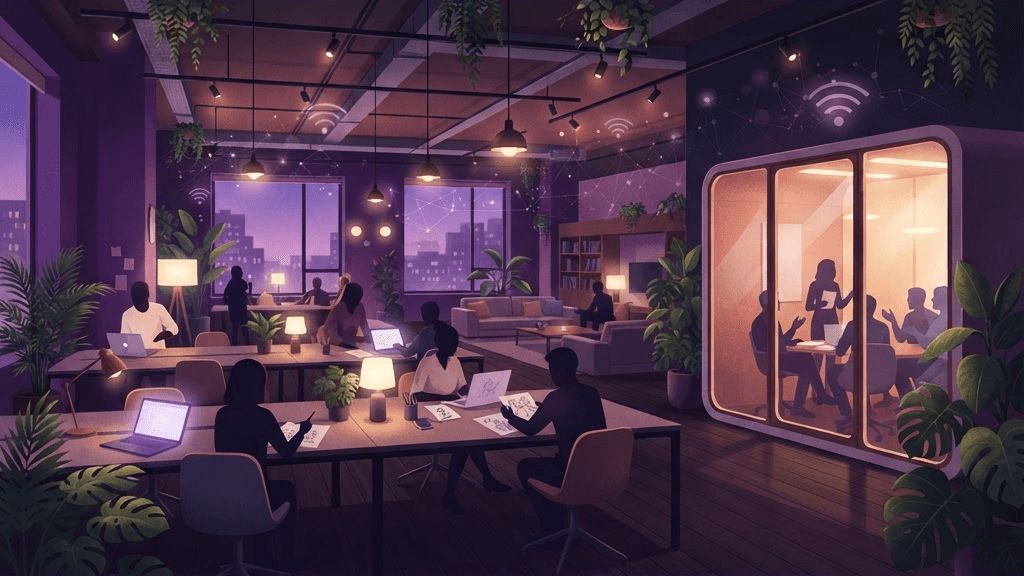
Why Coworking Took Hold in Fremont
Fremont's coworking market exists because of a specific commuting reality. Thousands of residents work for companies headquartered in Santa Clara, Mountain View, San Jose, and San Francisco, and hybrid schedules have made the daily journey unnecessary. But working from a bedroom in a shared household, particularly for people on video calls for much of the day, is unsustainable. A coworking space within a ten-minute drive replaces a ninety-minute commute with a professional environment.
Beyond remote employees, Fremont's coworking demand comes from startup founders who need a business address and meeting space without a lease, consultants and independent professionals, and small hardware companies that require light assembly or prototyping space alongside desks. The city's manufacturing heritage means some local spaces cater to physical product development in ways that pure office coworking cannot.
Choosing the Right Membership Type
Coworking is sold in tiers, and paying for the wrong one is the most common mistake. Hot desk or open floor memberships give access to unassigned seating and are cheapest, suiting people who visit a few days weekly and take calls with headphones. Dedicated desk memberships assign a specific workstation you can leave equipment at, which matters if you use multiple monitors or visit daily. Private offices provide a lockable room for one to a dozen people, appropriate for teams and for anyone handling confidential material or conducting frequent calls.
Virtual memberships provide a business address, mail handling, and occasional meeting room access without regular desk use, which is genuinely useful for registering a business and maintaining professional correspondence.
Beyond tier, evaluate the practical details that determine whether a space works. Internet reliability and speed, including whether there is redundant connectivity. Call booth availability, since a space with two phone booths and eighty members is unworkable for anyone on frequent calls. Meeting room credits and how overage is billed. Parking availability, which is a real constraint at some Fremont locations. Access hours, since many spaces are not truly around the clock. And the noise culture, which varies enormously and is best judged by working there for a day.
Ten Coworking Spaces Serving Fremont
1. Regus Fremont
Part of a global network, Regus offers private offices, coworking areas, meeting rooms, and virtual office services with professional business-center presentation. Its principal advantage is network access, allowing members to use locations across the Bay Area and internationally, which suits consultants who travel.
2. Spaces Fremont
Operating under the same corporate umbrella as Regus but with a design-led, more informal aesthetic, Spaces targets creative and technology teams with open lounges, event areas, and community programming alongside private offices. It sits between traditional business center formality and startup casualness.
3. Fremont Coworking Collective
An independent local space built around community rather than scale, typically offering hot desks, dedicated desks, and a handful of private offices with a strong emphasis on member events, skill sharing, and referral networking. Independent spaces often provide better value and more genuine community than large operators.
4. Warm Springs Innovation Workspace
Located in Fremont's innovation district near the BART station, this type of space serves hardware startups and advanced manufacturing entrepreneurs, combining desks and meeting rooms with access to prototyping equipment and light assembly areas. That combination is rare and specifically valuable in Fremont's economy.
5. Downtown Fremont Executive Suites
Traditional executive suite format offering furnished private offices with reception support, mail handling, conference rooms, and administrative services. It appeals to attorneys, accountants, financial advisors, and medical billing practices that need client-appropriate professional presentation rather than open-plan energy.
6. Mission Peak Workspace
A quieter, focus-oriented space designed for deep work, with library-style zones, generous call booth provision, and a culture that discourages open-floor conversation. Engineers, writers, and analysts who find bustling coworking environments counterproductive tend to gravitate here.
7. Fremont Makerspace and Studio
Blending coworking desks with fabrication capability including three-dimensional printing, laser cutting, electronics benches, and woodworking, this format supports product designers and hardware founders who need both computer work and physical prototyping. Membership typically includes equipment training and certification.
8. Tri-City Business Hub
Serving Fremont, Newark, and Union City with flexible desk and office arrangements plus meeting facilities, this type of space emphasizes affordability and local small business support. It often hosts chamber and small business development programming that provides practical value beyond the desk.
9. Ardenwood Corporate Center Flexible Offices
Located in Fremont's established office corridor with straightforward freeway access, this option provides flexible-term private suites for small teams that have outgrown coworking but are not ready for a multi-year direct lease. Ample parking and conventional office infrastructure are its practical strengths.
10. Fremont Public Library Study and Meeting Rooms
Not coworking in the commercial sense, but worth acknowledging as a legitimate free resource. Quiet study areas, reservable meeting rooms, and reliable internet serve students, job seekers, and early-stage founders operating without budget. For occasional use, it removes cost as a barrier entirely.
Trends in Flexible Workspace
Suburban and neighborhood coworking has grown substantially while central business district demand has softened, reflecting the hybrid preference to work near home rather than commute to a downtown. Enterprise adoption has expanded, with large employers purchasing flexible memberships for distributed staff instead of maintaining satellite offices.
Space design has shifted toward call and video infrastructure, with well-designed spaces now providing a much higher ratio of enclosed call booths and small video rooms than earlier open-plan layouts. Hybrid membership products offering a set number of days per month at a reduced rate have become standard. And amenity competition has moved beyond coffee toward childcare proximity, fitness access, and genuinely useful community programming.
Practical Advice
Take a day pass or trial week before committing, and use it on your typical working day rather than a quiet one. Run a video call from the space to test both bandwidth and acoustic privacy. Count call booths relative to occupancy. Confirm parking situation and access hours in writing.
Match tier to actual usage patterns rather than aspiration, since most people overestimate how often they will attend. Ask about month-to-month flexibility versus annual commitment pricing, and clarify meeting room credit allocation and overage rates. If community and referrals matter to you, ask what events actually happen and talk to existing members rather than relying on the sales tour.
Final Thoughts
Fremont's coworking market has matured into something genuinely useful, offering global-network professionalism, independent community spaces, focus-oriented environments, and hardware-capable maker facilities. The right choice depends on how you work: whether you need call privacy, physical prototyping, client-facing presentation, or simply a desk and reliable internet ten minutes from home. Trial before you commit, and prioritize the practical infrastructure over the amenities that look good on a tour.